 Anacortes Exterior
 Exterior Work Built for March Point's Waterfront Exposure
March Point sits out on the water, tucked between Fidalgo Bay and Padilla Bay just outside Anacortes proper. That location is part of what makes it a desirable place to live, and it's also exactly why homes out there take a harder beating than homes a few miles inland in Skagit County. Wide-open water on multiple sides means wind has a long runway to build speed before it hits a house, and that wind almost always carries salt spray with it. Add in the Pacific Northwest's long, wet fall-through-spring stretch and a shady, moisture-heavy microclimate in places, and you've got a punishing combination for exterior materials.
We work throughout Anacortes and the surrounding Skagit County waterfront communities, and March Point is a neighborhood we know well — not because we're guessing at what the climate does to a house out there, but because we've seen it firsthand on siding, trim, roofing, and decking that wasn't built to handle it.
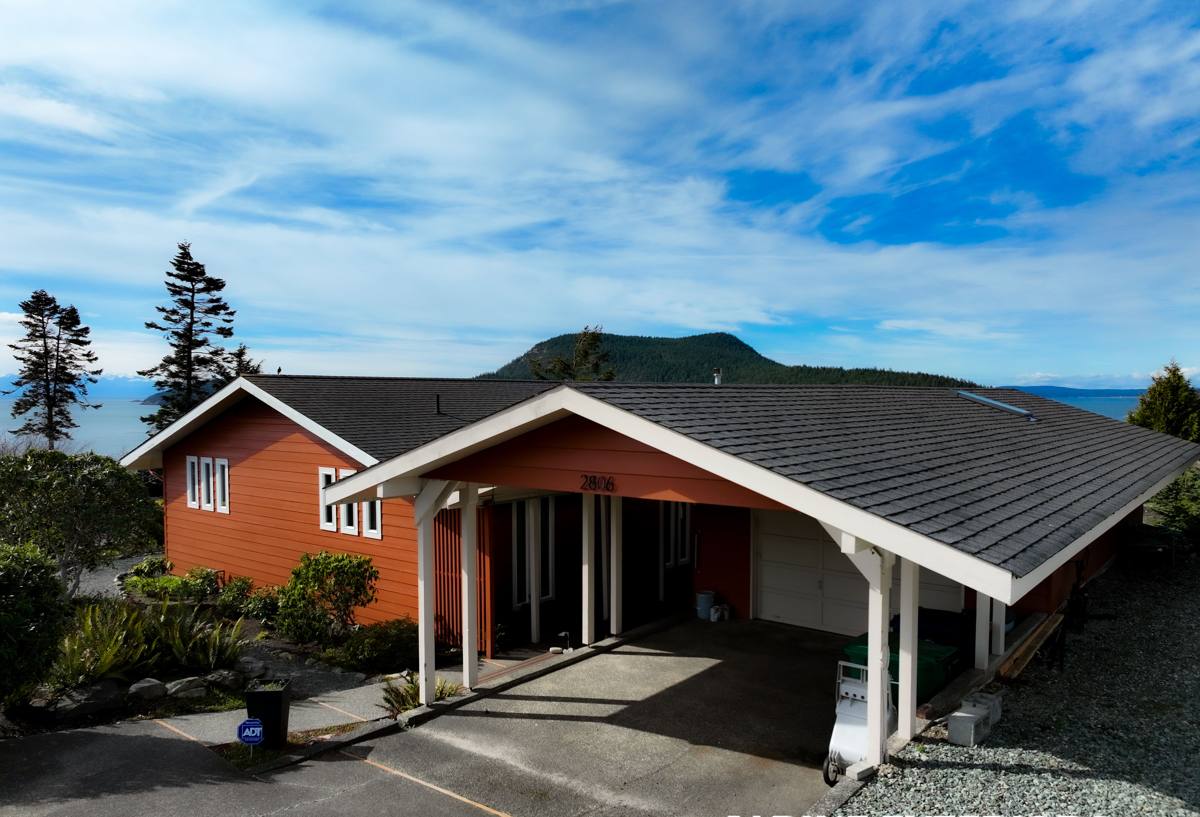
What Salt Air and Wind Actually Do to a Home
Salt air doesn't just smell like the coast — it's chemically corrosive. Airborne salt settles on every exterior surface and, combined with moisture, accelerates rust on fasteners, flashing, and hardware, and it breaks down paint and coatings faster than they'd wear inland. On a home exposed to open water, that process runs on a shorter clock than most manufacturers' product literature assumes.
Wind adds a second layer of stress. Sustained wind off the bay drives rain sideways into wall assemblies, siding laps, window frames, and roof edges — surfaces that are only designed to shed water falling straight down. Wind-driven rain finds every gap, every under-caulked seam, every place where a product wasn't installed tight to spec. Over years, that's how water gets behind siding, into sheathing, and into framing, long before anything looks wrong from the curb.
Moss Season Adds a Third Problem
Skagit County's wet season runs long, and shaded north- and west-facing walls near the water often stay damp for days after a storm passes. That's exactly the environment moss and algae need to take hold on roofing, siding, and decking. Beyond the cosmetic staining, moss holds moisture directly against the surface it's growing on, which is a slow but steady path toward rot in wood-based products and premature wear in less durable siding materials.
Siding: Why We Only Install James Hardie Fiber Cement
We install James Hardie fiber cement siding exclusively. We don't install vinyl, LP SmartSide, Cemplank, Allura, primed spruce, or cedar, and on a site like March Point that's not a marketing position — it's a practical one built around what actually holds up to salt air and driving rain.
- Vinyl can warp and become brittle under repeated wind loading and temperature swings, and its seams and J-channels give wind-driven rain more places to work its way in over time.
- Wood-based siding (LP SmartSide, primed spruce, cedar) depends on an intact factory or field-applied coating to keep moisture out. Salt air degrades coatings faster, and once moisture reaches the wood substrate in a chronically damp, shaded spot, rot and swelling follow.
- Other fiber cement brands (Cemplank, Allura) are chemically similar to Hardie in composition, but we've standardized on Hardie for its factory-applied ColorPlus finish, its HZ5 product engineering for harsh climates, and the depth of its installer network and warranty backing in this region.
James Hardie fiber cement is non-combustible, doesn't expand and contract with moisture the way wood does, and its ColorPlus finish is baked on in a factory-controlled process rather than field-applied — which matters enormously in a climate where field-applied coatings get tested hard and often. Hardie's HZ5 line is specifically engineered for climates with heavy moisture exposure, which describes March Point about as well as anywhere in Skagit County.
None of that means other products are junk — it means that on a site like this, with this much sustained wind and salt exposure, we've chosen not to install products where the long-term maintenance burden and moisture risk outweigh the upfront savings. We'd rather put on a product we can stand behind for decades.
Roofing: Standing Up to Wind and Moss
A roof out on the point takes wind uplift most inland roofs never see, and it's also prime real estate for moss if it isn't detailed and maintained correctly. Roofing work in an area like this comes down to a few fundamentals done right every time: proper fastening schedules for wind exposure, correctly lapped and sealed flashing at every valley, penetration, and roof-to-wall transition, and ventilation that keeps the underside of the roof deck dry so moisture doesn't get trapped from the inside out.
We also pay close attention to moss-prone areas — typically the shaded, north-facing slopes — and talk through preventive options with homeowners so moss doesn't get the multi-year head start it needs to start lifting shingles and holding moisture against the deck.
Windows: Sealing Out Wind-Driven Rain
Windows are one of the most common places we find water intrusion on wind-exposed homes, and it's almost never the glass — it's the installation. Wind-driven rain pushes water horizontally and even upward into gaps around a window frame that a straight-down rain would never reach. That makes correct flashing, sealant selection, and integration with the surrounding siding just as important as the window unit itself.
Older or improperly installed windows on exposed walls near the water are frequently where we find hidden rot when we open up a wall during a siding project — water's been getting in slowly for years, and it's not visible until the siding comes off.
Decks: Built for Salt, Sun, and Standing Water
A deck on or near March Point deals with everything at once — salt air corroding fasteners and hardware, UV exposure, and repeated wet-dry cycling through the wet season. Framing hardware and fasteners rated for coastal exposure aren't optional out here; standard-grade hardware corrodes faster than most homeowners expect, and a corroded ledger or joist hanger is a structural problem, not just a cosmetic one. Proper drainage and airflow underneath the deck also matter more in a shaded, damp spot than they would on a sunny inland lot.
Comparing Exterior Priorities for a March Point Home
| Exterior Component | Main Local Risk | What We Prioritize |
|---|---|---|
| Siding | Salt corrosion, wind-driven rain, coating breakdown | James Hardie fiber cement with factory ColorPlus finish, correct flashing and fastening |
| Roofing | Wind uplift, moss on shaded slopes | Wind-rated fastening, sealed flashing, ventilation, moss prevention |
| Windows | Wind-driven rain intrusion at frame edges | Correct flashing integration with siding, quality sealant work |
| Decks | Corroding hardware, wet-dry cycling, drainage | Coastal-rated fasteners and hardware, proper under-deck drainage |
Why a Local Crew Matters Here
A general contractor working from a one-size-fits-all playbook can put a house back together and have it look fine for a season or two. What separates that from work that actually lasts on a site like March Point is knowing, before the first piece of material goes up, that this particular wall faces open water, that this roof slope stays shaded and damp longer than the rest, and that standard fastener hardware isn't going to cut it. That's the kind of judgment that comes from doing this work repeatedly in Skagit County's coastal microclimates, not from a generic spec sheet.
We also know the practical side of working in this area — permitting through the county, navigating driveway and site access on the point, and scheduling around the wetter stretches of the year so materials aren't installed in conditions that compromise them.
A Simple Checklist Before Your Next Exterior Project
- Ask what fastener and hardware grade will be used — coastal exposure calls for corrosion-resistant hardware, not standard-grade.
- Ask how flashing will be detailed at windows, doors, and roof transitions — this is where wind-driven rain gets in.
- Ask whether the siding material has a factory-applied finish or relies on field-applied paint or stain.
- Ask how moss and algae growth will be addressed on shaded roof and wall sections.
- Ask about the manufacturer's warranty and whether it's transferable if you sell the home.
Get a Straightforward Look at Your Home's Exterior
If you're dealing with siding that's showing its age, a roof with moss creeping in, windows that let in more draft or water than they should, or a deck that's starting to feel soft in spots, we're glad to come take a look. We'll give you a straightforward, no-pressure estimate based on what your home actually needs — not a generic package. Reach out using the form below to schedule a free assessment for your March Point property.