 Anacortes Exterior
 Why March Point Siding Takes More Punishment Than Most
March Point sits out on the water, exposed on multiple sides to Skagit County's marine weather in a way that inland Anacortes neighborhoods simply aren't. Homes here deal with salt-laden air moving off the bay, wind-driven rain that hits siding sideways instead of running straight down, and a shaded, damp moss season that can run half the year. That combination is hard on any exterior product, but it's especially unforgiving on siding that wasn't engineered for it.
Salt air accelerates corrosion on fasteners and trim. Driving rain finds every gap, seam, and poorly lapped joint and pushes water where it doesn't belong. Moss and algae hold moisture against the wall assembly long after a storm passes, which is exactly the condition that rots wood-based products and delaminates weaker composites. None of this is unique to March Point in the abstract sense — it's Pacific Northwest coastal weather — but the exposure here is more direct and more constant than a few miles inland.
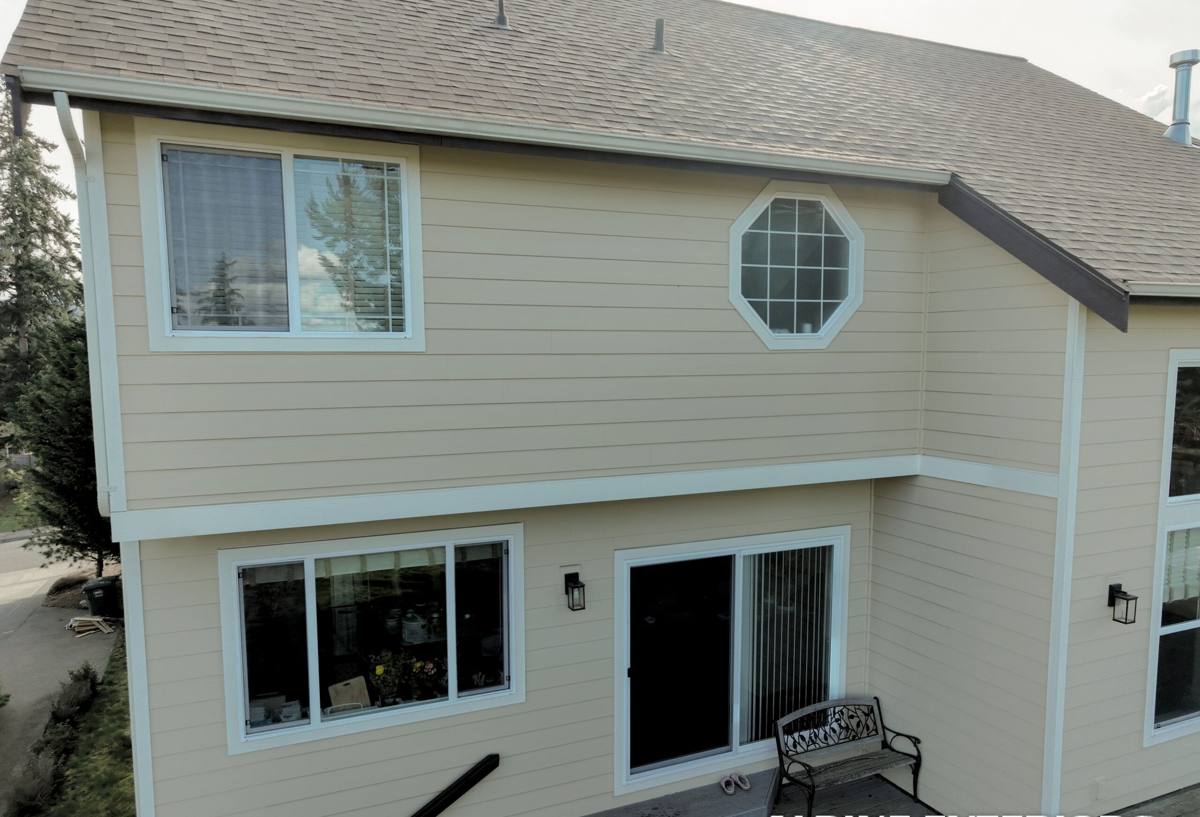
Why We Only Install James Hardie in This Kind of Exposure
We standardized on James Hardie fiber cement for every job we take, and a property like a March Point home is a good illustration of why. Hardie's HZ5 product line is engineered specifically for the wet, freeze-thaw-adjacent climates of the Pacific Northwest — it resists moisture absorption, won't rot, and doesn't support the kind of fungal growth that plagues wood and some engineered wood siding in a shaded, salt-humid environment. It's also non-combustible, which matters in a region where wildfire smoke and ember exposure have become a real seasonal concern even out here near the water.
The factory-applied ColorPlus finish is part of the same logic. It's baked on in a controlled environment, not brushed or sprayed on site, so it holds color and resists fading and chalking far longer than field-applied paint — which matters when salt air and UV are working on a finish year-round. We don't install LP SmartSide, vinyl, Cemplank, Allura, or primed wood siding. Each of those has legitimate uses somewhere, but none of them hold up to this specific combination of salt, driving rain, and sustained dampness as well as correctly installed Hardie fiber cement, and we'd rather turn down a job than install something we don't trust on a house exposed like this.
What "Correct" Actually Means on a Job Like This
James Hardie siding is only as good as the installation behind it. In a low-exposure environment, installation mistakes might take years to show up. On March Point, with wind-driven rain and near-constant humidity, mistakes show up fast — usually as staining, soft trim, or paint failure at seams within a few seasons. Correct installation here means:
- A drainage gap (rain screen) behind the siding so any water that gets past the cladding can drain and dry instead of sitting against the wall sheathing
- Weather-resistive barrier installed and lapped correctly, with all penetrations properly flashed before a single board goes up
- Butt joints, corners, and trim caulked and flashed to Hardie's published fastening and clearance specifications, not "close enough"
- Minimum ground clearance and proper flashing at all horizontal transitions, since standing water at the base of a wall is one of the most common failure points we see
- Fasteners rated for coastal, corrosion-prone environments — not general-purpose fasteners that will streak or fail early in salt air
- Correct board overlap and nailing pattern so the siding can handle wind-driven rain hitting it at an angle, not just straight-on moisture
Every one of these is a step that can be skipped without being visible on install day. They only become visible two, five, or ten years later — as a stain, a soft spot, or a warranty claim that gets denied because the installation didn't meet manufacturer spec.
Our Process on a March Point Home
We start with an on-site walkthrough of the specific exposures on your home — which walls take the worst of the wind and rain, where moss and algae are already established, where the old siding is failing first. That tells us where extra attention to flashing and drainage detail matters most before we ever price the job.
From there, tear-off exposes the sheathing so we can check for any hidden moisture damage from the old siding system — this is common on homes that have gone years with failing caulk joints or no drainage gap. We repair or replace damaged sheathing before anything new goes on; covering rot with new siding just hides the problem. Then the weather-resistive barrier, flashing, and drainage gap go in, followed by the Hardie boards or panels fastened to spec, with trim, caulking, and touch-up paint matched to the ColorPlus finish where field cuts require it. We clean up thoroughly and walk the finished job with you before we call it done.
Signs a March Point Home Needs Siding Attention
Because of the local exposure, some warning signs show up earlier here than they would a few miles inland:
Moss and Algae Buildup
Green or black staining that keeps coming back no matter how often it's washed usually means moisture is staying in contact with the siding longer than it should — often a sign of poor drainage behind the wall, not just shade.
Soft or Spongy Spots
Pressing gently on wood-based or lower-grade siding and feeling give underneath is a sign of water intrusion and rot starting underneath. This is one of the most common issues we find on tear-offs in this area.
Paint or Finish Failure at Seams
Peeling, bubbling, or chalking concentrated at joints and trim, rather than spread evenly across a wall, usually points to a caulking or flashing failure letting water behind the surface at that specific spot.
Cupping or Warping Boards
Boards that have started to bow or cup are absorbing and releasing moisture unevenly — a sign the material itself, or the installation behind it, isn't managing water the way it should in this climate.
Cost Factors on a March Point Siding Job
Every home is different, and we'll walk your property before giving a real number, but these are the main factors that move the price on a job like this:
| Factor | Why It Matters Here |
|---|---|
| Extent of hidden sheathing damage | Homes with long-term moisture exposure often need sheathing repair discovered only after tear-off |
| Wall exposure to wind and rain | Sides facing open water usually need extra flashing and drainage detail, which adds labor |
| Home size and wall complexity | Dormers, multiple gables, and cut-up wall lines take more trim work and time than a simple rectangular wall |
| Hardie product line chosen | Lap siding, panel systems, and shingle-style profiles carry different material and labor costs |
| Color and finish selection | Factory ColorPlus finishes vs. field-painted trim affect both material cost and long-term maintenance |
| Site access | Waterfront and sloped lots common in this area can affect staging, scaffolding, and disposal logistics |
Maintenance That Actually Matters in This Climate
Correctly installed Hardie siding is low-maintenance, not no-maintenance. In a salt-air, moss-prone environment like March Point, a little attention goes a long way:
- Rinse siding periodically to clear salt residue and organic buildup before moss gets established
- Check caulking at trim, corners, and penetrations annually — caulk is the first line of defense and the first thing to degrade in constant UV and salt exposure
- Keep vegetation and sprinklers from holding moisture directly against the siding
- Watch drainage at the base of walls after heavy rain events to confirm water isn't pooling against the siding
Why It Matters That We Already Work This Area
A crew that installs siding across a wide range of climates learns general best practices. A crew that regularly works the water-exposed neighborhoods around Anacortes and Skagit County learns which specific walls fail first, which flashing details actually hold up to driving rain off the bay, and which corners never to cut on a property like this. That local pattern recognition is the difference between a siding job that looks right on install day and one that's still performing correctly ten years in.
If you're comparing bids on a siding job in March Point, a few questions are worth asking any contractor:
- Do you install a drainage gap behind the siding, or fasten directly to the weather barrier?
- What fastener type do you use, and is it rated for coastal/salt-air exposure?
- Will you inspect and repair sheathing before installing new siding, not just over it?
- Is your installation certified or trained specifically to James Hardie's published specifications?
- What does the manufacturer warranty actually require to stay valid?
We install James Hardie siding exclusively because, done to spec, it's the product we trust most against this exact combination of salt air, wind-driven rain, and moss. If you'd like us to take a look at your March Point home and put together a straightforward, no-pressure estimate, the form below is the fastest way to get that started.