 Anacortes Exterior
 Why Siding Choice Matters More in Anacortes Than Most Places
Anacortes sits at the edge of Fidalgo Island, surrounded by saltwater on three sides, and that changes what "good siding" means here. Salt-laden air corrodes fasteners and finishes faster than inland air does. Driving rain off Rosario Strait and Guemes Channel drives moisture sideways into wall assemblies, not just down. And Skagit County's long, damp winters give algae and moss months on end to take hold on north-facing walls and anything shaded by fir or cedar trees. A siding product that performs fine in Spokane or Boise can struggle here.
We've installed a lot of different siding materials over the years. At this point we install James Hardie fiber cement exclusively — not because we have a marketing deal with Hardie, but because after years of callbacks, warranty claims, and repaint jobs on other materials, it's the one product we're comfortable standing behind on every home we touch in this climate.
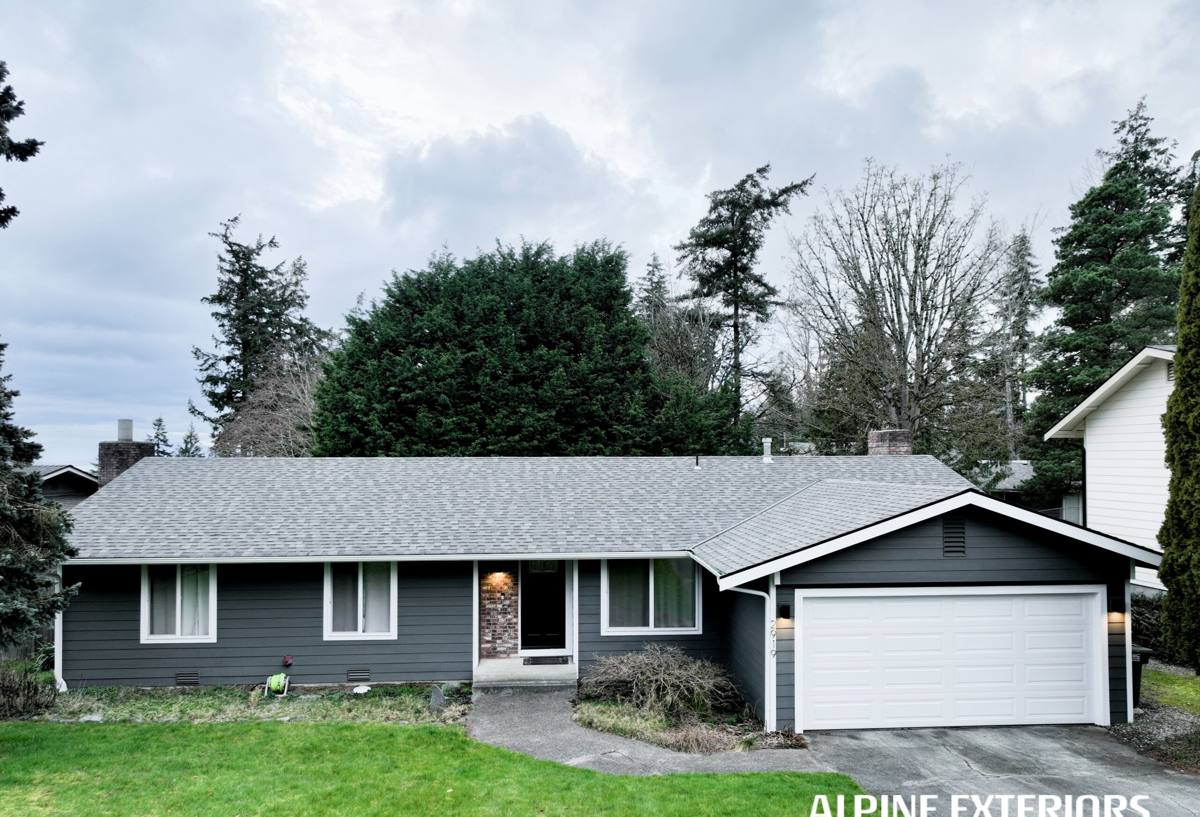
What James Hardie Fiber Cement Actually Is
James Hardie siding is fiber cement: a mix of Portland cement, sand, cellulose fiber, and water, cured into rigid boards and panels. It's not a coating or a composite in the way vinyl or engineered wood products are — it's closer to a factory-made masonry product shaped like siding. That composition is the reason it doesn't rot, doesn't feed insects, and doesn't burn (it's certified noncombustible).
It's heavier and more rigid than vinyl or engineered wood siding, which matters for two reasons: it holds paint and factory finish better over time, and it resists wind-driven rain intrusion better when installed with the correct flashing and gapping details. The trade-off is that it has to be cut, fastened, and finished correctly — fiber cement doesn't forgive sloppy installation the way more flexible materials sometimes do.
What It Isn't
Fiber cement isn't waterproof — no siding is. It's a water-shedding cladding, not a water barrier; the actual waterproofing happens at the weather-resistive barrier and flashing behind it. Anyone who tells you a siding product alone will keep water out of your walls is oversimplifying. What Hardie gives you is a rigid, stable, long-lasting outer layer that sheds bulk water reliably when the assembly behind it is built right.
The HZ5 Climate Engineering
James Hardie makes region-specific formulations under its HardieZone system. HZ5 is engineered for the Pacific Northwest and other freeze-thaw, high-moisture climates — it's formulated to resist moisture-related damage and cracking in exactly the kind of wet, cool, marine-influenced weather Anacortes gets. This isn't a generic product with a regional sticker; the mix design itself differs from what Hardie ships to Arizona or Florida.
For a Skagit County home, that means the siding is engineered around the actual stresses it will see: sustained dampness, salt exposure near the water, and repeated wet-dry cycling through our mild but rainy winters. It's one of the clearer examples of a manufacturer building for climate reality rather than a one-size-fits-all spec sheet.
ColorPlus Finish vs. Field-Painted Siding
Most Hardie products are available with a factory-applied ColorPlus finish — a baked-on, multi-coat finish applied in a controlled environment before the boards ever reach a job site. This matters more on the water than it does inland:
- Factory finishing avoids the adhesion problems that come from painting in damp, marine-layer conditions
- ColorPlus finishes carry their own extended finish warranty separate from the substrate warranty
- Color and sheen are consistent board to board, since it's not mixed and sprayed on-site
- Touch-up paint is formulated to match, rather than guessed at from a hardware store swatch
You can still order primed Hardie boards for field painting, and there are legitimate reasons to do that on a custom color match. But for most homeowners in this climate, ColorPlus removes one more variable — paint failure — from the list of things that can go wrong on an exterior that's supposed to last decades.
The Product Lines We Install
James Hardie isn't one product — it's a system of lines that cover the whole exterior, which is part of why we standardized on it rather than mixing brands on a single house.
| Product Line | What It's For | Common Use |
|---|---|---|
| HardiePlank Lap Siding | Traditional horizontal lap siding | Primary field siding on most homes |
| HardiePanel Vertical Siding | Vertical panel siding | Board-and-batten looks, gables, accent walls |
| HardieShingle Siding | Staggered or straight-edge shingle profiles | Craftsman and cottage-style facades |
| HardieTrim Boards | Fascia, corner boards, window and door trim | Finishing details around openings and rooflines |
| HardieSoffit Panels | Vented and non-vented soffit | Eave and overhang protection |
Using one manufacturer's system for siding, trim, and soffit means the expansion rates, fastening specs, and finish warranties are all designed to work together. Mixing a Hardie field with a different brand's trim is one of the more common sources of finish mismatch and premature caulk failure we see on homes we're asked to repair.
Why We Don't Install the Alternatives
We get asked fairly often about vinyl, LP SmartSide, and other fiber cement brands, plus primed spruce or cedar. We're honest about the trade-offs rather than pretending these are bad products — they're just not what we choose to stand behind:
Vinyl Siding
Vinyl is inexpensive and low-maintenance in mild climates, but it's a thin, flexible material that expands and contracts significantly with temperature swings, and it can crack or become brittle over decades of UV and salt exposure. It also can't be painted a darker color without risk of heat warping, which limits homeowners who want to change their exterior look down the road.
Engineered Wood (LP SmartSide and similar)
Engineered wood siding uses treated wood strand substrate, which performs well when kept dry and properly maintained, but wood-based products are inherently more moisture-sensitive than cement-based ones. In a climate with our rainfall and humidity, that means caulking, touch-up, and edge sealing become an ongoing maintenance obligation rather than a one-time install detail.
Other Fiber Cement Brands (Cemplank, Allura)
These are legitimate fiber cement competitors, and the base chemistry is similar to Hardie's. Our reasons here are less about the material and more about consistency: standardizing on one manufacturer's system, warranty structure, and installation specs lets our crews install to the same detail on every job, and lets us give homeowners one clear warranty conversation instead of several.
Primed Spruce or Cedar
Solid wood siding has real aesthetic appeal and a long track record, but it demands the most maintenance of any option — regular repainting or staining, vigilance about moisture and rot at end grain, and vulnerability to the moss and algae growth that our wet winters encourage. For homeowners who want that look with less upkeep, Hardie's shingle profiles are usually the better long-term answer.
Warranty Structure: What's Actually Backed
| Coverage | What It Typically Covers | Notes |
|---|---|---|
| Substrate (product) warranty | Manufacturing defects in the board itself | Non-prorated, transferable to one subsequent owner under Hardie's program |
| ColorPlus finish warranty | Finish integrity — cracking, peeling, fading of factory finish | Separate term from the substrate warranty |
| Installer workmanship warranty | Installation errors — flashing, fastening, gapping | Backed by us, not the manufacturer; ask any contractor for this in writing |
A siding warranty is only as good as the installation behind it. Most manufacturer warranties, Hardie included, can be voided by installation that doesn't follow their published specs — wrong fastener spacing, missing flashing, or boards installed too close to grade or a roofline. That's a big part of why we treat installation detail as seriously as we do.
What Correct Installation Actually Involves
Fiber cement is unforgiving of shortcuts in a way that shows up years later, not on install day. A proper Hardie installation in our climate includes:
- Correct starter strip and clearance from grade, decks, and roof surfaces to prevent wicking
- Proper weather-resistive barrier and flashing integration at every window, door, and penetration
- Manufacturer-specified fastener type, size, and spacing — not whatever's fastest to shoot
- Correct board gapping at butt joints and trim to allow for expansion without caulk failure
- Sealing and priming of factory-cut edges before caulking, especially field-cut ends
- Rain screen or drainage gap detailing appropriate to the wall assembly
Skip any one of these and the siding can still look fine for a year or two before moisture finds the weak point — usually right around the time a manufacturer warranty claim would otherwise apply.
What It Costs to Do Right
Fiber cement installed to spec costs more upfront than vinyl and is generally in a similar range to or somewhat above engineered wood, largely because of the labor involved in correct cutting, fastening, and detailing rather than the material itself. The real cost comparison isn't the install quote — it's install cost plus 20-30 years of maintenance (or lack of it). A lap siding job that never needs repainting and doesn't require replacing rotted boards at year twelve usually wins that comparison, even with a higher day-one number.
Get a Straight Answer for Your Home
Every house on Fidalgo Island faces the water and weather a little differently depending on exposure, tree cover, and age of the existing siding. If you're weighing your options or just want an honest look at what your current siding needs, we're happy to come take a look and give you a straightforward, no-pressure estimate — no sales pitch, just what we'd actually recommend for your home.