 Anacortes Exterior
 Primed wood siding — usually finger-jointed pine, primed spruce, or clear cedar boards sold with a factory prime coat — still shows up in bid packages and lumberyard displays across Skagit County. It has a real place in this region's building history, and there are still applications where a painter or a purist prefers it. But we don't install it as exterior siding on homes in Anacortes, and we think homeowners deserve a plain-English explanation of why, especially given what this specific climate does to primed wood over time.
This isn't a knock on wood as a material. Old-growth cedar sided homes that are still standing on Fidalgo Island prove wood can last generations under the right conditions. The issue is what "primed" actually means, what it doesn't protect against, and how that gap plays out in a marine environment with salt air, long wet winters, and a moss season that doesn't really end.
What "Primed" Actually Means — and What It Doesn't
A primed board has one factory-applied coat meant to help paint adhere and to slow moisture absorption during shipping and storage. It is not a finished, sealed product. The primer is a base layer, not a weather barrier, and every manufacturer that sells primed wood siding is explicit that field painting — a full topcoat, and often two — is required promptly after installation, with total dry-film thickness the homeowner is responsible for maintaining.
That distinction gets lost on job sites more often than it should. Primed wood shows up, looks finished, and sits stacked or installed longer than it should before topcoat goes on. Every day of exposure before that final paint layer is a day untreated end grain, cut edges, and nail penetrations are soaking up whatever moisture is in the air — which around here is a lot, most of the year.
The Cut-Edge Problem
Every board gets field-cut for corners, window and door openings, and butt joints. Factory priming covers the face and back of the board before it leaves the mill. It does not cover the cuts made on site. Unless every single field cut is back-primed and sealed before installation — a step that gets skipped constantly under schedule pressure — those raw edges become the entry point for moisture. Wood siding fails from the edges in, not the face in.
Why the Skagit County Climate Makes This Worse
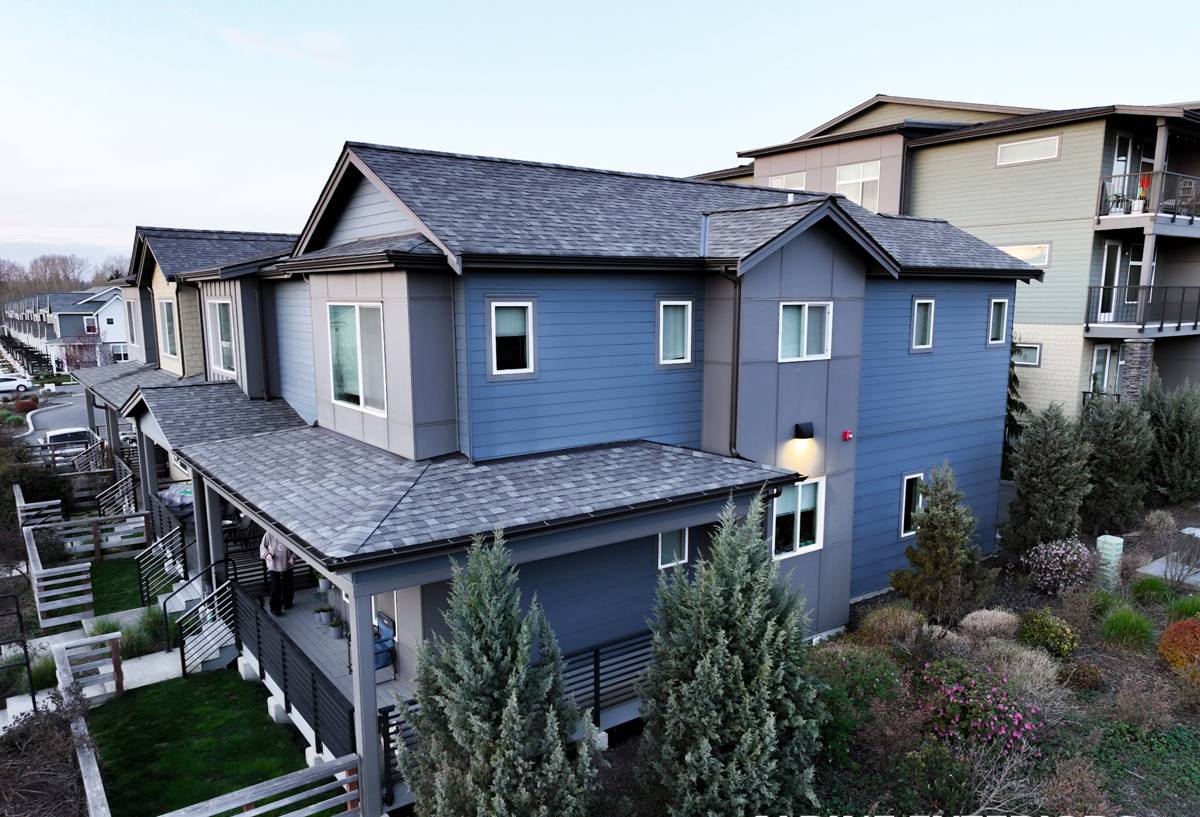
Anacortes sits on Fidalgo Island surrounded by salt water, which means siding here deals with salt-laden air on top of everything the Pacific Northwest already throws at exterior surfaces. Salt air is hygroscopic — it pulls moisture out of the atmosphere and holds it against surfaces longer than dry inland air would. Combined with driving rain off the Strait and Rosario Strait, that's a lot of cumulative wetting on wall assemblies that primed wood siding is not really built to shrug off.
Then there's moss. Skagit County's moss season runs long — mild, wet winters and shaded north and west elevations create ideal conditions for moss and algae growth on any organic building material. Wood siding is an organic substrate moss can actually use as a growth medium, which means it's not just cosmetic. Moss and lichen hold moisture directly against the wood surface for extended periods, which accelerates exactly the kind of moisture cycling that causes paint failure, cupping, and eventually rot.
| Climate Factor | Effect on Primed Wood Siding |
|---|---|
| Salt air (island/coastal exposure) | Draws and holds moisture against the surface; accelerates paint breakdown |
| Driving rain, wind-blown | Forces water into seams, laps, and unsealed cut edges |
| Extended moss/algae season | Organic growth holds moisture on the surface long-term, especially on shaded elevations |
| Freeze-thaw cycling in winter | Trapped moisture in wood fibers expands, splitting paint film and grain |
The Maintenance Burden Homeowners Actually Take On
The single biggest issue with primed wood siding isn't the material — it's the ongoing labor it demands from the homeowner, indefinitely, for as long as the siding is on the house.
- Repaint cycle: Expect a full repaint every 5-8 years in this climate, sooner on south and west exposures that see more direct sun and thermal cycling.
- Caulk maintenance: Joints, seams, and trim intersections need caulk inspection annually and re-caulking as it cracks or pulls away.
- Moss and algae washing: Soft-washing is needed periodically to keep organic growth from taking hold, particularly on shaded walls.
- Spot repair: Any area where paint fails first — usually butt joints, bottom courses near grade, or areas near sprinklers and downspouts — needs to be caught and repainted before it becomes a rot repair.
- Woodpecker and insect vulnerability: Untreated or moisture-softened wood is more attractive to woodpeckers and carpenter ants than fiber cement.
None of that is unusual for wood — it's just the deal you're signing up for. The question is whether a homeowner wants that deal, or wants a material engineered to reduce it.
What Happens When Maintenance Slips
Paint failure on primed wood rarely stays cosmetic for long. Once the topcoat cracks or peels and bare or under-primed wood is exposed, moisture gets into the fibers directly. In a climate that doesn't offer long dry stretches to let a wall assembly fully dry out, that moisture can sit in the wood for weeks. Rot doesn't announce itself — by the time it's visible from the outside, it has often traveled further than it looks, and repair means replacing boards, not just repainting them.
Where Primed Wood Still Makes Sense
To be fair to the product: primed wood trim, fascia, and accent details still have a place, especially on protected elevations, under generous roof overhangs, or in architectural applications where a painter wants full control over color-matching custom millwork. Some homeowners also value being able to repaint wood any color at any time without replacing the material, which fiber cement's factory finish doesn't offer in quite the same way. We're not telling anyone their taste is wrong — we're telling you what full-field exterior wood siding actually costs in upkeep on an island exposed to salt air and a long wet season.
Why We Standardized on James Hardie Fiber Cement
We install James Hardie fiber cement siding exclusively, and the reasoning is directly tied to everything above. Hardie board is non-combustible, dimensionally stable, and doesn't feed moss the way organic wood does — it's a cement-based composite, not a food source for algae or fungal growth. The HZ5 product line is engineered specifically for climates with the kind of moisture exposure Anacortes deals with, addressing freeze-thaw performance and moisture resistance in the formulation itself rather than relying entirely on a field-applied topcoat.
ColorPlus factory finish is the other half of the equation. It's baked on at the factory under controlled conditions, not brushed or sprayed on site in whatever weather window the crew gets. That finish is backed by its own finish warranty separate from the product warranty, and it holds up to UV and moisture cycling far longer than a field-applied paint job on wood — which means the years-later repaint cycle that comes standard with wood siding largely goes away.
Warranty Structure Matters
James Hardie's product warranty is transferable, which matters in a real estate market where homes change hands. Primed wood siding doesn't come with a manufacturer performance warranty in the same sense — the material is a commodity board, and any long-term performance is entirely a function of how well it was primed, painted, caulked, and maintained by whoever owned the house at any given time. That's a hard thing to verify or warranty when you're the one buying the house.
What This Means If You're Comparing Siding Options
If you're currently re-siding a home in Anacortes or elsewhere in Skagit County and primed wood is on your list, ask yourself honestly whether you or a future owner will keep up a 5-8 year repaint cycle, annual caulk checks, and periodic moss washing — on every elevation, including the ones facing the water and the ones that don't get much sun. If the answer is yes and you value the specific look and repaintability of solid wood, that's a legitimate choice, just not one we install.
If the honest answer is that a busy household isn't going to keep that maintenance calendar, a factory-finished fiber cement system is going to perform closer to expectations with far less intervention required from you.
A Practical Checklist Before Choosing Any Wood Siding Product
- Confirm every field cut, not just factory faces, will be back-primed and sealed before installation
- Get a written commitment on topcoat timing — how many days after installation the final paint coat goes on
- Ask what warranty, if any, covers the material itself versus just workmanship
- Plan a realistic maintenance budget: repaint, caulk, and wash cycles, not a one-time cost
- Walk the property and identify shaded, low-airflow elevations where moss will establish first
- Check clearance from grade and sprinkler placement — both accelerate moisture problems at the base of the wall
We'd rather have this conversation up front than watch a homeowner discover the maintenance reality three years into ownership. If you'd like us to walk your home, look at your specific exposures — sun, shade, salt air direction, moss-prone elevations — and talk through what would actually hold up long-term, we offer free, no-pressure estimates with no obligation to choose Hardie or anything else.