 Anacortes Exterior
 Skyline is one of the more exposed pockets of Anacortes — up on the bluff, facing open water, catching wind and rain that homes tucked farther into town simply don't see as often. That exposure changes what "good siding" actually means here. A product and installation that hold up fine on a sheltered inland lot in Skagit County can fail early on a Skyline wall that takes salt air and driving rain almost every winter. This page is specifically about James Hardie fiber cement siding for Skyline homes — what the climate demands from it, what a correct installation involves, and why we don't offer anything else.
Skyline's Exposure and What It Does to Siding Over Time
A bluff-facing lot with a water view is also a lot with nothing much to break the wind before it hits the house. That means more wind-driven rain forced sideways into joints, seams, and fastener holes than a typical wall sees, and it means salt-laden air working on anything metal — fasteners, flashing, trim caps — year-round. Add the long, damp Pacific Northwest moss season, plus the shade many Skyline lots get from mature evergreens, and you have a wall assembly that's wet more often and dries out more slowly than most.
None of that is exotic — it's the same coastal pattern you'll find up and down this part of Washington. But the degree matters, and on Skyline specifically it's high enough that shortcuts in the siding assembly show up faster than they would elsewhere. A gap in caulking, a missed flashing detail, or a fastener that isn't corrosion-rated might take years to become visible on a sheltered lot. On an exposed Skyline wall, it can show up in a couple of seasons.
Signs We Look For on a Skyline Inspection
- Moss or algae established on shaded, north- or east-facing siding, not just the roof
- Caulking that's pulled away from trim joints, window returns, or panel seams
- Rust bleed or staining around fasteners, corner flashing, or J-channel
- Soft or discolored trim near window sills and door thresholds — a sign water has been getting behind the material
- Paint chalking or peeling on any wood trim or wood-based siding still on the house
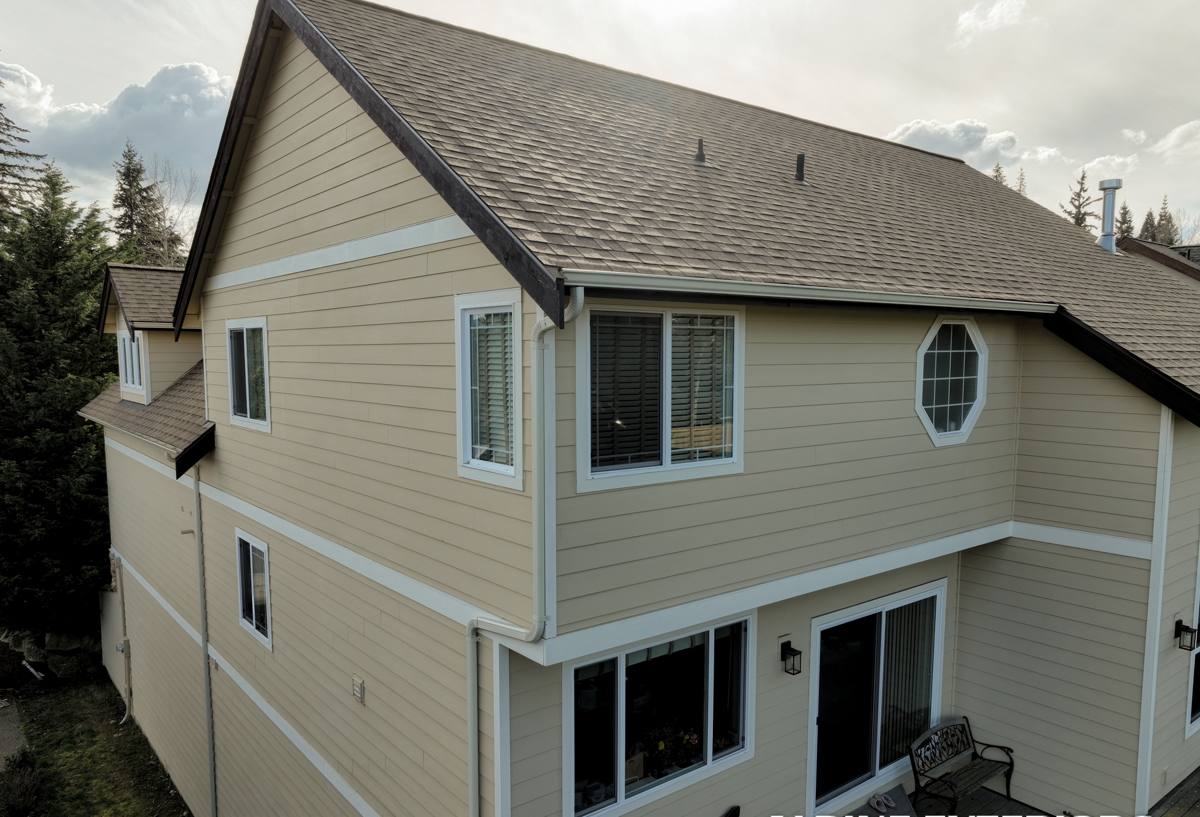
What a Correct James Hardie Installation Actually Involves
Fiber cement is only as good as the assembly it's installed into. Hardie's own installation manual is specific and detailed, and on an exposed lot like Skyline, following it to the letter is the difference between siding that holds up for decades and siding that starts showing problems within a few years despite being a premium product.
Clearances, Starter Strips, and the Drainage Plane
Hardie siding needs a water-resistive barrier behind it, correct starter strip placement at the base of the wall, and minimum clearances from grade, roofing, and decks — typically several inches, depending on the detail. Skipping or shorting these clearances is one of the most common installation mistakes we find when we're re-siding a home that had problems with its previous install. On a Skyline lot where the base of the wall can stay damp longer in the shade, that clearance isn't a formality — it's what keeps splashback and standing moisture away from the bottom course of siding.
Fastening for Wind and Moisture Exposure
Fastener spacing, type, and depth all matter more on a wall that takes direct wind load. We use corrosion-resistant fasteners set to Hardie's specified pattern and depth — not overdriven, which cracks the board's fiber cement over time, and not underdriven, which leaves the board loose and prone to working itself free in sustained wind. On an exposed bluff wall, fastener choice is one of the details that separates an installation that lasts from one that starts loosening at the edges after a few hard winters.
Flashing Details That Actually Keep Water Out
Most of the water problems we find behind failed siding trace back to flashing — around windows, doors, at butt joints, and where siding meets roofing or decks. Wind-driven rain finds any gap in that system and works its way in over time. On a Skyline installation we pay particular attention to head flashing over openings and to how the siding integrates with the water-resistive barrier, because this is the wall detail that has to work every time it rains, not just most of the time.
The HZ5 Climate-Engineered Line and Why It Matters Here
James Hardie doesn't sell one universal siding formulation — it engineers different product lines for different climate zones. For this region, we install Hardie's HZ5 line, formulated for areas with sustained moisture exposure and repeated wet-dry cycling, which describes a Skagit County winter well and describes a Skyline winter even better given the added wind and salt exposure. The base material — cement, sand, and cellulose fiber, pressed and cured into a dense board — is the same across Hardie's lines, but the formulation tuning is what's built for climates like ours rather than a hot, dry region where moisture cycling isn't the primary stress.
| Factor | Standard-Climate Formulation | HZ5 (Our Region) |
|---|---|---|
| Primary stress engineered for | General-purpose durability | Sustained moisture, wet-dry cycling |
| Fit for a Skyline bluff lot | Not the intended climate profile | Matches the moisture load this lot actually sees |
| Core material | Cement, sand, cellulose fiber | Same base material, climate-tuned formulation |
ColorPlus Factory Finish vs. Field-Applied Paint
Most Hardie siding we install goes on with the ColorPlus factory finish rather than being painted on site. That finish is baked on in a controlled environment, cures more consistently than field-applied paint, and comes with a longer warranty against fading and chipping than site-applied paint typically gets. On a wall that takes direct UV plus salt air, the difference is real — a factory finish tends to hold its color and adhesion longer than paint applied on site, where wind, moisture, and temperature swings during application all affect how well it bonds and cures.
Touch-up kits matched to the specific ColorPlus color are available for the rare nick or scratch, so a factory finish doesn't mean you can never touch it up — it just means the vast majority of the wall never needs repainting on the cycle wood or field-painted siding would require.
Matching the Right Hardie Profile to a Skyline Home
Hardie makes several distinct siding profiles, and picking the right one is about more than looks — it affects how water sheds off the wall and how much detail work goes into trim and joints.
| Product | Typical Use | Why It Fits Skyline |
|---|---|---|
| HardiePlank Lap Siding | Most homes, traditional or modern | Overlapping profile sheds wind-driven rain well; widest color selection |
| HardiePanel Vertical Siding | Gable ends, accent walls, modern builds | Fewer horizontal joints for water to find on exposed elevations |
| HardieTrim Boards | Window/door surrounds, corners, fascia | Won't absorb and hold moisture the way wood trim does in constant damp shade |
| HardieShingle Panels | Accent gables, coastal-style homes | Traditional look without the maintenance burden of real cedar shingles |
Why This Company Installs Only James Hardie
We don't offer vinyl, LP SmartSide, Cemplank, Allura, primed spruce, or cedar as alternatives — every job we take is Hardie fiber cement. That's a standard we settled on, not a sales pitch. Vinyl expands and contracts with temperature and isn't a water barrier on its own; it depends entirely on what's behind it, which is a bigger liability on a wall that takes direct wind-driven rain than on a sheltered one. Wood and wood-based products need a repainting or resealing cycle to stay ahead of moisture, and if that cycle slips even one season on an exposed lot like this, rot can start at cut edges and joints before it's visible from the ground. Other fiber cement brands may be reasonable products, but we've built our process, our crew's training, and our warranty backing entirely around one manufacturer's system rather than spreading that expertise across several — and Hardie's climate-specific engineering and factory finish are why it's the one we chose.
Our Process for a Skyline Siding Project
- Walk-around inspection of existing siding, trim, and any water damage, with photos and notes on what's failing and why
- Written estimate specifying the exact Hardie products, profile, and color, plus a scope covering flashing, trim, and any wall-assembly repairs found
- Removal of old siding and inspection of the sheathing and water-resistive barrier underneath, repairing anything compromised before new material goes on
- Installation to Hardie's specified clearances, fastening pattern, and flashing details — not shortcuts to save a day of labor
- Final walk-through so you can see the finished work and ask questions before we consider the job done
Why a Crew That Already Works Skyline Matters
Skagit County's coastal microclimates aren't uniform, and a crew that's worked Skyline before knows things a generic spec sheet won't tell you — which elevations take the worst of a winter southwesterly, where moss keeps coming back no matter what you do to the roof above it, and which flashing details are worth the extra time versus which ones are just code minimums. That's knowledge built by doing the work here repeatedly, not by reading a manufacturer's install guide once.
It also shows up in the practical side of the job — narrow bluff-lot access, tree cover that affects scaffolding and staging, and knowing how to sequence a job around this area's weather windows so materials aren't sitting out exposed longer than they need to be.
What to Expect From a Free Estimate
- An honest read on your current siding — what's failing from age versus what's failing from a past installation shortcut
- A specific product and profile recommendation for your home's exposure, not a generic quote
- A written scope that spells out flashing, fastening, and clearance details, not just square footage and color
- No pressure to sign on the spot — take the estimate, think it over, and call with questions
If you own a home in Skyline and you're seeing moss creeping onto the siding, caulking that's pulled away from trim, or staining near a window, we're glad to take a look. Reach out for a free, no-pressure estimate — we'll tell you plainly what your siding needs and why we'd do it in James Hardie.