 Anacortes Exterior
 Why March Point's Exposure Changes How Board & Batten Should Be Built
March Point sits out on open water, and that changes the math on vertical siding. Board and batten has always been a popular look here — the clean vertical lines read well against the water views and the mix of newer waterfront homes and older Skagit County farmhouses nearby. But the same wide-open exposure that makes the views great is hard on siding. Wind off the bay drives rain sideways into wall assemblies, salt-laden air accelerates corrosion on fasteners and trim, and the long, damp Pacific Northwest off-season keeps wood surfaces wet for weeks at a stretch. That combination is exactly what board and batten needs to be engineered for, not just installed to a generic spec.
Board and batten is a vertical siding pattern — wide flat panels or boards with narrower strips (battens) covering the seams. It's a strong look, but every one of those seams and batten laps is a place water can find its way in if the install isn't done right. On an exposed site like March Point, that margin for error shrinks considerably compared to a more sheltered in-town lot.
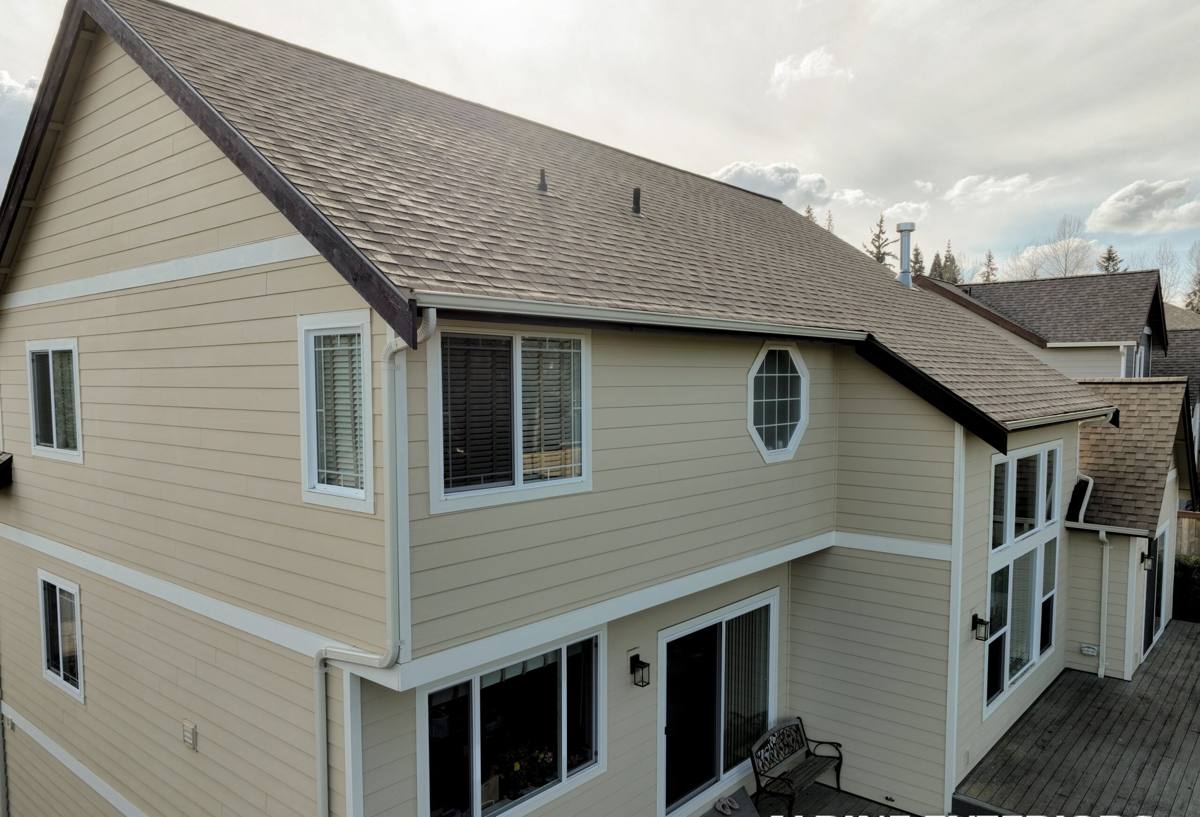
What a Correct Board & Batten Job Actually Requires
Weather-Resistive Barrier and Drainage
Every board and batten wall needs a continuous weather-resistive barrier behind it, and on a wind-driven-rain site that barrier should be paired with a drainage plane — a rain screen gap or furring strategy that lets any water that does get past the siding drain and dry instead of sitting against the sheathing. This is where a lot of budget installs fall short: siding goes straight over housewrap with no gap, and moisture that gets trapped behind wide vertical boards has nowhere to go.
Fastening and Flashing
Batten strips have to be fastened into framing or blocking, not just through the panel into sheathing, and every horizontal transition — window heads, trim boards, the base of the wall — needs proper flashing and kickout details so water is directed out and away from the wall, not down behind the panels. Around here, we also spec corrosion-resistant fasteners as standard, not an upgrade, because salt air will find the weak link in ordinary galvanized fasteners over time.
Panel Spacing and Movement
Fiber cement moves with temperature and moisture, so panel gaps, batten spacing, and caulking joints all need to follow the manufacturer's engineered tolerances. Get this wrong and you get cracked caulk lines and open seams within a couple of seasons — exactly the failure point that lets water behind the wall.
James Hardie Board & Batten: The Only System We Install
We install James Hardie fiber cement exclusively, including their board and batten profiles and HardiePanel vertical siding system. That's a deliberate standard, not a default. Fiber cement is non-combustible, doesn't swell or rot the way wood does when it stays wet, and holds a factory-applied ColorPlus finish that's baked on rather than field-painted, which matters a lot in a climate where field-applied paint is fighting damp conditions for a good chunk of the year.
Hardie also builds specific product lines engineered for different climate zones (HZ5 for our colder, wetter Pacific Northwest conditions), which means the product itself — not just the installation — is matched to what March Point actually throws at a wall. The finish carries a strong transferable warranty when installed to Hardie's spec, which is part of why installation quality isn't optional for us; a warranty is only as good as the install underneath it.
We won't install vinyl, LP SmartSide, primed spruce, cedar, or other fiber cement brands as a substitute. Each of those has legitimate uses elsewhere, but on an exposed, moisture-heavy site like this one, we've standardized on one system we can install to spec and stand behind.
Material Comparison for Vertical Siding on an Exposed Waterfront Site
| Material | Moisture Behavior | Salt Air / Marine Durability | Maintenance Burden |
|---|---|---|---|
| James Hardie Fiber Cement | Doesn't absorb and swell like wood; engineered for wet climates | Non-combustible, holds finish well in marine air | Low — factory finish, occasional wash and caulk check |
| Cedar / Primed Wood | Absorbs moisture, prone to cupping and rot at joints if not sealed consistently | Salt air accelerates finish breakdown | High — repainting/sealing on a recurring cycle |
| Vinyl Board & Batten | Doesn't rot, but can warp or become brittle with UV and temperature swings | Fasteners and trim can corrode over time | Low, but limited repair options if damaged |
| LP SmartSide / Engineered Wood | Wood-based core is moisture-sensitive at cut edges and seams | Requires diligent edge sealing near water | Moderate — edge maintenance is critical |
Our Process for a March Point Installation
Site and Exposure Assessment
Before we quote anything, we walk the site and look at which walls take the worst of the wind and rain — usually the ones facing open water — versus which are more sheltered by the house itself or nearby structures. That exposure map drives decisions on drainage detailing and flashing priorities, not a one-size approach applied to every wall.
Removal and Sheathing Check
Old siding comes off and we inspect the sheathing and framing underneath for existing moisture damage before anything new goes up. Covering up a problem that's already there defeats the purpose of a quality reside.
Drainage Plane and Weather Barrier
We install a continuous weather-resistive barrier with a rain screen or furring approach on exposed elevations so the wall assembly can actually dry if moisture gets behind the cladding.
Panel and Batten Installation
Hardie panels and battens go up to manufacturer spacing and fastening specs, with corrosion-resistant fasteners and properly flashed transitions at every window, door, and trim intersection.
Final Detailing
Caulking, touch-up paint on cut edges, and a final walk-through where we point out what maintenance the homeowner should expect and on what timeline.
Common Failure Points We See on Vertical Siding Near the Water
When we're called out to look at failing board and batten on siding jobs done by others in this area, the same handful of issues show up repeatedly:
- No drainage gap behind the siding, so trapped moisture sits against the sheathing
- Battens face-nailed only into the panel with no blocking behind, leading to loose battens and open seams
- Standard fasteners corroding faster than expected in salt air, leaving rust streaks and loose points
- Missing or undersized flashing at window heads and wall-to-roof transitions
- Caulk joints that weren't sized to the manufacturer's movement tolerances, so they crack early
Every one of these is a detailing failure, not a material failure — which is why we treat installation spec as non-negotiable rather than something to speed through.
Maintenance Checklist for Board & Batten in a Marine Climate
A correctly installed Hardie board and batten system is genuinely low-maintenance, but "low" isn't "none," especially with the moss season and salt exposure March Point deals with every year.
- Rinse the siding once or twice a year to clear salt residue and organic buildup before it feeds moss growth
- Walk the wall after major windstorms to check for loose battens or trim
- Inspect caulk joints annually, especially around windows and doors, and re-caulk any that have cracked or pulled away
- Keep gutters and downspouts clear so wall-adjacent water isn't sheeting down the siding
- Trim back vegetation that keeps a wall shaded and damp longer than the rest of the house
- Touch up any exposed cut edges with matching paint if trim work exposes raw material
Why Hiring a Crew That Already Works This Area Matters
March Point isn't a typical in-town lot, and a crew that mostly works sheltered Anacortes streets will make different — and sometimes wrong — assumptions about exposure, drainage, and fastener choice than one that's already built for wind-driven rain off the water. Knowing which elevations need the most attention, how the local moss season behaves, and how fast standard hardware corrodes out here isn't something you get from a manufacturer install guide alone. It comes from doing the work in this specific environment, on this specific coastline, in Skagit County's specific weather pattern.
If you're weighing board and batten for a March Point home, we're glad to walk the site, look at your exposure, and talk through what a correctly built James Hardie system would involve for your specific walls. Reach out for a free, no-pressure estimate — there's a form right below to get started.