 Anacortes Exterior
 Storm Damage Roofing in Mount Vernon: What Skagit County Weather Does to a Roof
Mount Vernon sits inland in the Skagit Valley, but it still lives inside the same weather system that moves through Anacortes and the rest of Skagit County. Wind funnels down the valley off the Sound, driving rain sideways instead of straight down, and during onshore weather events salt-tinged marine air reaches well past the waterfront. That combination does specific, predictable damage to a roof over time: fasteners and flashing corrode faster than they would in a dry inland climate, shingle edges lift under sustained wind pressure, and water finds its way in wherever a seal has weakened rather than waiting for an obvious hole.
Layer on the valley's long moss season — the shaded, damp stretches of fall through spring when moss and lichen get a foothold on north-facing slopes and shaded roof planes — and you get roofs that fail in quiet ways long before a homeowner notices a leak. A single windstorm rarely destroys a roof outright. More often it finishes off a section that moss, corrosion, or years of driving rain had already weakened, and that's the damage we get called out to look at.
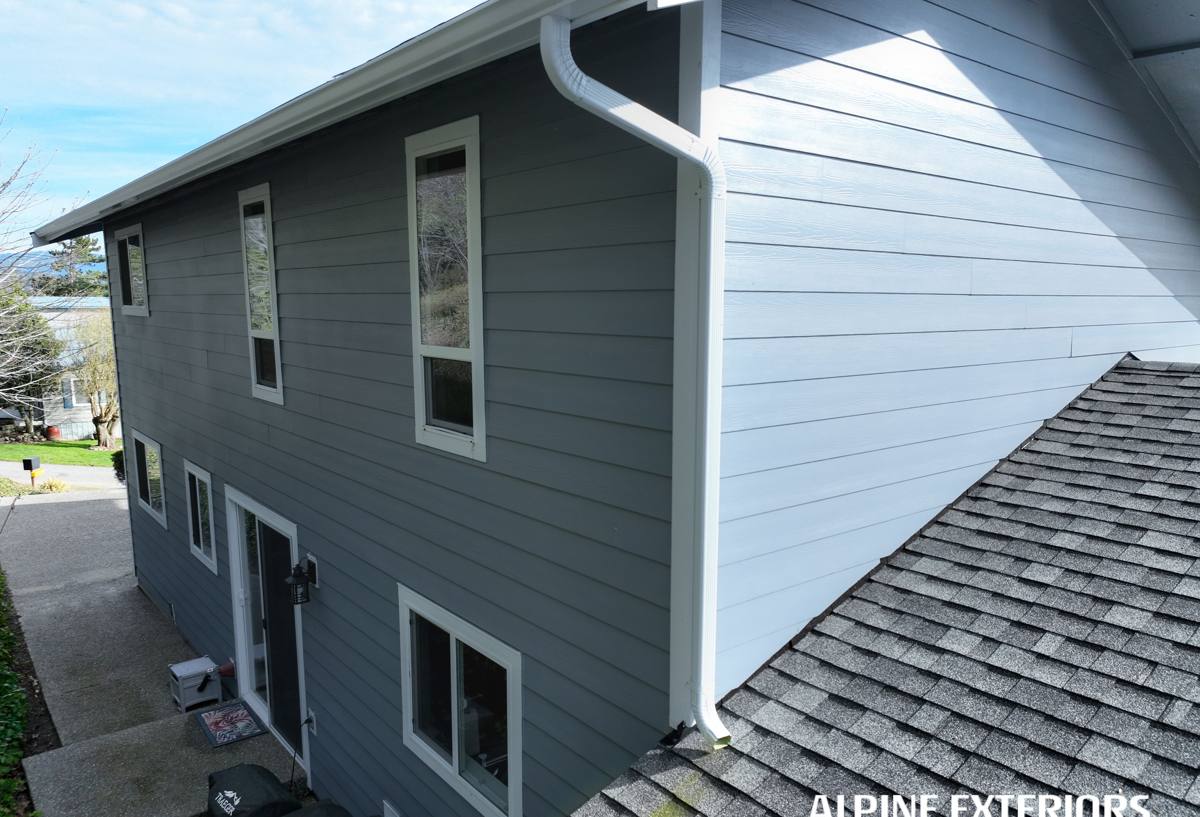
Signs Your Mount Vernon Roof Has Storm Damage
After a windstorm or a heavy rain event, it's worth doing a quick visual check from the ground, and if anything looks off, getting a professional look at the roof itself. Common signs of storm-related damage include:
- Missing, torn, or visibly lifted shingles or shakes, especially on the side of the roof that faced the wind
- Heavy granule buildup in gutters or at downspout outlets after the storm passes
- Curled, cracked, or creased shingle edges that weren't there before
- Exposed or backed-out nail heads along shingle courses or ridge caps
- Dented, bent, or separated metal flashing around chimneys, vents, and skylights
- Soft or spongy spots when the deck is checked from the attic side
- New water stains or discoloration on ceilings or in the attic following a storm
- Thick moss growth that's holding debris and moisture against the shingles rather than shedding water
- Gutters pulling away from the fascia board, which often points to wind uplift under the roof edge
Not every one of these means you need a new roof. Some are minor repairs. But each one is a sign the roof's ability to shed water has been compromised somewhere, and that's worth confirming rather than guessing about.
What a Correct Storm Damage Repair Actually Involves
Inspection First, No Guessing
A proper storm damage repair starts with someone getting on the roof — not just eyeballing it from the driveway — and checking the full system: shingles or shakes, flashing, underlayment where it's exposed, ridge and hip caps, and the roof deck itself where damage has gone through to the wood. Storm damage is often worse, or better, than it looks from the ground, and the repair plan should be based on what's actually found, not on an assumption.
Matching Materials and Fastening Correctly
Repairing storm damage means tying new material into old material in a way that performs like one system, not two. That means matching shingle type, profile, and as close a color as the existing product allows, and fastening according to the manufacturer's pattern and exposure — not just enough nails to hold the piece down. Under-fastened repairs are one of the most common reasons a "fixed" section fails again in the next windstorm.
Flashing, Underlayment, and the Parts You Don't See
Most storm-related leaks trace back to a flashing detail — around a chimney, a vent pipe, a skylight, or a valley — rather than the shingle field itself. A correct repair replaces or reseals compromised flashing and, where the deck is exposed, installs proper underlayment before anything new goes over it. Covering damaged flashing with a new shingle on top is a cosmetic fix, not a repair.
Documentation That Holds Up
Whether or not you're filing an insurance claim, a good repair is documented: photos of the damage before it's covered up, a written scope of what was found and what was done, and, where relevant, notes on material and fastening specs. That record protects you if a related issue shows up later and gives you something concrete if you do end up working with an adjuster.
Storm Damage and Your Insurance Claim
Not every storm repair goes through insurance, and not every claim gets approved as filed — that's a decision between you and your carrier, and we won't promise an outcome we don't control. What we can control is showing up with clear, useful documentation before anything gets covered up or hauled away, which puts you in a stronger position either way.
| Approach | What You Get | Where It Falls Short |
|---|---|---|
| Homeowner documents alone | Photos taken quickly, often after the fact | May miss technical damage (flashing, deck, fastening) an adjuster looks for |
| Contractor-assisted documentation | Photos and a written scope tied to specific roofing components and causes | Still your claim to file and negotiate — we support it, we don't manage it |
| Repair before documenting | Roof gets sealed up faster | Removes the evidence an adjuster or future buyer might need to see |
Our practice is simple: document what we find before we fix it, keep the estimate itemized by component, and give you paperwork you can hand to an adjuster or keep for your own records.
Repair or Replacement? What Actually Decides It
Storm damage doesn't automatically mean a full new roof, and it doesn't automatically mean a small patch either. A few factors genuinely drive that decision:
| Factor | Leans Toward Repair | Leans Toward Replacement |
|---|---|---|
| Roof age | Roof is well within its expected service life | Roof is already near the end of its material's typical lifespan |
| Extent of damage | Damage is limited to one slope or a localized area | Damage is spread across multiple slopes or the whole roof |
| Deck condition | Deck underneath is sound once exposed | Deck shows rot, soft spots, or repeated past water intrusion |
| Material availability | Existing shingle or shake product is still available to match | Product is discontinued or too weathered to blend a patch invisibly |
| Pattern of prior repairs | This is the roof's first significant repair | Roof already has a history of patch-on-patch repairs |
We'll tell you honestly which category your roof falls into, including when a repair is the right call even though a full replacement would be the bigger job for us. A roof that's ten years into a thirty-year expected life doesn't need to be replaced because one slope took wind damage.
Our Storm Damage Repair Process in Mount Vernon
- Initial call and, if needed, emergency tarp. If a roof is actively leaking or has an open section exposed after a storm, getting it temporarily weathertight comes first, before any long-term plan is decided.
- On-site inspection. A full walk of the roof, attic, and affected interior areas to identify every point of damage, not just the obvious one.
- Written scope and estimate. A clear, itemized plan covering exactly what's being repaired, with what materials, and why — with a broad, honest range rather than a padded number.
- Material matching and sourcing. We confirm what will match the existing roof before work starts, so you're not surprised by a patch that stands out.
- Repair work. Flashing, underlayment, decking, and shingle or shake work performed to manufacturer fastening and installation specs, not just "good enough to hold."
- Cleanup and walkthrough. Job site cleared of debris and nails, and a walkthrough so you can see what was done and why, along with your documentation.
Why Hiring a Crew That Already Works in Mount Vernon Matters
After a regional windstorm, roofing crews get busy fast, and homeowners across Skagit County are often calling the same handful of contractors at once. A crew that already works this area regularly has a head start: they know the roof types and ages common in Mount Vernon's older neighborhoods and newer subdivisions alike, they're familiar with how wind moves through the valley and which roof orientations tend to take the worst of it, and they've dealt with local permitting requirements before, so a repair that needs a permit doesn't stall out on paperwork.
It also matters for material matching. A contractor who regularly works Skagit County roofs has working relationships with local suppliers and a better sense of what's actually in stock versus what will take weeks to order — which matters when you've got an open section of roof and a wet forecast.
And it matters for accountability. A local, licensed crew with a physical presence in the area is easy to find again if a question comes up after the job, which is worth more than a lower bid from a crew that showed up right after the storm and moved on to the next town.
Preventing the Next Storm From Doing the Same Damage
Storm damage repair is a good moment to also address the conditions that made the damage worse than it needed to be. A few things worth checking or scheduling once the immediate repair is done:
- Moss treatment on shaded or north-facing slopes before it re-establishes and starts lifting shingle edges again
- Gutter cleaning and fastening checks, since clogged or loose gutters compound wind and rain damage at the roof edge
- A flashing check around chimneys, vents, and skylights even where there's no visible leak yet
- A pre-storm-season inspection in late summer or early fall, before the wetter months set in across Skagit County
- Trimming back tree limbs that overhang the roof, which cause both direct impact damage and extra shade that feeds moss growth
None of this eliminates storm risk entirely — no roof is stormproof — but it narrows the gap between "the roof handled it" and "the roof needed emergency repair" the next time a system moves through.
Get an Honest Look at Your Roof
If your Mount Vernon home has taken storm damage, or you're not sure whether what you're seeing is storm-related or just wear, we're glad to come take a straightforward look. The estimate is free, there's no pressure attached to it, and if the honest answer is a small repair rather than a bigger job, that's what we'll tell you. Use the form below to get in touch and we'll go from there.