 Anacortes Exterior
 Flounder Bay's Marine Climate Is Tougher on Siding Than It Looks
Flounder Bay sits right on the water on the west side of Fidalgo Island, and that waterfront position is exactly what makes siding decisions here different from a house a few miles inland in Anacortes. Homes close to the marina and shoreline take a steady dose of salt-laden air, wind-driven rain off the Sound, and long stretches of shade and dampness that keep moss and algae active for most of the year. None of this is dramatic on any given day. It's the accumulation over years — salt film on siding, moisture that never fully dries between rain events, and organic growth working into any weak seam or joint — that separates a siding job that holds up from one that starts failing quietly around year six or seven.
Skagit County's marine climate is mild by national standards, which is part of the problem: homeowners don't associate our weather with siding damage the way someone in a hailstorm or wildfire region would. But constant moisture exposure, combined with salt air near the water, is one of the hardest environments on wood-based and moisture-sensitive siding products. Flounder Bay properties feel that more than most Anacortes neighborhoods simply because of proximity to the water.
Why We Install Only James Hardie Fiber Cement
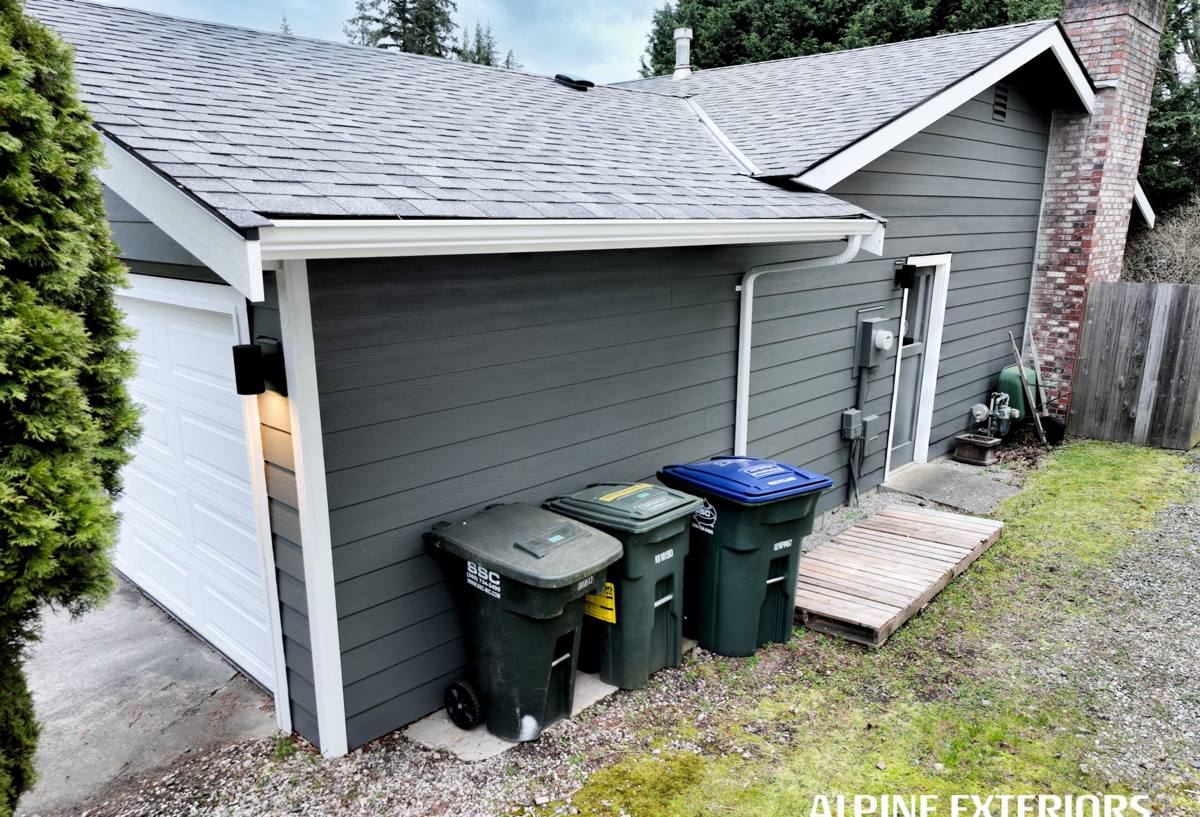
We made a decision as a company to install James Hardie fiber cement siding exclusively — not vinyl, not cedar, not primed spruce, not LP SmartSide, not other fiber cement brands. That's not a marketing position; it's a response to what we've seen hold up on Anacortes homes over time versus what tends to need attention sooner than homeowners expect.
Fiber cement itself is a mix of cement, sand, and cellulose fibers, and James Hardie engineers regional formulations under its HZ5 product designation for the Pacific Northwest's wet, moderate climate. That matters in a place like Flounder Bay because the product is non-combustible, doesn't swell or rot when it takes on moisture the way wood-based products can, and holds paint and factory finish far longer than primed wood siding exposed to constant damp conditions.
The other piece is the ColorPlus factory finish — a baked-on finish applied under controlled conditions before the boards ever reach the jobsite, rather than field-applied paint that has to cure in our variable weather. In a salt-air environment, a factory finish resists fading and chalking better than most site-applied coatings, and Hardie backs its products with a strong transferable warranty when installation follows their specifications. We won't install a product we can't stand behind twenty years out, and that's the short version of why Hardie is the only siding on our trucks.
What This Means If You're Comparing Options
We're not going to tell you vinyl or cedar are bad products — they have real strengths, and plenty of homes wear them fine in drier climates. Our issue is specific to what Flounder Bay's waterfront exposure does to them over a decade-plus timeline: vinyl can warp and fade under UV plus salt exposure and offers little in the way of real insulation or impact resistance; cedar and primed wood need consistent refinishing to keep moisture out once a coating starts to fail, and a missed maintenance cycle near saltwater compounds fast. Fiber cement removes most of that ongoing vulnerability, which is why it's the only product we put our name on.
What Correct Fiber Cement Installation Actually Involves
Fiber cement is only as good as the installation behind it. Most of the siding failures we get called out to inspect in coastal Skagit County neighborhoods trace back to installation shortcuts, not the material itself. For a Flounder Bay home, a few details matter more than they would somewhere drier and more sheltered.
Rainscreen and Moisture Management
A drainage gap (rainscreen) behind the siding lets any moisture that gets past the cladding drain and dry out instead of sitting against the wall sheathing. On a home this close to the water, we treat this as non-negotiable rather than optional upgrade — the extra bulk water and humidity load here makes a ventilated assembly earn its keep.
Fastening and Joints
Hardie specifies fastener type, spacing, and placement precisely, and those specs assume the fasteners will be exposed to weather over the life of the product. We use corrosion-resistant fasteners appropriate for a marine environment, and we don't cut corners on butt joint treatment — every horizontal joint is a place water can find its way in if it's not flashed and sealed correctly.
Flashing and Sealant Detail
Windows, doors, and any wall penetration are the most common failure points on any siding job, and salt air accelerates the breakdown of lower-grade sealants. We flash these openings so that water is directed out and down rather than relying on caulk alone, and we use sealants rated for sustained UV and moisture exposure.
Finish and Touch-Up
Because ColorPlus is a factory finish, field touch-up at cut ends and fastener heads uses Hardie's matched touch-up products so the factory warranty coverage stays intact. Skipping this step is a small shortcut that can void protection a homeowner is counting on.
Our Process for a Flounder Bay Project
- On-site assessment — we walk the home's exposure to wind, water, and shade, checking for existing moisture damage, moss buildup, and any areas where past siding or trim work has already let water in.
- Removal and sheathing check — old siding comes off and we inspect the wall sheathing and framing underneath before anything new goes up. This is the point where hidden rot or moisture damage from years of marine exposure gets caught, if it's there.
- Weather barrier and rainscreen install — a code-compliant water-resistive barrier goes on first, followed by the drainage gap assembly.
- Hardie siding installation — panels or planks installed to manufacturer spec for fastening, clearances, and joint treatment.
- Flashing, trim, and sealant detail — all openings and transitions sealed and flashed to shed water away from the wall assembly.
- Final walkthrough — we go over the finished work with the homeowner and flag any maintenance notes specific to the property's exposure.
Comparing Siding Options in a Waterfront Climate
| Factor | James Hardie Fiber Cement | Vinyl | Cedar / Primed Wood |
|---|---|---|---|
| Salt air resistance | Strong — non-combustible, factory finish holds color | Moderate — can chalk and warp with UV/salt exposure over time | Weak without frequent refinishing |
| Moisture behavior | Does not rot or swell when properly installed with drainage plane | Doesn't absorb water but can trap it behind panels if not vented | Absorbs moisture; prone to rot if finish fails |
| Maintenance cycle | Occasional wash; touch-up only at cuts/fasteners | Low, but damage (cracking) isn't repairable, only replaceable | Repaint/reseal every few years, sooner near water |
| Fire resistance | Non-combustible | Combustible, can melt/deform | Combustible |
| Typical lifespan (installed to spec) | 30+ years | 20–30 years | Variable, heavily maintenance-dependent |
This table reflects general product behavior, not a claim about any specific competing brand's failure rate — the point is simply that Flounder Bay's exposure rewards products and details that shrug off salt and standing moisture, which is why our crews only install fiber cement here.
Moss, Algae, and the Long Wet Season
Anacortes gets a long stretch of overcast, damp weather, and shaded or north-facing walls near the water can stay green with moss or algae growth for much of the year if the siding surface holds moisture. Fiber cement's factory finish sheds water better than porous or aging painted surfaces, which slows organic growth, but no siding is immune to it. Homes tucked near trees or with limited sun exposure on one side will need more frequent gentle washing regardless of material.
Simple Maintenance Checklist for Flounder Bay Homes
- Rinse siding (garden hose pressure, not a pressure washer directly on the surface) once or twice a year, more often on shaded or north-facing walls
- Check caulking around windows, doors, and trim annually for cracking or gaps
- Keep gutters clear so water isn't sheeting down the siding face
- Trim back vegetation that keeps walls shaded and damp longer than necessary
- Touch up any exposed cut ends or fastener heads with matched touch-up paint if you notice bare spots
- Have a professional inspect flashing at roof-to-wall transitions every few years — these are common entry points for water
Why Local Experience in This Neighborhood Matters
Flounder Bay isn't a generic Anacortes lot — its exposure to wind off the water, the salt content in the air, and the shade patterns from surrounding trees and terrain all shape how a siding job needs to be detailed. A crew that's worked other homes in this immediate area already has a feel for which walls take the worst weathering, how much drainage capacity a given exposure needs, and where past jobs in the neighborhood have run into trouble. That local pattern recognition is hard to replace with a generic install crew working from a standard spec sheet, no matter how good the product is.
We also know that a marine-adjacent property like this deserves an honest look before any siding goes up — not just a quote, but an assessment of what's happening behind the current siding and what your specific exposure actually calls for.
Get a Straightforward Look at Your Siding
If you're weighing a siding project on a Flounder Bay home, we're glad to walk the property, look at what's going on with your current siding, and give you a clear, no-pressure estimate for James Hardie fiber cement done right for this climate. Use the form below to get started.