 Anacortes Exterior
 Why Old Town Anacortes Is a Tougher Environment for Siding
Old Town Anacortes sits close to the water, and that proximity shapes everything about how siding ages here. Salt-laden air moves through the neighborhood on a near-daily basis, driving rain comes in sideways during winter storms, and the mature tree cover and shaded lots that give Old Town its character also trap moisture against exterior walls for long stretches of the year. Add in a moss season that can run from fall through spring in this part of Skagit County, and you have a climate that punishes any siding product with a weak spot.
None of this is unique to one house or one block — it's a neighborhood-wide condition. Homes facing the water take the worst of the wind-driven rain and salt exposure, while homes tucked under trees on the interior streets deal more with shade, moss, and slow-drying wall surfaces. Either way, siding here needs to handle moisture two ways at once: shedding wind-driven rain on the outside while resisting rot and swelling from trapped humidity underneath.
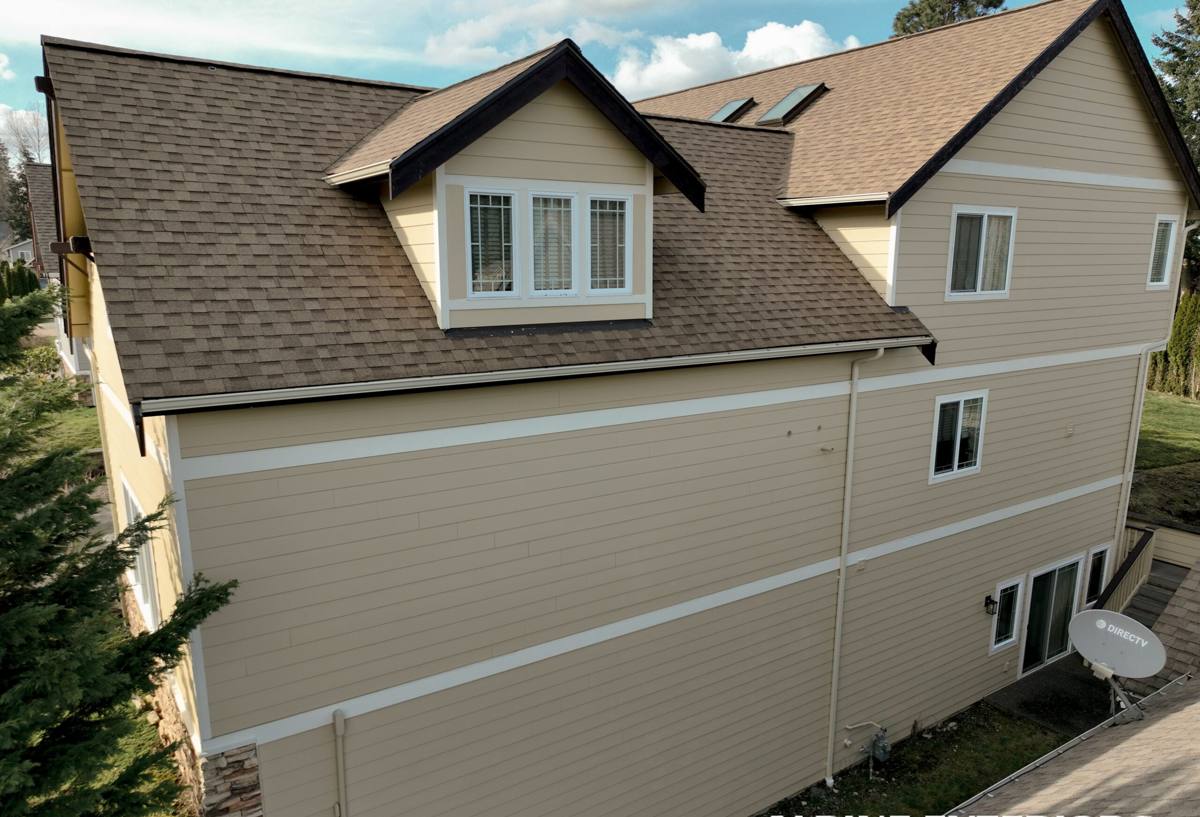
What Happens When Siding Isn't Built for This Climate
We see the same failure patterns repeat across Old Town Anacortes, regardless of what brand of siding is on the house. Wood-based products swell, delaminate at the seams, or develop soft spots where water has worked its way in behind trim and around fasteners. Vinyl siding can hold up reasonably well against rain, but it doesn't stop moisture from getting behind it, and in the salt air common near the water its fasteners and hardware are more prone to corrosion over time. Moss and algae take hold fastest on siding with a rough or absorbent surface, and once established, they hold moisture against the wall even longer, compounding the problem.
The end result on a lot of older Old Town homes is the same story: siding that looked fine for a few years, then started showing dark streaking, soft or bubbling spots, and paint that won't hold no matter how often it's redone. By the time those signs show up, the damage usually isn't just cosmetic — it's often reached the sheathing or framing underneath.
Why This Matters More on Older Housing Stock
Old Town Anacortes has a lot of older homes, and older homes were often built without the moisture-management details modern building science calls for — things like a proper drainage plane, adequate flashing at windows and trim, and ventilation gaps behind the siding. That means the siding material itself has to work harder to compensate. A product that's sensitive to moisture, or that traps it rather than shedding it, is a poor match for a house that already has fewer built-in defenses.
Why James Hardie Fiber Cement Fits This Neighborhood
James Hardie fiber cement siding is engineered specifically for the moisture and climate demands that Old Town Anacortes homes face. It's non-combustible, dimensionally stable, and doesn't absorb water the way wood-based or wood-composite products do, which matters directly for a neighborhood dealing with salt air and near-constant rain exposure. Hardie's HZ5 product line, in particular, is engineered for climates with more moisture and freeze-thaw cycling — a good match for a marine environment like this one.
The factory-applied ColorPlus finish is just as important as the substrate underneath. Because the color and protective coating are baked on in a controlled factory environment rather than applied on-site, the finish resists fading, chipping, and peeling far longer than field-applied paint — which matters in a spot where UV exposure, salt, and rain are all working against a painted surface at once. That also means fewer repaint cycles over the life of the siding, which adds up over the years in a wet climate like this one.
Fiber cement's dense, non-absorbent surface also resists moss and algae growth better than wood or rough-textured composite sidings. It won't stop moss from settling on a shaded, damp wall entirely — nothing does — but it doesn't feed the problem the way an absorbent surface does, and it holds up to periodic cleaning without degrading.
What a Correct Installation Involves Here
Product choice only gets you halfway. On a house in Old Town Anacortes, the installation details are what actually determine whether the siding performs for its full service life or fails early despite being a good product.
Moisture Management Behind the Siding
Every installation should include a proper weather-resistive barrier and, where the wall assembly allows for it, a drainage gap so that any moisture that does get past the siding has somewhere to go rather than sitting against the sheathing. This is especially important on older Old Town homes where the original construction may not have included any of these details.
Flashing and Fastening
Windows, doors, and trim transitions are where water intrusion starts on almost every siding failure we inspect. Flashing has to be integrated correctly at every one of these penetrations, not just caulked over. Fasteners need to be corrosion-resistant and placed according to Hardie's fastening specifications — get this wrong near the water and you shorten the life of the installation regardless of how good the panels themselves are.
Clearances and Trim Details
Proper clearance at the ground, decks, patios, and roof lines keeps siding from sitting in standing water or trapped debris — a common problem on older lots with mature landscaping and uneven grading. Trim needs to be installed with the same moisture-shedding logic as the field siding, since trim boards are often where rot shows up first.
Comparing Siding Materials for a Neighborhood Like Old Town Anacortes
| Factor | James Hardie Fiber Cement | Vinyl | Wood / Cedar | Wood-Composite (LP-type) |
|---|---|---|---|---|
| Salt air / corrosion resistance | Strong — non-metallic substrate | Moderate — hardware/fasteners at risk | Weak without diligent upkeep | Moderate, depends on coating |
| Moss/algae resistance | Strong — dense, low-absorption surface | Moderate | Weak — absorbs and holds moisture | Weak to moderate |
| Finish durability | Factory ColorPlus, long fade resistance | Color molded in, can chalk/fade | Field-applied, needs regular repainting | Field-applied or factory, variable |
| Fire resistance | Non-combustible | Combustible | Combustible | Combustible |
| Typical maintenance burden | Low — periodic wash, caulk checks | Low, but hides moisture problems | High — repainting, sealing, rot checks | Moderate to high |
This is a general comparison, not a claim that every product in another category will fail — plenty of siding materials perform adequately when maintained closely. The distinction is how much ongoing attention each one demands in a climate like this one, and how forgiving it is when maintenance slips for a season or two, which happens in every real household.
Signs Your Current Siding Is Falling Behind
Homeowners in Old Town Anacortes should keep an eye out for these signs, especially on the sides of the house that face the water or sit in shade for most of the day:
- Dark streaking or green-black staining that comes back soon after cleaning
- Paint that's peeling, bubbling, or chalking faster than it used to
- Soft spots when you press on the siding, especially near the bottom courses or trim
- Visible gaps or separation at seams, corners, or around window trim
- A musty smell near exterior walls inside the house
- Fasteners that are rusted, popped, or backing out of the siding
Any one of these on its own might just mean a cleaning or a caulk touch-up. Several at once, especially on a wall that's older or hasn't been serviced in years, usually points to a bigger moisture problem underneath that a fresh coat of paint won't fix.
Our Process From Estimate to Finished Job
Assessment
We start by walking the exterior with you, looking at the current siding's condition, checking for soft spots and moisture damage, and looking at how the house is oriented relative to sun, shade, and prevailing wind and rain direction — all of which affect which walls need the most attention.
Installation
We remove the old siding down to the sheathing, address any rot or moisture damage we find before it gets covered up again, install the weather-resistive barrier and flashing details correctly the first time, and install the James Hardie panels and trim to manufacturer fastening specifications.
Final Walkthrough
We walk the finished job with you, point out what was done at key details like windows and trim, and go over basic care so the siding performs the way it's designed to for its full service life.
Why Hiring a Crew That Already Works in Old Town Anacortes Matters
Old Town Anacortes has a mix of older homes with their own quirks — different wall assemblies, different degrees of prior weatherproofing, tight lots, and mature landscaping that affects drainage and shade patterns. A crew that already works in this specific area has seen those quirks before and knows to check for them rather than assuming a standard approach will work everywhere. That local familiarity, combined with fiber cement siding that's actually engineered for a wet, salt-air marine climate, is what keeps a siding job performing for decades instead of needing attention again in five or six years.
We only install James Hardie fiber cement siding — we don't install vinyl, LP SmartSide, or other wood-composite products — because after years of working on homes in this climate, it's the system we trust to hold up to what Old Town Anacortes actually throws at a house year after year.
If your siding is showing its age or you're planning ahead for a replacement, we're happy to take a look and walk you through what your home specifically needs. Reach out for a free, no-pressure estimate — there's no obligation, just a straight assessment of where things stand.