 Anacortes Exterior
 Building a Deck That Holds Up in Edison
Edison sits in one of the wetter, more exposed corners of Skagit County — close enough to Samish Bay and Padilla Bay that salt-laden air is part of daily life, surrounded by farmland that keeps humidity high, and shaded in places by trees and outbuildings that never let the ground dry out fully. A deck built here does a different job than a deck built on a dry, open lot inland. It has to shed water fast, resist corrosion from salt air, and keep moss and mildew from getting a foothold in the joints and fasteners. Get those three things right and a deck will look good and stay solid for decades. Get them wrong and you'll be fighting soft boards, rusted hardware, and a slick, mossy surface within a few seasons.
We build and repair decks throughout the Anacortes area, and Edison properties come with their own checklist. This page covers what actually matters for a deck in this specific setting — not generic deck-building advice.
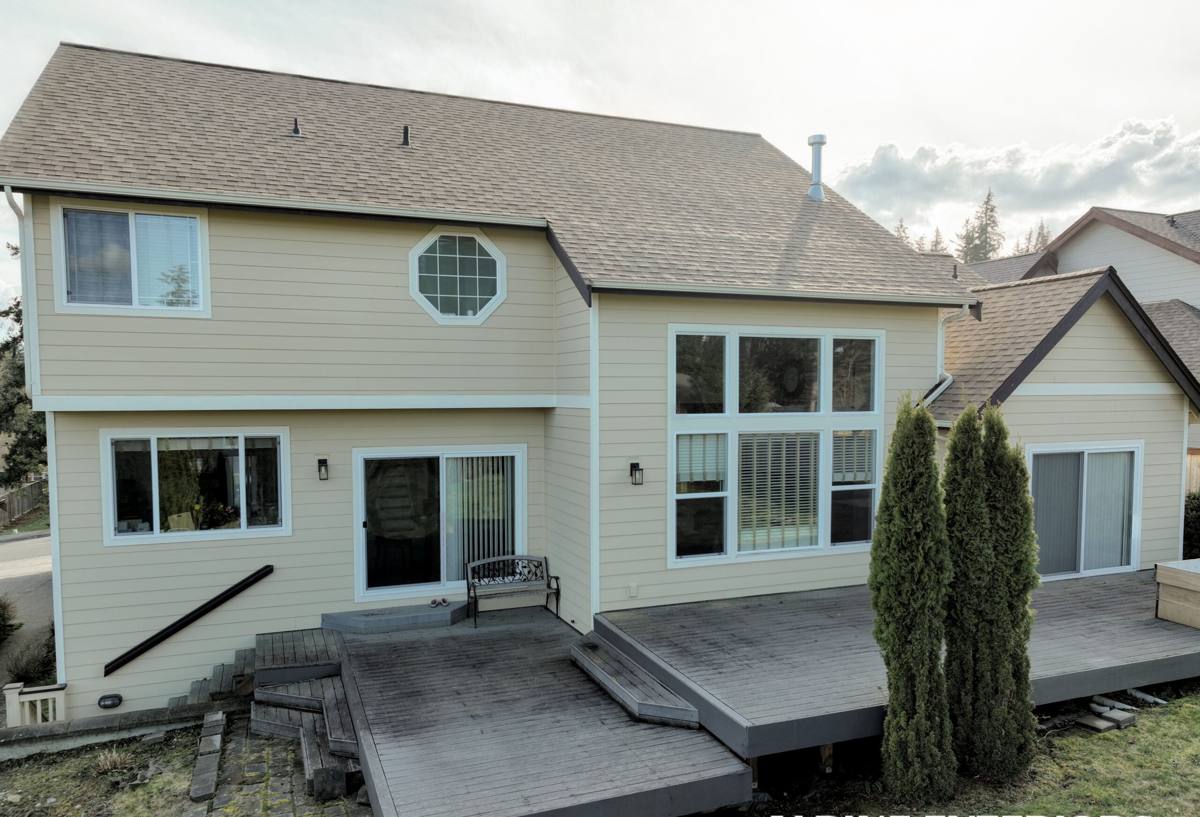
What Edison's Climate Does to a Deck
Salt Air
Airborne salt from the bay accelerates corrosion on anything metal — nails, screws, joist hangers, post bases. A fastener rated fine for an inland deck can start rusting within a year or two out here. Rust doesn't just stain the wood around it; it weakens the connection itself, which is a structural problem, not a cosmetic one.
Driving Rain
Storms coming off the water tend to arrive sideways, not straight down. That means water gets pushed into places a vertical rain wouldn't reach — under railings, behind ledger boards, into fastener heads that aren't sealed. Flashing and drainage details that would be optional in a drier climate are not optional here.
Long Moss Season
Between the tree cover common on Edison lots and the near-constant moisture, moss has a long growing window — often most of the year. Moss holds water against the decking surface, keeps wood from drying between rains, and turns a walking surface slick and dangerous if it's not managed from the start.
Framing and Structure: Where a Deck Actually Fails First
Most deck failures don't start with the visible decking boards — they start underneath, in the framing, ledger connection, and footings. This is where we spend the extra attention on an Edison build.
- Ledger board flashed and flashed correctly where the deck attaches to the house, so wind-driven rain can't work its way behind the siding
- Joist tape or a comparable membrane on top of every joist, so water can't sit in end grain and start rot from the inside
- Footings sized and set to local frost depth and soil conditions, not just a minimum guess
- Post bases that hold the post above the concrete, not embedded in it, so water has nowhere to pool against the wood
- Adequate airflow underneath the deck so the framing has a chance to dry out between storms instead of staying damp for weeks
None of this is visible once the deck is finished, which is exactly why it matters — it's the part a homeowner can't inspect later, so it has to be done right the first time.
Choosing a Decking Material for This Environment
There's no single "correct" decking material for every Edison property — it depends on how much maintenance you want to do, how much shade the deck gets, and your budget. Here's how the common options actually perform in salt air, rain, and moss conditions, in plain terms.
| Material | Moss & moisture resistance | Salt air behavior | Maintenance | Relative cost |
|---|---|---|---|---|
| Pressure-treated fir/hem-fir | Fair — needs sealing and cleaning to keep moss from taking hold in shaded spots | Wood itself is unaffected; fasteners need to be corrosion-rated | Annual cleaning, periodic sealing | Low |
| Cedar | Good natural resistance, but still needs cleaning in heavy shade | Handles salt air well; still use stainless or coated fasteners | Periodic oiling/sealing to hold color and grain | Mid |
| Composite decking | Very good — doesn't absorb water like wood, so moss has less to grip; surface can still get algae film and needs occasional washing | Excellent — no corrosion concern in the board itself | Occasional washing, no sealing or staining | Mid-High |
| PVC / capped polymer | Excellent — fully sealed surface resists moisture and moss growth | Excellent | Low — soap and water as needed | High |
We install both wood and composite/PVC decking and will walk through the real trade-offs for your specific lot — how much sun the deck gets, whether it's tucked under trees, and what upkeep you're realistically willing to do. There's no upsell pressure either direction; the honest answer depends on your yard, not ours.
A Note on Wood Species and Grades
If you go with wood, the grade and species matter as much as the species name on the invoice. Lower grades have more knots and checking, which gives moisture more entry points and gives moss more texture to grip. We spec material based on what the deck will be used for and how exposed it is, not just the cheapest option that technically qualifies as "cedar" or "PT."
Fasteners and Hardware: The Detail Homeowners Rarely Ask About
In a salt-air environment, hardware is often the first thing to fail — long before the decking or framing shows any wear. We use stainless steel or heavy hot-dip galvanized fasteners and connectors on Edison decks, matched to the fastener manufacturer's compatibility with whatever decking and framing material is used. Mixing incompatible metals (for example, the wrong fastener with certain treated lumber chemicals) can actually speed up corrosion instead of preventing it, so the pairing matters as much as the material grade itself.
Drainage and Moss Prevention Built In, Not Bolted On
Moss control on a deck isn't really about scrubbing — it's about not giving moss the conditions it needs in the first place. That comes down to design choices made before a single board is installed:
- Proper board spacing so water drains through instead of pooling on the surface
- A slight slope away from the house on the overall deck frame
- Keeping decking clear of overhanging vegetation where practical, without asking you to remove trees you want to keep
- Selecting a decking surface texture that sheds water rather than holding a film of moisture
- Ventilated skirting or gaps at deck edges so shaded, low-airflow areas underneath don't stay perpetually wet
These choices don't eliminate the need for occasional cleaning, but they mean you're cleaning a deck that drains well, not fighting a design that was never going to shed water in this climate.
Our Process for an Edison Deck Project
1. On-Site Assessment
We walk the property, look at sun and shade patterns, existing drainage, soil conditions, and how close the deck will be to salt-exposed air off the bay. This is also when we talk through material options honestly, based on what we see on your specific lot.
2. Design and Permitting
Deck permitting requirements are handled through Skagit County for unincorporated areas like Edison, and we take care of that process as part of the build — footing depth, guardrail height, and stair requirements all have to meet current code, and we build to it, not around it.
3. Framing and Structural Work
This is where the ledger flashing, joist protection, footings, and post bases described above get installed. It's the least visible stage and the most important one.
4. Decking, Railing, and Finish Work
Decking goes down with correct spacing and fastening for the chosen material, railings are installed to code, and any staining or sealing is done as a final step, not rushed to hit a deadline.
5. Walkthrough
We go over the finished deck with you, including what maintenance it actually needs (and what it doesn't) so you're not guessing later.
Maintenance: What an Edison Deck Actually Needs
- Sweep debris (leaves, needles, fir cones) off the surface regularly — trapped organic matter is what feeds moss
- Rinse or lightly scrub the surface once or twice a year, more often in heavily shaded areas
- Check fastener heads and railing connections annually for early rust or loosening
- Re-seal or re-stain wood decking on the schedule appropriate to the product — don't wait until it's visibly gray and dry
- Keep gutters and downspouts near the deck clear so roof runoff isn't dumping extra water onto or under the structure
- Trim back vegetation that's shading the deck surface if moss becomes a recurring problem
Why Local Experience on This Type of Build Matters
A deck built to a generic spec sheet can still fail early in a place like Edison if the crew building it hasn't accounted for salt air, driving rain, and a long moss season together. We work throughout the Anacortes and greater Skagit County area, including Edison, and we build to the conditions that are actually present on the coast and around the bay — not to a one-size-fits-all standard written for a drier climate. That means the right fasteners from the start, flashing details that account for wind-driven rain, and material recommendations based on how your specific lot drains and how much shade it gets.
If you're planning a new deck, replacing an aging one, or want a second opinion on a deck that's showing early moss or soft spots, we're happy to take a look and give you a straightforward assessment. Reach out for a free, no-pressure estimate using the form below.