 Anacortes Exterior
 Skyline's Waterfront Exposure Changes How Siding Ages
Skyline sits on the water side of Fidalgo Island, and that location does more to a home's exterior than most owners realize until repair work is already needed. Homes here take a steadier dose of salt-laden air, wind-driven rain off the water, and shade from mature trees than homes further inland in Anacortes. Siding that would hold up fine on a dry, sun-exposed lot in another part of Skagit County can fail years early on a shaded, water-facing wall in Skyline. We've worked enough of these properties to know the repair calls here follow a pattern: moisture damage concentrated on north and west-facing walls, corner and trim failure before field damage shows, and moss and algae staining that owners often mistake for a cosmetic problem when it's actually a sign of trapped moisture underneath.
This page is about one thing: doing siding repair correctly on a Skyline home, given what this specific location does to a building envelope over time.
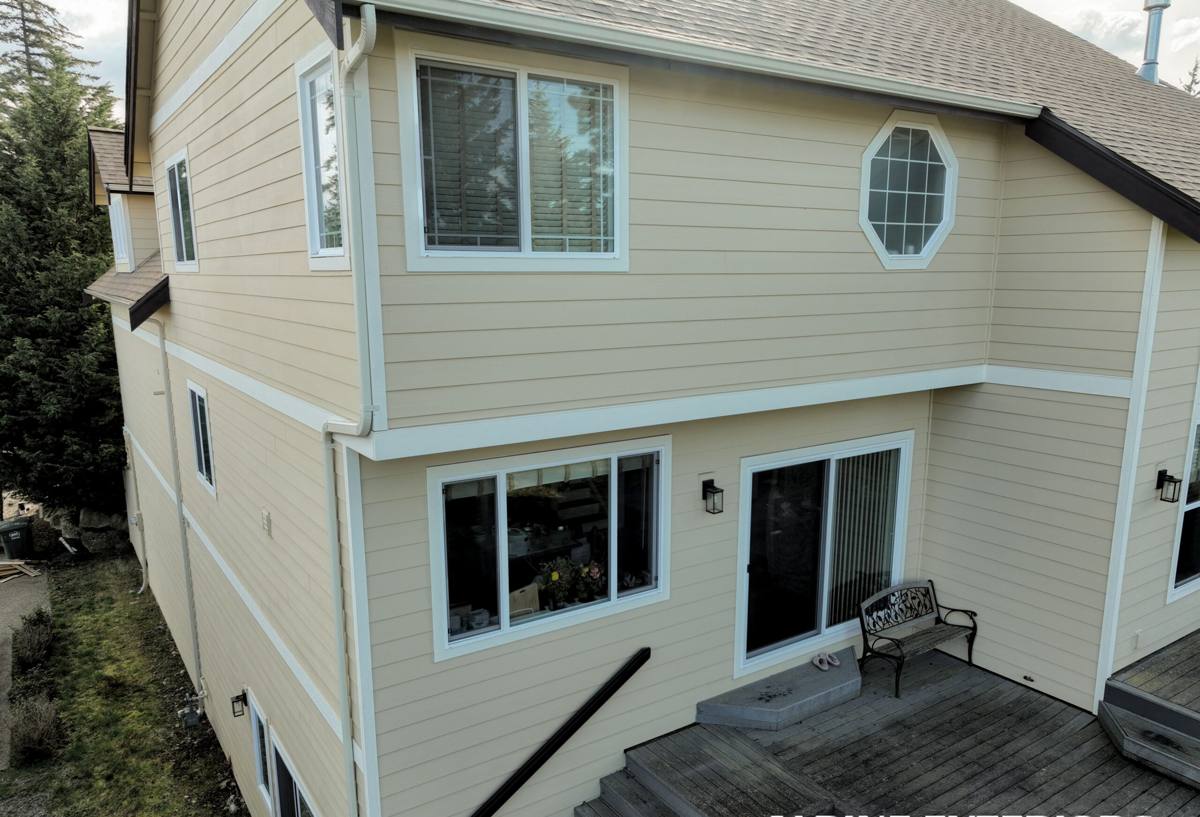
What Salt Air, Driving Rain, and Moss Season Do to Siding
Salt air and coastal humidity
Airborne salt from the water accelerates corrosion on exposed fasteners, flashing, and trim hardware. On siding materials that rely on paint film or a factory coating for protection, salt exposure combined with constant humidity speeds up coating breakdown at seams, edges, and fastener heads — the exact places where water gets behind the cladding once the finish fails.
Wind-driven rain
Anacortes gets plenty of rain that falls straight down and causes no trouble at all. The rain that damages siding is the kind that comes in sideways off the water during a windstorm, driving moisture up under laps, around window and door trim, and into any gap in the flashing. A siding system that isn't detailed for wind-driven rain will eventually let water in, even if the surface material itself is sound.
Moss and organic growth
Shaded, damp walls in Skyline grow moss and algae far more readily than exposed, sun-facing elevations. Left alone, that growth holds moisture against the siding surface for extended periods, which softens caulk joints, degrades paint, and — on wood-based products — feeds rot. Moss on siding is rarely just a cleaning problem; it's usually a sign the wall isn't drying out between rain events the way it should.
Signs a Skyline Home Needs Siding Repair, Not Just Paint
Owners often call about a paint or appearance issue and find out the real problem is underneath. These are the signs worth a professional look before you spend money on a cosmetic fix that won't hold:
- Soft or spongy siding when pressed, especially near the bottom courses or around window trim
- Paint that bubbles, peels, or fails repeatedly in the same spots year after year
- Persistent moss or dark staining that returns quickly after cleaning
- Visible gaps, cracking, or separation at butt joints and corners
- Warping or bowing panels, particularly on north- or west-facing walls
- Musty smell or discoloration on interior walls that back up to exterior siding
- Caulk that has shrunk, cracked, or pulled away from trim and window edges
What a Correct Siding Repair Actually Involves
Diagnosing what's behind the siding, not just what's on it
A repair that only addresses the visible surface is a repair that comes back. Before we touch anything, we check for soft sheathing, compromised house wrap, and moisture trapped behind the cladding. In a location like Skyline, where moisture problems tend to be hidden by shade and salt-driven coating failure, skipping this step is how homeowners end up paying for the same repair twice.
Matching material and profile
Mismatched repair patches are one of the most common complaints we hear about prior work — a different plank profile, a slightly off color, or a butt joint that doesn't line up with the existing coursing. Correct repair means matching the reveal, profile, and finish so the repaired section reads as part of the wall, not a patch on it.
Flashing and water management at every repair point
Every seam, corner, and penetration created or reopened during a repair needs proper flashing and water-resistive barrier detailing — not just fresh caulk over the gap. Caulk is a backup to good flashing, not a substitute for it. This is especially important on Skyline's water-facing elevations, where wind-driven rain will find any shortcut in the detailing.
Fastening and sealant standards
We use corrosion-resistant fasteners appropriate for a marine-influenced climate and sealants rated for the movement and UV exposure the wall will actually see. Cutting corners on fastener grade is a common cause of early repair failure in coastal Skagit County locations.
Repair or Replace? How We Make That Call
Not every damaged section needs full replacement, and not every repair is worth doing instead of replacing a wall outright. We walk owners through the real trade-offs rather than defaulting to the more expensive option.
| Factor | Repair Usually Makes Sense | Replacement Usually Makes Sense |
|---|---|---|
| Extent of damage | Isolated to one or two walls or sections | Widespread across multiple elevations |
| Underlying sheathing | Sound, dry, structurally intact | Soft, rotted, or water-damaged |
| Siding age and material | Newer material, still in production or matchable | Discontinued profile, or original material already near end of life |
| Cause of damage | Localized impact, flashing failure, or trim issue | Systemic moisture intrusion behind the whole wall |
| Cost over time | Lower upfront cost, may need future attention | Higher upfront cost, resets the clock on the whole wall |
Why We Repair and Install Exclusively with James Hardie Fiber Cement
When a repair calls for new material — a damaged section, a full wall, or an eventual full re-side — we use James Hardie fiber cement, and only James Hardie. It's a decision we made because of what actually happens to siding in a climate like this one. Fiber cement doesn't feed rot the way wood-based products can, and it holds up to sustained moisture exposure far better than materials that rely on their paint film for protection. Hardie's ColorPlus factory finish is baked on and warranted separately from the substrate, which matters directly in a salt-air environment where field-applied paint tends to fail first at the coating, not the material underneath. Hardie's HZ5 product line is also engineered for cold, wet climates, which fits the west side of Fidalgo Island better than a one-size-fits-all siding product.
We won't repair a damaged wall with vinyl, LP SmartSide, primed spruce, cedar, or other fiber cement brands, even when a homeowner already has one of those products installed and just wants a patch. If that's your situation, we'll still tell you honestly what your options are — but our own installs and repairs are Hardie, because it's what we're confident will still be doing its job on a Skyline home in twenty years.
Our Siding Repair Process for Skyline Homes
- On-site inspection — we look at the damaged area and check surrounding sections and the wall assembly behind it, not just the spot you called about
- Honest diagnosis — you get a clear explanation of what's causing the damage, not just what's visible
- Repair or replace recommendation — based on the actual condition of the sheathing and siding, not a default upsell
- Material matching — profile, reveal, and color matched as closely as possible so the repair blends in
- Correct water management detailing — flashing, house wrap, and sealant done to spec at every point we open up
- Walkthrough — we show you what was done and why, including anything worth keeping an eye on going forward
Why a Crew That Already Works in Skyline Matters
Siding repair in a marine-influenced neighborhood isn't the same trade as siding repair on a dry inland lot. A crew that regularly works Skyline and similar waterfront areas of Anacortes already knows which elevations take the worst of the wind-driven rain, how much shade and moisture a given wall typically holds, and what corrosion-resistant hardware and detailing hold up here versus somewhere drier in Skagit County. That local pattern recognition shows up in faster, more accurate diagnosis and repairs that are built for the exposure the wall actually faces — not a generic repair spec pulled from a manual written for a different climate.
If you're seeing moss, peeling paint, soft spots, or staining on your Skyline home's siding, we're happy to take a look and give you a straight answer about what's going on and what it will take to fix it right. Reach out for a free, no-pressure estimate — the form below gets you started.