 Anacortes Exterior
 La Conner's Climate Is Hard on Siding — Here's Why
La Conner sits close to the water in Skagit County, and that proximity shapes everything about how siding performs there. Salt-laden air drifts off the Swinomish Channel and the surrounding waterways, and over years that salt works its way into paint films, fastener heads, and any seam where moisture can collect. Add in the driving, wind-blown rain that comes through this part of Western Washington for much of the year, and siding here takes on water from angles that a drier inland home never has to deal with.
Then there's moss. Skagit County's long wet season, combined with shade from mature trees on many older La Conner lots, gives moss and algae months at a time to establish themselves on anything with texture or a porous surface. Moss holds moisture against the wall long after a storm has passed, which is exactly the condition that rots wood trim, delaminates old siding products, and breaks down paint faster than the manufacturer's warranty ever accounted for.
None of this means a La Conner home is doomed to constant siding trouble. It means the product and the installation both have to be matched to the actual conditions, not to a national average climate that doesn't apply here.
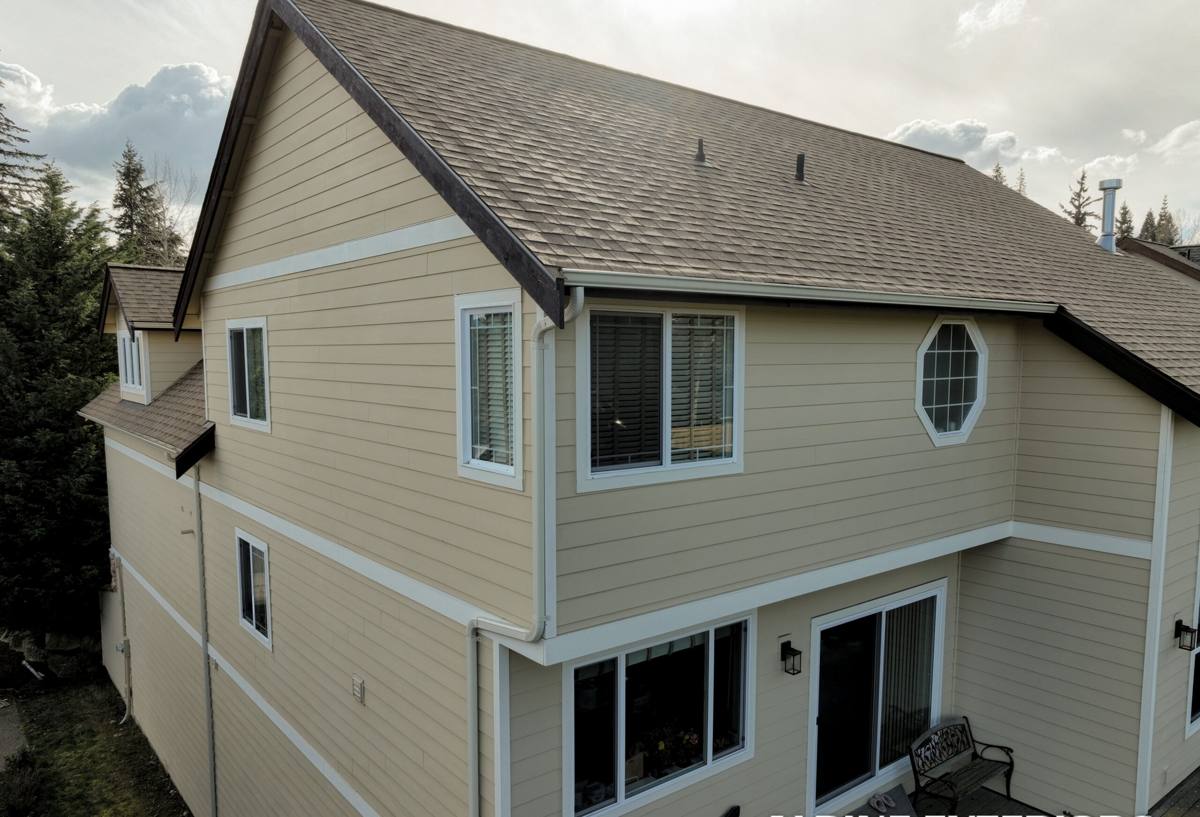
Signs a La Conner Home Needs Siding Replacement, Not Another Repair
We get called out to a lot of homes where the siding has been patched, caulked, and repainted for years past the point where that made sense. Here's what typically tells us a full replacement is the right call rather than another round of repairs:
- Soft or spongy spots when you press on the siding, especially near the bottom courses and around window trim
- Paint that won't hold anymore, even after prep and a fresh coat — it's failing within a year or two
- Persistent moss or algae staining that comes back within a season of cleaning
- Visible gaps, warping, or buckling in lap siding, particularly on the north and west-facing walls that see the most weather
- Cracking or splitting at butt joints and corners, where water has been getting behind the material
- Musty smell or visible staining on interior walls that share an exterior wall with damaged siding
If you're seeing two or more of these, the underlying wall assembly has likely been absorbing moisture for a while, and a repair only addresses what's visible — not what's happening behind it.
Why We Install Only James Hardie Fiber Cement
We made a decision as a company to install James Hardie fiber cement siding exclusively, and we don't install vinyl, LP SmartSide, cedar, or primed spruce, even when a customer asks for one of those specifically. That's not about brand loyalty — it's about what actually holds up in a climate like this one.
Vinyl siding is inexpensive and easy to install, but it's a petroleum-based product that expands and contracts with temperature swings, and in coastal wind it can crack or blow off at the edges over time. Wood products like cedar and primed spruce look great initially but require an ongoing maintenance commitment — repainting, caulking, and moisture monitoring — that most homeowners underestimate until they're dealing with rot. Engineered wood products like LP SmartSide perform reasonably well when installed and maintained exactly to spec, but they're still a wood-based substrate, and wood-based substrates and sustained coastal moisture are a difficult combination no matter how the manufacturer treats the surface.
James Hardie fiber cement is different because it isn't wood and isn't plastic. It's a mix of cement, sand, and cellulose fiber, which means it doesn't rot, it isn't a food source for insects, and it's non-combustible. It holds paint and factory finish far longer than wood because it doesn't expand and contract the same way, and it simply doesn't care about moss sitting on its surface the way an organic material does.
The HardieZone System
James Hardie engineers its products by climate zone, and the Pacific Northwest falls into HZ5, the zone built around sustained damp conditions and moderate freeze-thaw cycling. The HZ5 formulation is engineered for exactly the kind of weather La Conner and the rest of Skagit County see for most of the year — it's not a generic product pulled off a national shelf.
What a Correct Installation Actually Involves
Fiber cement siding is only as good as the installation behind it. A huge share of the "Hardie problems" homeowners hear about online trace back to shortcuts during installation, not the product itself. On a La Conner home, where wind-driven rain is a real factor, these details matter more than they would somewhere drier:
| Detail | Correct approach | Common shortcut we won't take |
|---|---|---|
| Weather-resistive barrier | Continuous, properly lapped house wrap with taped seams before siding goes on | Reusing or patching an old barrier that's already compromised |
| Flashing at windows and doors | Full flashing integration so water is directed out, not behind the siding | Caulk used as a substitute for proper flashing |
| Clearance at grade and roof lines | Minimum gap maintained per Hardie's installation spec so siding never sits in standing water or under a roof line with no drainage path | Siding installed tight to grade, decks, or roofing to save trim work |
| Fastening | Correct fastener type, spacing, and depth per Hardie's published guidelines | Standard framing nails driven too deep, cracking the board's edge |
| Joints and butt seams | Properly spaced and either flashed or sealed with a Hardie-approved sealant | Tight-butted joints with no room for material movement |
Every one of these details affects how the wall behind the siding handles the amount of rain this area gets. Skip one and you can end up with moisture problems in a fiber cement wall just as easily as in wood siding — the product isn't magic, the installation is what makes it perform.
Our Process, Start to Finish
1. On-Site Assessment
We walk the exterior with you, check the condition of the existing siding and the sheathing underneath where it's exposed, and talk through what we're seeing — including anything that suggests moisture has already gotten into the wall assembly.
2. Tear-Off and Wall Inspection
Old siding comes off in sections so we can inspect the sheathing as we go, rather than discovering a rot problem after the new siding is already up. Any damaged sheathing or framing gets addressed before anything new goes on — that's not an upsell, it's the point of doing a full replacement instead of a repair.
3. Weather Barrier and Flashing
A new, continuous weather-resistive barrier goes on with proper flashing at every window, door, and penetration. This is the layer that actually keeps water out of your wall — the siding is the second line of defense, not the first.
4. James Hardie Installation
Siding is installed to Hardie's published specifications for fastening, clearance, and joint treatment, matched to the HZ5 climate engineering appropriate for this region.
5. Trim, Caulking, and Final Walkthrough
Trim details get finished, joints get sealed where specified, and we walk the finished job with you before calling it complete.
What Siding Replacement Costs Depend On
We won't quote a number without seeing the house, but the factors that move the price on a La Conner project are pretty consistent:
| Factor | Why it matters |
|---|---|
| Home size and wall complexity | More corners, dormers, and trim details mean more labor and material waste |
| Condition of the sheathing underneath | Rot discovered during tear-off adds repair scope before new siding can go on |
| Siding profile chosen | Lap width, shingle-style panels, and board-and-batten all price differently |
| ColorPlus vs. field-painted finish | Factory-applied ColorPlus finish costs more upfront but eliminates a future repaint |
| Site access | Waterfront lots, steep grades, or tight setbacks can slow tear-off and staging |
Questions Worth Asking Before You Hire Anyone
- Will you inspect and repair sheathing before installing new siding, or just cover what's there?
- What weather-resistive barrier and flashing details will you use at windows and doors?
- Are you a certified James Hardie installer, and can you explain the HZ5 spec for this region?
- What's your fastening schedule, and will it match Hardie's published installation guide?
- Do you carry proper insurance, and will that be in writing before work starts?
Why a Crew That Already Works La Conner Matters
Siding installation isn't identical everywhere, and a crew that mostly works drier inland areas doesn't always adjust their habits for a place like La Conner. We work throughout Anacortes and the surrounding Skagit County waterfront communities, so the clearance details, flashing choices, and material handling we use already account for salt air exposure and sustained rain rather than treating this coastline like any other job site. That familiarity shows up in the small decisions — where we add extra flashing, how we treat grade clearance near a channel-facing wall, how we sequence work around the wetter months — that don't show up on a spec sheet but do show up in how the siding holds up five and ten years out.
Get a Free, No-Pressure Estimate
If your La Conner home's siding is showing its age, or you just want an honest read on whether repair or replacement makes more sense, we're happy to take a look. Use the form below to request a free estimate — no pressure, no obligation, just a straight assessment from a crew that works this area.