 Anacortes Exterior
 Siding Built for Sedro-Woolley's Skagit County Climate
Sedro-Woolley sits inland along the Skagit River, but it doesn't escape the marine-influenced weather that defines this part of Washington. Moisture-laden air drifts in from the Salish Sea, and combined with the valley's tree cover and river humidity, homes here spend a good chunk of the year damp. Add driving winter rain, long stretches of overcast days, and a moss and algae season that can run from fall through spring, and you get exterior conditions that punish the wrong siding material fast.
Wood-based products swell, check, and rot when they can't dry out between rain events. Vinyl expands and contracts with temperature swings and gets brittle in cold snaps, and it can't hold paint if a homeowner ever wants to change the color. Engineered wood siding relies on factory sealants at the edges and joints staying intact — miss one cut edge in the field and moisture finds its way in. None of these are theoretical problems in Skagit County; they're the normal wear pattern we see on older homes throughout the area.
Fiber cement doesn't share those weaknesses. It's a cement, sand, and cellulose fiber composite that doesn't swell with moisture, doesn't rot, and doesn't feed mold or moss the way wood fiber does. That's why it's the only siding material we install — not as a sales pitch, but because it's the product that actually holds up to what this climate throws at a house year after year.
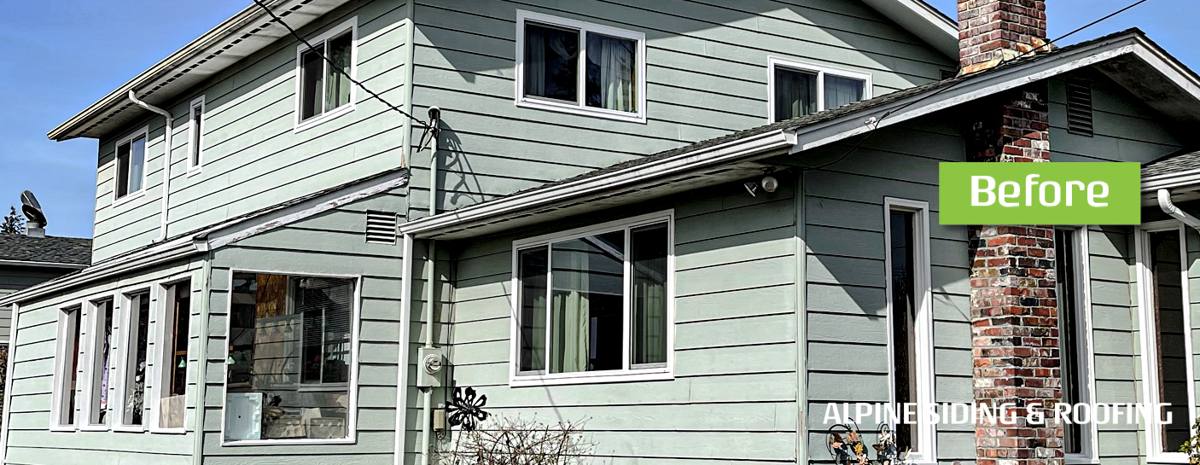
Why We Install James Hardie Exclusively
We don't install LP SmartSide, vinyl, Cemplank, Allura, primed spruce, or cedar. That's a deliberate standard, not a lack of options. Each of those products has legitimate strengths — LP SmartSide is lighter and easier to handle, vinyl is inexpensive up front, cedar looks the part on the right home. But each also comes with a real-world trade-off we've decided isn't worth putting on a home we stand behind: engineered wood siding depends heavily on perfect field-cutting and caulking to keep water out of exposed wood strand; vinyl can't be repainted and degrades visibly in UV and salt-tinged air; cedar demands a maintenance schedule most homeowners don't keep up with, and once it falls behind, the damage compounds.
James Hardie fiber cement is non-combustible, engineered specifically for the Pacific Northwest through its HZ5 product line, factory-finished with ColorPlus technology so the color is baked on rather than field-painted, and backed by a warranty that transfers to a new owner if the home sells. When it's installed to Hardie's specifications — which is where most siding failures actually originate, not the material itself — it's the most durable, lowest-maintenance option available for a Skagit County home.
What a Correct Fiber Cement Installation Actually Involves
Fiber cement siding is only as good as the installation behind it. The board is engineered to last decades, but a rushed or improperly detailed install can undercut all of that. A correct job includes several steps that aren't visible once the siding is up but determine whether it performs for the next 30-plus years:
- Water-resistive barrier: A continuous weather-resistant barrier goes over the sheathing before any siding, with proper lapping so water sheds downward and out, never into the wall cavity.
- Flashing at every penetration: Windows, doors, vents, hose bibs, and any other wall penetration get flashed so water is directed out and away, not trapped behind the siding.
- Correct fastening: Hardie specifies fastener type, spacing, and placement by product and exposure. Fastening through the wrong zone of the board or over-driving nails voids the warranty and creates failure points.
- Proper clearances: Siding needs a minimum gap above roof lines, decks, patios, and grade so it never sits in standing water or gets wicking moisture from below.
- Factory-cut edges sealed: Any field cut exposes raw fiber cement; those cut edges need to be primed or sealed per Hardie's specification before installation, especially on butt joints.
- Caulking only where specified: Hardie's panel systems are engineered with certain joints meant to be caulked and others meant to be left as rain-screen gaps — caulking the wrong joint traps moisture instead of releasing it.
Skip any one of these and the siding can still look right for a few years while a moisture problem builds behind it. This is the gap between "siding installed" and "siding installed correctly," and it's the entire reason installation crew experience matters as much as the product choice.
The James Hardie Product Lines We Work With
Not every Hardie product fits every home, and part of our job is matching the right line to the house rather than defaulting to one option. The table below covers the systems we most commonly install on Sedro-Woolley and greater Skagit County homes.
| Product | Best Fit | Notes |
|---|---|---|
| HardiePlank lap siding | Traditional and modern homes alike | Most common choice; multiple textures and exposures available |
| HardieShingle | Craftsman and cottage-style homes | Staggered or straight-edge panels for a shingle look without cedar's upkeep |
| HardiePanel vertical siding | Gable accents, modern facades, mixed-material designs | Often paired with lap siding for visual contrast |
| HardieTrim boards | Corners, fascia, window and door surrounds | Matches the siding's moisture resistance so trim doesn't become the weak point |
All of these come in the HZ5 formulation engineered for the Pacific Northwest's freeze-thaw cycles and sustained moisture exposure, and all are available with ColorPlus factory finishes, which hold color far longer than field-applied paint and don't require repainting on the same cycle a wood-sided home would.
Our Process for a Sedro-Woolley Project
Because we're based in Anacortes and already work throughout Skagit County, a Sedro-Woolley project follows the same process we use everywhere else in our service area — no learning curve, no guesswork about how the local weather affects timing or material handling.
1. On-site assessment
We walk the exterior, check for existing moisture damage, evaluate the current siding and sheathing condition, and note anything unusual about the home's exposure — tree cover, drainage patterns, sun and wind sides.
2. Scope and estimate
We put together a clear, itemized estimate covering material, tear-off if needed, any sheathing repair, and installation — no vague allowances that turn into surprise costs mid-project.
3. Prep and tear-off
Old siding comes off, the sheathing gets inspected for hidden rot or moisture damage, and any necessary repairs happen before a single new board goes up. Covering up a problem is how failures happen a few years down the road.
4. Installation to spec
Water-resistive barrier, flashing, correct fastening, clearances, and finish work follow Hardie's installation manual, not shortcuts.
5. Final walkthrough and warranty registration
We walk the finished job with the homeowner and register the material with James Hardie so the transferable warranty is active from day one.
Signs Your Sedro-Woolley Home May Need New Siding
Siding damage in this climate often starts quietly. A few things worth checking before problems get expensive:
- Soft or spongy spots when you press on the siding, especially near the bottom courses or under windows
- Persistent moss, algae, or dark streaking that comes back within weeks of cleaning
- Visible warping, buckling, or gaps between boards
- Paint that's peeling, bubbling, or needs repainting more often than every 7-10 years
- Rising energy bills that suggest the wall assembly isn't sealing the way it used to
- Soft trim or window casings, which often signal moisture has already moved past the siding
Any one of these is worth a closer look. Several together usually mean the siding is past the point where patching makes sense.
Why a Crew That Already Works Sedro-Woolley Matters
Siding contractors who only pass through an area occasionally miss things that a crew working the region regularly catches automatically — which wall orientations take the worst weather, how drainage tends to behave on older Skagit County lots, what moisture patterns look like on homes with heavy tree cover near the river. That familiarity shows up in the details: where extra flashing attention matters, which clearances need double-checking, how a home's siding will actually perform through its second and third winter, not just its first.
It also matters for logistics. A crew based in Anacortes and already serving Sedro-Woolley and the rest of Skagit County can schedule efficiently, source material without long delays, and be reachable afterward if a question comes up — not a company that did one job in the area and moved on.
What Affects the Cost of a Siding Project
| Factor | Why It Matters |
|---|---|
| Home size and wall complexity | More corners, gables, and dormers mean more cutting, flashing, and labor time |
| Tear-off vs. new construction | Removing existing siding and addressing what's underneath adds time and sometimes repair costs |
| Sheathing condition | Hidden rot or moisture damage found during tear-off needs to be repaired before new siding goes on |
| Product mix | Combining lap siding, shingle accents, panel sections, and trim changes material and labor totals |
| Color and finish | Factory ColorPlus finishes vs. field-painted options affect both cost and long-term maintenance |
| Access and site conditions | Steep lots, limited access, or heavy landscaping near the home can add labor time |
We don't quote broad numbers without seeing the home — every one of these factors moves the total, and an honest estimate has to account for the actual house, not a generic average.
Caring for Hardie Siding After Installation
One of the real advantages of fiber cement is how little upkeep it demands compared to wood. A rinse with a garden hose once or twice a year to knock off dust, pollen, and early moss growth is usually enough. Avoid pressure washing directly at the joints and avoid harsh chemical cleaners, which can damage the ColorPlus finish over time. Because the color is baked in at the factory rather than painted on site, most homeowners won't need to repaint for well beyond what a wood-sided home would require — though it's still worth doing a visual check each fall before the wet season sets in, looking for any caulking that's pulled away or any spots where debris has built up against the bottom courses.
If you're weighing a siding replacement or repair for a home in Sedro-Woolley, we're happy to come take a look and put together a straightforward, no-pressure estimate — just fill out the form below.