 Anacortes Exterior
 Why Oak Harbor Roofs Wear on a Different Schedule
A shingle roof in Oak Harbor lives a harder life than the same roof fifty miles inland. This stretch of the Salish Sea throws three things at a roof at once: salt-laden air off the water, wind-driven rain that comes in sideways instead of straight down, and a moss season that can run eight months out of the year in shaded, north-facing sections. None of these alone is unusual for western Washington. Together, they shorten the useful life of a poorly installed or poorly matched shingle roof by years, and they show up first in the small details — nail heads, flashing laps, ridge caps — long before a homeowner notices a leak.
We're based in Anacortes, just across Deception Pass from Whidbey Island, and Oak Harbor is a regular part of our service area. That matters more than it sounds like it should. A crew that mostly works drier, more sheltered inland neighborhoods tends to build to a general Pacific Northwest standard. A crew that works this specific coastline every week builds to what this coastline actually does to a roof.
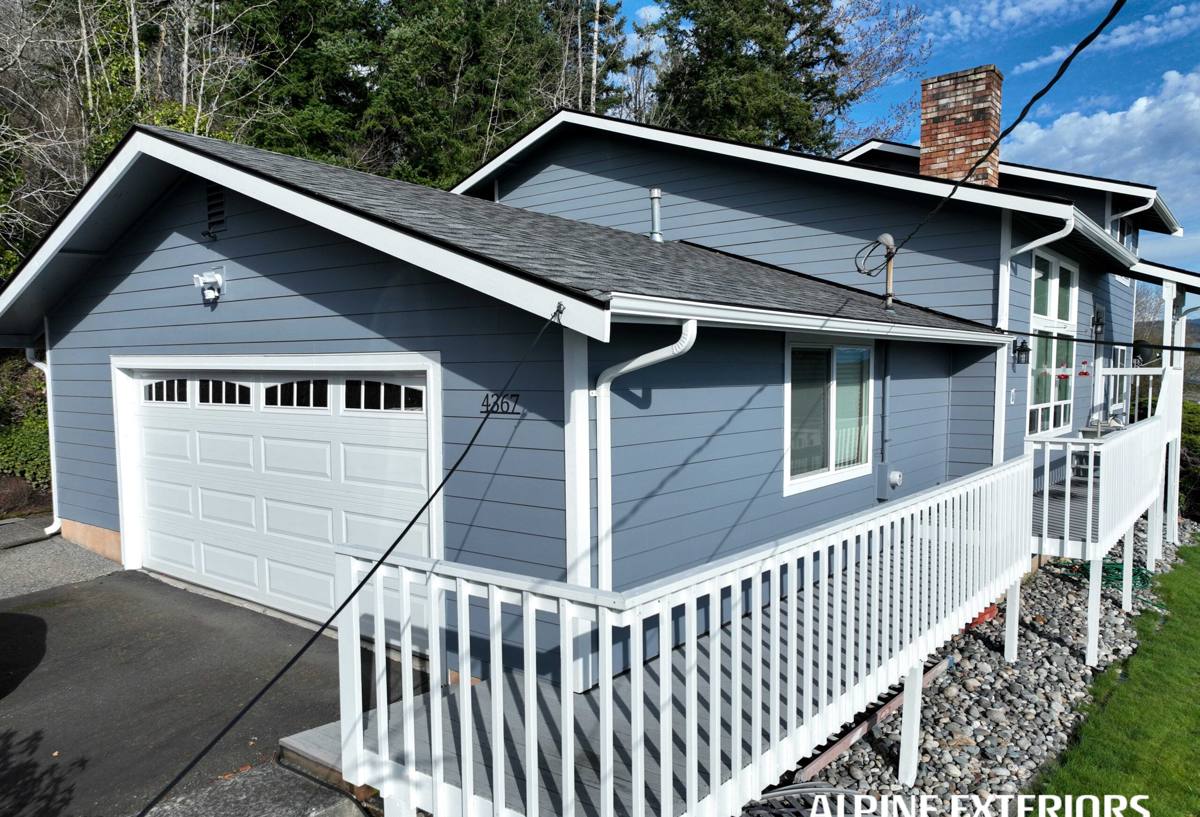
What Salt Air, Rain, and Moss Actually Do to a Shingle Roof
Salt Air
Airborne salt doesn't dissolve shingles, but it accelerates corrosion on every metal component tied into the roof system — nails, flashing, drip edge, vent stacks, and gutter hangers. Once a fastener starts to corrode, it loses grip and a shingle tab can work loose in the next windstorm. This is why fastener choice and flashing material matter more here than in a lot of other markets.
Wind-Driven Rain
Rain that comes in at an angle, rather than falling straight down, gets pushed up and under shingle tabs, into vent flashing laps, and along valleys and roof-to-wall transitions. A roof that would shed water fine in calmer conditions can leak here if the underlayment, valley work, and flashing details weren't built with sideways rain in mind.
Moss
Moss needs shade, moisture, and time — all three are common on north- and east-facing slopes under overhanging trees. Moss doesn't just look bad. As it grows, it lifts shingle edges, holds moisture against the roof deck, and works its way under tabs, which speeds up granule loss and shortens the life of the shingle underneath it.
What a Correct Asphalt Shingle Roof Looks Like Here
"Correct" for an Oak Harbor roof isn't just a matter of nailing shingles down in rows. It's a system, and every layer has to do its job for the whole roof to perform in this climate.
- Ice-and-water shield or a high-quality synthetic underlayment at eaves, valleys, and roof-to-wall transitions — the spots where wind-driven rain concentrates
- Corrosion-resistant fasteners and flashing, not the cheapest option that happens to pass inspection
- Balanced intake and exhaust ventilation, sized to the actual attic — not just a handful of vents added because the code requires "some"
- Shingles rated for high wind exposure, properly nailed to manufacturer spec (nail count and placement, not just "close enough")
- Algae-resistant (AR) shingle granules on any section with shade exposure or a history of moss and streaking
- Proper step flashing and counter-flashing at every wall intersection, chimney, and skylight — not roofing cement used as a substitute for flashing
Skip any one of these and the roof might still look fine for a year or two. The problems that show up on badly built roofs in this area — soft decking at the eaves, streaked and moss-covered north slopes, lifted tabs after a windstorm — almost always trace back to one of these details being shortcut during the original install.
Signs an Oak Harbor Roof Needs a Closer Look
Because this climate hides early damage well — a roof can look fine from the ground while the deck underneath is already softening — it helps to know what to actually watch for:
- Dark streaking or thick moss growth, especially on shaded or north-facing slopes
- Granules collecting in gutters or at downspout outlets
- Shingle tabs that look lifted, curled, or cupped, particularly after a windy winter
- Rust staining below vent stacks, flashing, or fasteners
- Soft or spongy spots when walking the roof, or sagging visible from a ladder
- Daylight or water stains in the attic near valleys, chimneys, or wall intersections
- A roof that's 18-22 years old and has never had underlayment or flashing replaced
Any one of these is worth a look. Several at once usually means it's time to plan a replacement rather than another round of patching.
Our Process for an Oak Harbor Roofing Project
The process itself isn't exotic — it's the attention at each step, in a climate that punishes shortcuts, that makes the difference.
- On-roof inspection. We walk the roof, check the decking condition from the attic side where possible, and look specifically at valleys, wall transitions, and shaded slopes for existing moss or rot damage.
- Honest scope and estimate. We tell you what we actually see — including if a partial repair is more sensible than a full replacement, or if deck repair will add to the cost.
- Tear-off and deck check. Old shingles come off down to the deck so we can inspect for soft or delaminated sheathing, which gets replaced rather than covered over.
- Underlayment and flashing. Ice-and-water membrane goes down at eaves, valleys, and penetrations first, followed by synthetic underlayment across the field, then new flashing and drip edge in corrosion-resistant material.
- Ventilation check. We confirm intake and exhaust ventilation are balanced for the attic's actual size and layout, adjusting or adding vents as needed.
- Shingle installation. Shingles go down per manufacturer nailing specs, with AR (algae-resistant) product used on any slope with shade or moisture exposure history.
- Final walk-through. We review the completed roof with you, cover warranty paperwork, and point out any maintenance items specific to your property's exposure.
Choosing a Shingle for This Climate
Not every shingle sold as "asphalt shingle" performs the same way in salt air and moss conditions. The table below is a general guide to how the common tiers compare for a roof in this area — actual products and pricing should be discussed against your specific roof during an estimate.
| Shingle Type | Typical Lifespan | Wind/Moisture Fit for This Area | Best For |
|---|---|---|---|
| 3-tab (standard) | 15-20 years | Lower wind rating; less algae resistance unless AR-treated | Budget-focused projects, outbuildings, low-exposure slopes |
| Architectural / dimensional | 25-30 years | Higher wind ratings, thicker mat, better moss/algae resistance with AR granules | Most Oak Harbor homes — the standard we recommend for full replacements |
| Premium / designer | 30+ years | Highest wind and impact ratings, strongest AR granule warranties | Homes with heavy tree cover, high wind exposure, or longer hold times before the next reroof |
We steer most Oak Harbor homeowners toward architectural shingles with an algae-resistant rating as the practical baseline. Standard 3-tab shingles without AR treatment tend to show moss and streaking faster on shaded slopes here, which means more maintenance and a shorter real-world lifespan even if the manufacturer's rated life looks similar on paper.
What Actually Drives the Cost
Two roofs of the same size can have very different price tags once the details are accounted for. The factors below are the ones that most often move the number up or down on a project in this area.
| Factor | Why It Matters Here |
|---|---|
| Roof pitch and access | Steeper roofs and limited ground access (common on Whidbey/Oak Harbor lots with tree cover or slopes) take longer and need more safety setup |
| Deck condition | Rot or soft sheathing found during tear-off has to be replaced before new shingles go down — this is the most common source of a mid-project cost change |
| Shingle tier | Architectural and premium shingles cost more up front but hold up better against moss, wind, and salt exposure |
| Flashing and ventilation scope | Full flashing and vent upgrades add cost but are what actually prevents the leaks and moss buildup this climate causes |
| Number of penetrations and valleys | Chimneys, skylights, and multiple valleys all add labor and detail work regardless of overall roof size |
Why Working With a Crew That Already Knows Oak Harbor Matters
A lot of roofing problems in this area aren't installation failures in the obvious sense — they're the result of a design built for a different climate. A crew unfamiliar with this coastline might spec a standard underlayment package where a heavier one is warranted, or skip AR shingles on a shaded slope because it wasn't flagged as a moss risk. A crew that regularly works Oak Harbor and the surrounding Whidbey Island and Anacortes area builds those details in as a default, not an upsell.
There's also a practical side: local scheduling around ferry and bridge traffic, familiarity with the wind exposure differences between a waterfront lot and a more sheltered inland one, and knowing which neighborhoods tend to have heavier tree cover and moss pressure. None of that shows up on a spec sheet, but it shapes how a roof should actually be built.
Getting the Most Life Out of a New Roof
Once a new asphalt shingle roof is installed correctly, a small amount of upkeep goes a long way in this climate:
- Clear moss buildup gently on shaded slopes before it spreads, rather than waiting until it's visibly thick
- Keep gutters clear so water isn't backing up under the eave edge during heavy rain
- Trim back overhanging branches to reduce shade and debris on north-facing slopes
- Have the roof looked at after any major windstorm, even if nothing looks obviously wrong from the ground
- Schedule a check-up every few years rather than waiting for a visible leak
If you're weighing a repair against a full replacement, or just want an honest read on where your current roof stands, we're happy to take a look. The estimate is free, there's no pressure either way, and you can use the form below to get started.