 Anacortes Exterior
 Why Burlington Roofs Take a Different Kind of Beating
Burlington sits inland from Anacortes and Fidalgo Island, but it still lives inside the same weather system: marine air moving off the Strait of Juan de Fuca and Puget Sound, funneled through the Skagit Valley. That means Burlington homes deal with a mix of coastal moisture and valley humidity — long stretches of low clouds, driving rain that comes in sideways during fall and winter storms, and enough salt-tinged air to slowly work on exposed metal fasteners and flashing over the years.
Then there's moss. Skagit County's mild, wet winters and shaded, tree-lined lots are close to ideal growing conditions for moss and algae. A roof that isn't detailed correctly — or isn't cleaned and inspected on any schedule — can go from a light green tint to a moisture-holding mat in a few seasons. Once moss gets a foothold under shingle tabs, it lifts them just enough to let wind-driven rain work its way underneath, which is where slow, hidden leaks usually start.
None of this means a roof in Burlington needs to be exotic or overbuilt. It means the installation details that get skipped on a "quick reroof" — proper underlayment, correct flashing, real ventilation, and moss-resistant material choices — matter more here than they would in a drier climate.
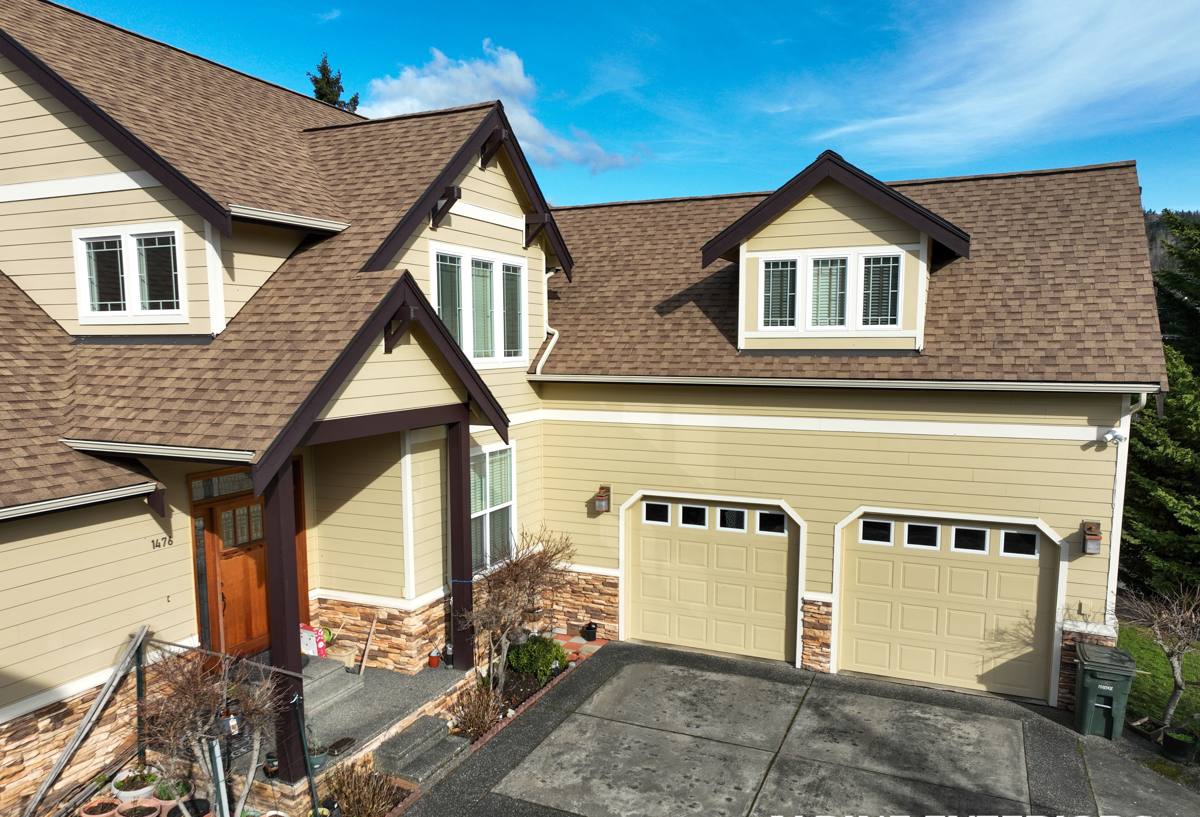
What a Correct New Roof Installation Actually Involves
It's Not Just Shingles
A new roof is a system, not a single product. The shingles or panels are the visible layer, but the parts underneath do most of the work of keeping a home dry through a Skagit County winter. A correct installation addresses each layer on purpose, not as an afterthought:
- Deck inspection and repair — any soft, delaminated, or water-stained sheathing gets replaced before anything new goes down, not covered over.
- Ice-and-water shield at eaves, valleys, and around penetrations, where wind-driven rain is most likely to force its way under the surface layer.
- Synthetic underlayment across the full deck as the real secondary water barrier — this is what protects the home if wind ever lifts or damages the roof covering itself.
- Metal flashing at chimneys, skylights, walls, and valleys, formed and installed so water sheds outward instead of being funneled toward a seam.
- Balanced ventilation — intake at the eaves and exhaust at the ridge, sized to the attic, so moist indoor air isn't trapped against the underside of the deck.
- Fasteners and edge metal rated for coastal-influenced conditions, since standard hardware corrodes faster with the salt content in this region's air and rain.
Skip any one of these and the roof can still look fine on install day. The failures show up two, five, or ten winters later — usually as a leak that seems to come from nowhere, when in reality it's been tracking along an underlayment gap or an under-flashed valley the whole time.
Choosing the Right Roofing System for a Burlington Home
There's no single "best" roofing material — the right choice depends on the home's roof pitch, tree cover, budget, and how much long-term maintenance the homeowner wants to take on. Here's how the common options compare for this climate specifically:
| Material | Moss & Moisture Behavior | Wind/Rain Performance | Maintenance |
|---|---|---|---|
| Architectural asphalt shingle | Good with algae-resistant granules; still needs periodic moss removal in shaded areas | Strong when properly nailed and sealed; wide range of wind ratings by product | Low to moderate — occasional cleaning, gutter checks |
| Standard 3-tab shingle | More prone to moss buildup; thinner profile holds less water off the surface | Lower wind rating than architectural shingles | Higher — shorter lifespan in this climate |
| Standing seam metal | Sheds moisture fast; very moss-resistant on steeper pitches | Excellent in driving rain and wind when seams and flashing are done correctly | Low — but installation quality is critical, since metal has little room for error at seams |
| Synthetic/composite shake | Doesn't absorb water like wood; resists rot | Good, product-dependent | Low to moderate |
For most Burlington homes, a well-detailed architectural asphalt shingle system offers the best balance of upfront cost, appearance, and performance against this region's rain and moss pressure. Metal earns its place on steeper roofs, homes under heavy tree cover, or for owners who want the lowest possible long-term maintenance and are comfortable with the higher installed cost. We'll walk through the honest trade-offs for your specific roof rather than pushing one product for every job.
A Note on Cedar Shake
Traditional wood shake has a real regional history here, but it also holds moisture longest of any common roofing material and needs the most consistent upkeep to resist moss and rot in a climate this wet. Our standard is to steer homeowners toward synthetic shake or architectural shingle products that give a similar look with far less long-term moisture risk — that's a maintenance and moisture-management call, not a knock on anyone who prefers the traditional material.
Ventilation: The Part of the Roof You Never See
Attic ventilation gets overlooked constantly, and it's one of the biggest factors in how long a new roof actually lasts in Skagit County. Warm, moist air from the living space rises into the attic. Without a clear path in at the eaves and out at the ridge, that moisture condenses against the cold underside of the roof deck — especially during the long stretches of damp, low-temperature weather typical of a Burlington winter.
Over time, trapped moisture can rot decking from the inside, feed mold growth, and shorten the life of the roofing material itself by cooking it from beneath in summer and soaking it from beneath in winter. Correct ventilation isn't an upsell — it's part of doing the installation right, and we size and balance it as part of every new roof.
Our Installation Process
We run the same disciplined process on every Burlington roof, adjusted for the home's specific layout and roof pitch:
- On-site assessment — we walk the roof, check the attic for existing ventilation and moisture signs, and confirm what's actually under the current roofing before quoting anything.
- Written scope and material selection — a clear breakdown of what's being removed, what's being installed, and why, so there are no surprises mid-project.
- Tear-off and deck inspection — old material comes off down to the sheathing, and any damaged decking is identified and replaced.
- Underlayment and flashing installation — ice-and-water shield, synthetic underlayment, and all flashing go in before a single shingle or panel is installed.
- Roofing installation — installed to manufacturer specification for nailing pattern, exposure, and sealing, which is what actually earns the material warranty.
- Ventilation tie-in — intake and exhaust vents installed or upgraded and checked for balance.
- Cleanup and final walkthrough — magnetic sweep for nails, debris removal, and a walk-through so the homeowner sees the finished work and understands what was done.
Permits, Codes, and Warranty Structure
New roof installations in Skagit County typically require a building permit, and code requirements around ice-and-water shield placement, ventilation, and fastening are there for a reason in a climate like this — they're the minimum spec, not the ceiling. We handle the permitting process as part of the job so homeowners aren't left tracking down inspections themselves.
Warranty coverage on a new roof is really two separate things: the manufacturer's material warranty, and the installer's workmanship warranty. A material warranty only holds up if the installation followed the manufacturer's exact specifications — which is one more reason installation quality matters as much as the product chosen. We're upfront about what's covered by the manufacturer versus what's covered by our own workmanship guarantee before work starts.
Signs a Burlington Home May Need a New Roof
Not every roof problem means full replacement — but these are the signs worth having checked before a small issue becomes a deck-level repair:
- Shingles that are cupping, cracking, or losing significant granule coverage
- Moss or algae buildup that returns quickly after cleaning
- Daylight visible through the roof deck from inside the attic
- Soft spots or sagging visible along the roofline
- Recurring leaks near valleys, chimneys, or skylights despite past patch repairs
- A roof approaching or past the expected lifespan of its material
- Rising energy bills that may point to attic moisture or failing ventilation
Why Hiring a Crew That Already Works in Burlington Matters
Roofing crews that work this part of Skagit County regularly aren't guessing at conditions — they know which roof orientations take the worst of the driving rain, which lots hold onto moss because of tree cover and shade patterns, and how to sequence a tear-off around the region's unpredictable rain windows so a home's interior is never left exposed overnight. That local familiarity shows up in small decisions throughout the job: where extra flashing attention pays off, how much ventilation a given attic actually needs, and which material choices hold up versus which ones look fine on day one and struggle by year five.
It also matters for logistics — permit familiarity with the local jurisdiction, knowing reliable material suppliers who can get product to the site on schedule, and understanding how weather timing works in this specific corner of the county rather than applying generic scheduling from a drier climate.
Get a Straightforward Estimate
If your Burlington home needs a new roof — or you're not sure whether it does yet — we're happy to take a look and give you a clear, no-pressure assessment of what we find and what it would take to do the job right. Use the form below to request a free estimate.