 Anacortes Exterior
 Building New in Ship Harbor Means Building for the Water
Ship Harbor sits close enough to the water that every new home going up here has to answer to the same conditions: salt-laden air off Rosario Strait and the Guemes Channel, wind-driven rain that doesn't fall straight down, and a wet season long enough that moss and algae get a real foothold on anything that stays damp too long. When you're framing a new home or a major addition in this part of Anacortes, the windows aren't just a finish item picked from a catalog at the end of the job. They're a structural and moisture-management decision that either gets baked in correctly during rough framing, or gets fought over for the next twenty years.
New construction is actually the best time to get this right. Unlike a retrofit into an existing wall, a new build lets us set flashing, sheathing, and window selection up together from the start, so the whole assembly works as one system instead of a window fighting the wall around it. That's the opportunity — and the risk if it's rushed.
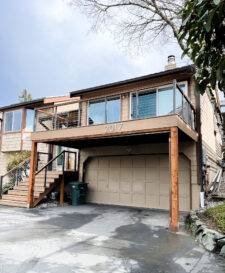
What Ship Harbor's Exposure Actually Does to a Window Assembly
Skagit County building code sets minimum standards for wind and moisture, but "meets code" and "built for a waterfront-adjacent lot" aren't always the same thing. A few things we watch for specifically in this area:
Salt air and hardware corrosion
Airborne salt accelerates corrosion on fasteners, hinges, cranks, and unprotected metal flashing. It's not usually dramatic — it's a slow degrading of hardware and finish over years, and it hits homes closer to the shoreline harder than those set back or shielded by trees and terrain.
Driving rain, not just rainfall totals
Wind off the water pushes rain sideways into wall assemblies, which is a different load than rain falling straight down. A window that would perform fine in a sheltered inland lot can leak here if the flashing details, sill pan, and water-resistive barrier integration aren't built for wind-driven water intrusion specifically.
Moss and biological growth
Long damp seasons mean anything that stays wet — shaded frames, poorly drained sills, north-facing trim — will grow moss and algae over time. That's mostly a maintenance and appearance issue rather than a structural one, but it's a strong argument for materials and details that shed water and dry out quickly rather than trapping moisture against the frame.
Getting the Rough Opening Right Before the Window Ever Shows Up
On a new build, most window failures we get called out to fix elsewhere started in the framing stage, not the window itself. The rough opening, the flashing sequence, and the sill pan all have to be right before the window is set, because once siding and interior finish go on, correcting a bad detail means tearing back into a finished wall.
A correct new-construction install, in this climate, generally includes:
- A sloped or pre-formed sill pan that directs any water that gets past the window back outside the wall, not down into the framing
- Flashing tape or self-adhered membrane integrated with the water-resistive barrier in the correct shingle-lap order — sill, jambs, then head — so water is always directed downward and outward
- Head flashing that extends past the jamb flashing and ties into the barrier above the opening
- Proper shimming and fastening so the frame stays square and doesn't rack under wind load, which is what causes seal failure at the corners over time
- Continuous, gap-free sealant at the exterior perimeter, paired with an air seal on the interior side — both matter, and they're not the same joint
- Backer rod and sealant sized correctly rather than sealant alone bridging a gap it wasn't designed for
None of this is exotic. It's just easy to skip steps when a crew is moving fast on a schedule, and the consequences don't show up until the first hard wind-driven rain a year or two later.
Window Materials That Hold Up Near Ship Harbor
We don't push one brand as the only answer, but material choice does matter more here than it would on a sheltered inland lot. The honest trade-offs:
| Material | How it handles salt air and moisture | Maintenance | Typical use case here |
|---|---|---|---|
| Vinyl | Won't corrode; performs well against salt exposure | Low — occasional cleaning | Strong value choice for most new-construction homes in the area |
| Fiberglass | Very stable dimensionally, holds paint well, resists corrosion | Low to moderate | Homes wanting a painted or specific color finish with long-term stability |
| Wood-clad | Exterior clad protects the wood, but any breach in the cladding lets moisture reach the wood core | Higher — depends on cladding integrity | Homes prioritizing interior wood aesthetic, away from direct salt spray |
| Aluminum (non-thermally-broken) | Conducts cold and can condense; standard aluminum hardware is more exposed to corrosion over time | Moderate | Generally not our first recommendation for exposed Ship Harbor lots unless thermally broken and marine-rated hardware is specified |
For homes with direct, unshielded exposure toward the water, we lean toward vinyl or fiberglass with corrosion-resistant hardware as the practical, lower-maintenance choice. That's a professional judgment based on maintenance burden and moisture behavior over time — not a claim that other materials can't be made to work with the right detailing and upkeep.
Glazing and Orientation for This Site
New construction gives you a rare chance to plan glazing by orientation instead of installing the same package everywhere. Homes with a water view often want larger glass facing west or north toward the strait, which is exactly the exposure that takes the most wind-driven rain and the most UV and glare off open water. On those elevations we typically discuss:
- Higher-performance low-E glass to manage solar heat gain and glare off the water
- Impact-resistant or heavier-gauge glass on faces most exposed to wind-borne debris
- Slightly deeper reveal or overhang detailing where the design allows it, to reduce direct wind-driven rain contact with the glass and frame
None of this changes the fundamentals of a correct install — it just means the highest-exposure windows in the house deserve the most attention during flashing and sealing, not an afterthought.
Cost Factors Worth Understanding Up Front
Every new-construction window job is priced around the same handful of variables. Knowing them ahead of time makes it easier to compare quotes honestly.
| Factor | Why it moves the price |
|---|---|
| Window count and size | Larger openings and more units mean more material, more flashing detail, and more labor hours |
| Material and glazing package | Vinyl, fiberglass, and upgraded low-E or impact glass carry different unit costs |
| Exposure and elevation | West- and north-facing, water-exposed elevations may warrant upgraded flashing details and hardware |
| Access and building stage | Coordinating with framers, siders, and other trades on an active job site affects scheduling and labor |
| Custom shapes or sizes | Non-standard openings require custom units, which cost more and take longer to order |
We won't quote a job without seeing the plans or the framed openings, but these are the honest levers that move a bid up or down, and we'll walk through them plainly rather than leaving them as a single lump-sum number.
Our New-Construction Window Process
On a build in this area, our process is built around catching problems before they're buried in the wall:
- Plan review: we look at window schedules, elevations, and exposure before ordering anything
- Rough opening verification: we check openings for square, level, and correct size before the window ever arrives on site
- Sill pan and flashing installation: done in the correct sequence, tied into the water-resistive barrier
- Window setting and fastening: shimmed, squared, and fastened per manufacturer instructions to keep warranty intact
- Head flashing and barrier integration: completed before siding closes the wall up
- Interior and exterior sealing: both air seal and weather seal, checked separately
- Final walkthrough: operation, seal, and fit checked before we consider the opening closed out
We coordinate directly with framers, siders, and general contractors so the window step doesn't hold up the schedule or get rushed to keep it moving.
A Pre-Drywall Checklist Worth Doing on Any New Build Here
Whether we're your window contractor or not, this is worth confirming before the walls close up on a Ship Harbor-area build:
- Sill pan is present and sloped to drain outward, not toward the framing
- Flashing tape is lapped sill-to-jamb-to-head, in that order, with no reverse laps
- Head flashing extends beyond the jamb flashing on both sides
- No gaps or fishmouths in the flashing tape at corners
- Window is shimmed square and plumb, not just tight to the rough opening
- Exterior sealant joint is continuous with no visible voids
- Interior air seal is separate from, and in addition to, the exterior weather seal
If a crew balks at showing you this before it's covered up, that's worth asking about directly.
Why Local Experience in Ship Harbor Matters
Anacortes and Skagit County code officials expect certain details on wind and moisture exposure, and inspectors here have seen enough sideways-rain leaks to look closely at flashing sequencing on new builds near the water. A crew that works this specific area regularly already knows which elevations need the extra attention, what the local inspectors want to see, and how salt air behaves on hardware and finishes over a few winters — not just what a manufacturer's install sheet says in general. That local pattern recognition is the difference between a window that's dry in year one and one that's still dry in year ten.
If you're framing a new home or planning window selection for a build in the Ship Harbor area, we're glad to walk the plans or the site with you and put together a straightforward, no-pressure estimate — no invented urgency, just an honest look at what your specific openings and exposure need. The form below is the easiest way to get that started.