 Anacortes Exterior
 Why Siding Wears Out Faster on Mount Vernon Homes
Homes in and around Mount Vernon sit in a stretch of Skagit County that gets hit from two directions at once. Moist air drifts in off the Salish Sea and the Skagit River delta, and the same low-pressure systems that bring driving rain off the water also keep humidity high for weeks at a time. That combination is hard on exterior materials in a way that drier inland climates never have to deal with.
Three things do most of the damage over time: salt-laden air that accelerates corrosion of fasteners and finishes, wind-driven rain that gets pushed sideways into seams and laps instead of simply running down the wall, and a moss and algae season that can run eight or nine months out of the year on shaded, north-facing walls. None of these are exotic problems — they're just constant, and constant is what wears siding down.
A siding system that's marginal in a milder climate can fail outright here. That's the lens we use when we talk to Mount Vernon homeowners about a replacement: not "what looks good on day one" but "what still looks good and still keeps water out after fifteen winters of this."
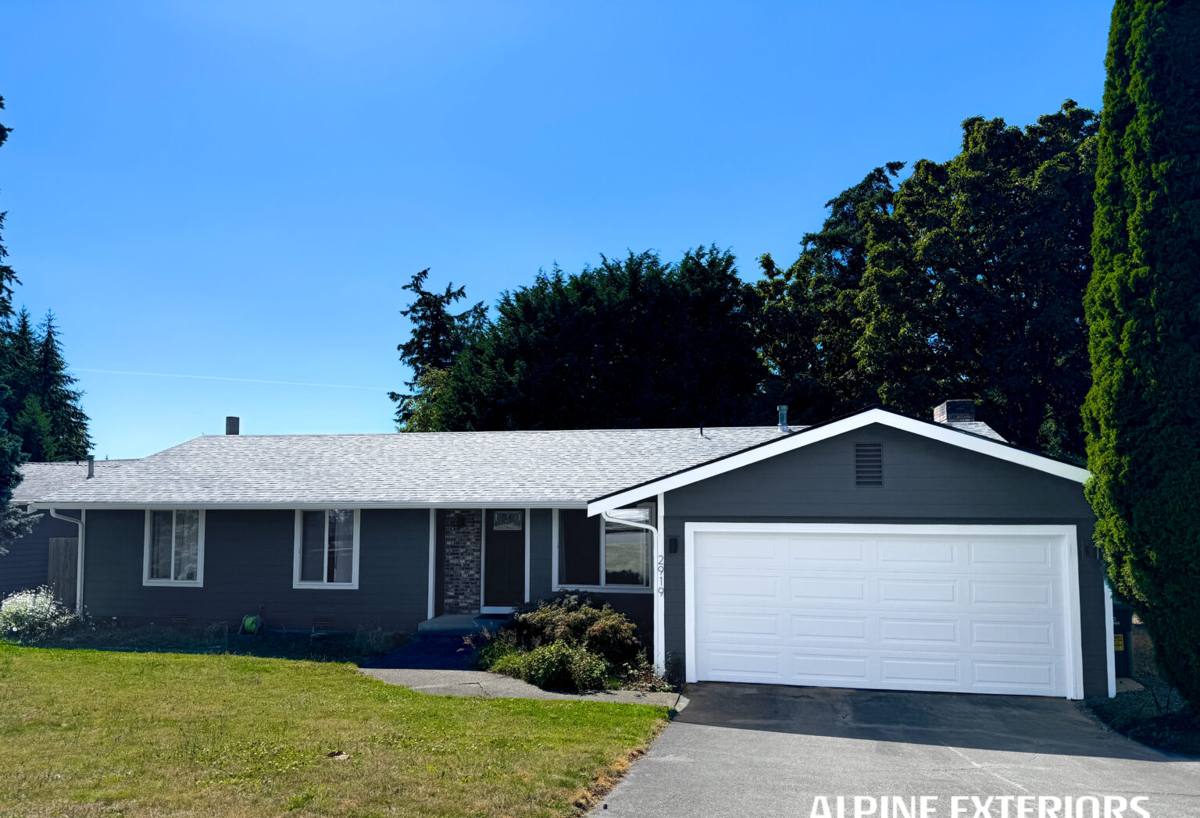
Signs a Mount Vernon Home Needs Siding Replacement, Not Just Repair
Not every siding problem calls for a full tear-off. But there's a point where patching becomes a losing game, especially once moisture has gotten behind the cladding. Here's what we look for during an inspection:
- Soft or spongy spots when you press on the siding, especially near the bottom courses and around window and door trim
- Paint that's bubbling, peeling, or failing repeatedly in the same spots year after year
- Persistent moss or algae growth that comes back within a season or two of cleaning
- Visible gaps, warping, or buckling in lap siding, particularly on the sides of the house that take the most weather
- Rust streaking from fasteners or trim, a common sign in areas with salt-influenced air
- Rot or staining at the bottom of walls, around hose bibs, or wherever siding meets a deck, porch, or roofline
- A musty smell in an interior room that shares a wall with visibly compromised siding
If you're seeing two or more of these, especially the soft-spot or musty-smell combination, it's worth a real inspection rather than another round of caulk and paint.
Why We Install Only James Hardie Fiber Cement
We've made a deliberate call as a company: James Hardie fiber cement is the only siding system we install. Not because every alternative is bad, but because after years of working on homes in this climate, the trade-offs of other products — vinyl's expansion and impact issues, engineered wood's sensitivity to sustained moisture, unfinished wood's ongoing maintenance demand — aren't ones we're willing to put our name behind in a place that stays wet as long as Mount Vernon does.
Fiber cement is non-combustible, holds paint and factory finish far longer than wood-based products, and doesn't swell or rot the way organic materials can when they take on moisture repeatedly. James Hardie's ColorPlus factory finish is baked on and warrantied against fading and peeling, which matters a lot on a coastal-influenced house that gets more sun-and-rain cycling than most inland siding ever sees. We'd rather install one product correctly and stand behind it than offer five options and hope one of them holds up.
What Correct Installation Actually Requires
James Hardie siding performs the way it's rated to perform only when it's installed to the manufacturer's specification — and that's true everywhere, but it matters more in a wet climate where mistakes get exploited by water instead of just sitting there looking wrong. Correct installation isn't optional detail work; it's the difference between a 30-year siding job and a 10-year one.
That means proper clearance between siding and grade, decks, and roofing; correctly lapped and integrated water-resistive barrier and flashing at every window, door, and penetration; fastener placement and spacing that matches Hardie's published specs; and factory-cut or properly sealed field cuts so raw edges aren't left exposed to weather. Skipping any one of these doesn't usually show up in year one. It shows up in year five, as a soft spot behind a window that nobody thought to check.
What a Full Siding Replacement Involves
A real replacement is more than swapping old boards for new ones. Here's the sequence we follow on every job:
- Full removal of the existing siding and trim, not just the visibly damaged sections
- Inspection of the sheathing underneath for rot, soft spots, or mold, with any compromised material repaired or replaced before anything new goes up
- Installation of a new water-resistive barrier, properly lapped from the bottom up so water sheds outward at every seam
- Flashing at all windows, doors, and penetrations, integrated with the barrier rather than just caulked over the top
- Installation of James Hardie panels, lap siding, or trim to manufacturer spec, including fastener type, spacing, and clearances
- Caulking and sealing at transitions, followed by a final inspection walk-through with the homeowner
Skipping the sheathing inspection is one of the most common shortcuts in this trade, and it's the one that costs homeowners the most down the road. If there's hidden rot and it just gets covered up with new siding, you've paid for a cosmetic fix on a structural problem.
Choosing the Right Hardie Product for a Mount Vernon Home
James Hardie makes several product lines, and the right one depends on the home's style and exposure, not just personal taste.
| Product | Best Suited For | Why It Fits This Climate |
|---|---|---|
| HardiePlank Lap Siding | Most single-family homes, traditional and modern styles | Classic look, wide color range, strong moisture resistance in horizontal lap form |
| HardiePanel Vertical Siding | Modern designs, accent walls, gable ends | Fewer horizontal laps means fewer joints for wind-driven rain to work into |
| HardieShingle | Craftsman and cottage-style homes | Textured look without the ongoing maintenance of real wood shingle in a wet climate |
| HardieTrim | Corners, window and door surrounds, fascia | Matches the siding's rot resistance so trim doesn't become the weak point |
We also spec siding using James Hardie's climate-engineered HZ5 formulation, built for regions that deal with both sustained rain and periodic freeze-thaw swings — which describes a typical Skagit County winter well.
Cost Factors for a Siding Replacement in Mount Vernon
Every home is different, so we won't quote a number without seeing the house, but the main variables that move the price are consistent:
| Factor | Why It Matters |
|---|---|
| Home size and wall complexity | More corners, gables, and dormers mean more cutting, flashing, and labor time |
| Extent of hidden damage | Rotted sheathing found during tear-off adds repair scope before new siding can go on |
| Product line and profile | Lap siding, panel, and shingle profiles carry different material and install costs |
| Trim and detail work | Custom trim around windows, corners, and rooflines adds time versus a simple box shape |
| Access and site conditions | Tight lots, mature landscaping, or multi-story walls affect staging and labor |
We give every Mount Vernon homeowner a written estimate that breaks these factors down, so there's no guessing at what's driving the number.
How Our Process Works, Start to Finish
We start with a walk-around inspection to assess the current siding, check for hidden moisture damage, and talk through what the homeowner wants out of the project. From there we provide a detailed written estimate covering product selection, scope of work, and timeline. Once a job is scheduled, we handle tear-off, sheathing repair as needed, barrier and flashing installation, and the Hardie installation itself, followed by a final walk-through so you can see the completed work and ask questions before we call it done.
We keep the site reasonably clean throughout and communicate directly if we find something during tear-off that changes the scope — no surprise change orders after the fact.
Why Hiring a Crew That Already Works Skagit County Matters
A siding crew that mostly works drier inland climates can install a technically correct job on paper and still get the details wrong for a place like Mount Vernon — under-flashing a window that takes direct wind-driven rain, or not accounting for how long a north wall stays damp under tree cover. Crews who work Skagit County regularly know which walls need extra attention, how local moss growth behaves, and what the salt-influenced air does to unprotected fasteners and trim over time. That local pattern recognition doesn't show up in a spec sheet — it shows up in whether the job still looks right in year ten.
If your Mount Vernon home's siding is showing its age, or you just want an honest read on whether repair or replacement makes sense, we're happy to take a look. Reach out for a free, no-pressure estimate using the form below.