 Anacortes Exterior
 Siding Built for the Skagit Valley, Not Just the Coast
Mount Vernon sits inland along the Skagit River, which means it doesn't take the direct salt spray that homes right on the water in Anacortes deal with. But don't mistake that for an easy climate. The Skagit Valley traps moisture — river fog, low clouds, and long stretches of steady rain move through and settle in, and that dampness lingers on north-facing walls, under eaves, and behind anything that isn't installed with real drainage in mind. Add a moss season that can run most of the year in shaded spots, and you've got a climate that's just as hard on siding as anywhere else in the county, just in a different way.
We're based out of Anacortes and work Mount Vernon regularly, which matters more than it sounds like it should. A siding system that holds up on a windy bluff overlooking the water and a siding system that holds up on a shaded lot near the river need the same core principles — proper flashing, a real water-resistive barrier, correct fastening — but the details of where moisture collects, how much shade a wall gets, and how long surfaces stay wet after a storm shift from block to block. Knowing the area isn't a nice-to-have. It's part of doing the job right.
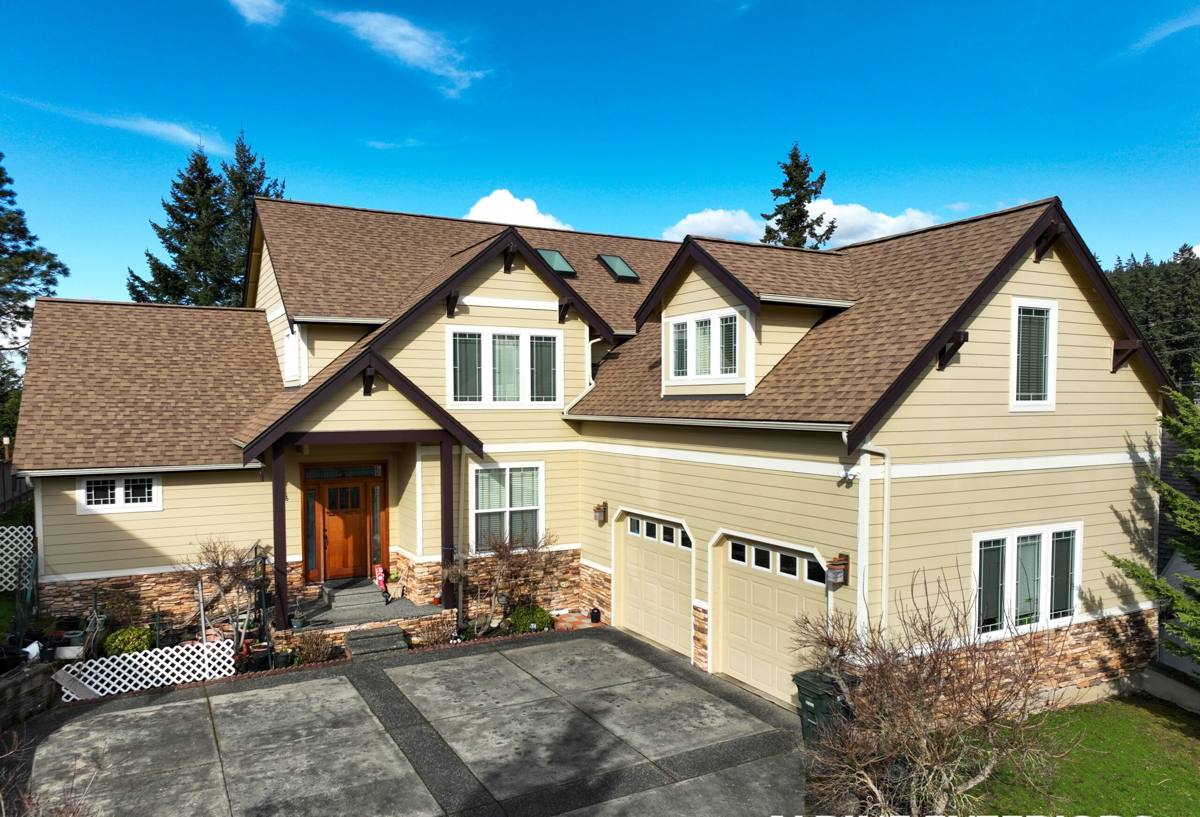
What Mount Vernon's Climate Actually Does to Siding
Moisture That Doesn't Leave
Valley towns like Mount Vernon get more still, humid air than exposed coastal spots. Wind off the water in Anacortes at least helps siding dry out between rain events. Inland, on a calm, overcast week — which the Skagit Valley gets plenty of — walls can stay damp for days. That's exactly the condition that lets moss, algae, and mildew take hold, and it's exactly the condition where a poorly sealed siding system starts trapping water instead of shedding it.
Moss and Organic Growth
Mount Vernon's tree cover and shaded lots give moss a long runway. Once it establishes on a wall, it holds moisture against the surface around the clock, which accelerates rot in wood-based products and stresses paint film on anything not factory-finished. Moss doesn't just look bad — it changes how much moisture your siding is exposed to, every single day it's there.
Driving Rain and Wind-Driven Water
The valley still gets its share of wind-driven storms, especially in the fall and winter months, and driving rain finds every gap in a siding system — unsealed joints, poorly lapped flashing, caulk that's failed. Where that water goes once it's behind the siding is the whole ballgame.
What a Correct James Hardie Installation Actually Involves
James Hardie fiber cement is a genuinely strong material for this climate — it doesn't rot, it doesn't feed moss the way organic materials can, and it holds paint (or in our case, factory finish) far longer than wood-based siding. But the material is only half the equation. Most siding failures we see, on any brand, trace back to installation shortcuts, not the product itself. A correct install includes:
- A continuous, properly lapped water-resistive barrier (WRB) behind the siding — not just housewrap stapled up and forgotten
- Correct flashing at every window, door, and roof-to-wall transition, installed so water is directed out, not trapped behind the cladding
- Manufacturer-specified gaps and clearances — siding held off decks, roofs, and grade by the distance James Hardie requires, so splash-back and standing water don't sit against the bottom edge
- Fasteners set to the correct depth and pattern, not overdriven (which cracks the board's protective seal) or underdriven (which lets the board move and fail early)
- Field-cut edges properly primed and sealed before installation, since factory finish only protects the surfaces it was applied to
- Caulking used correctly at butt joints and penetrations — not as a substitute for proper flashing, but as a secondary line of defense
Skip any one of those steps and you can end up with water intrusion behind a material that's otherwise nearly immune to it. That's the irony of fiber cement done wrong — the siding survives, but the wall behind it doesn't.
Picking the Right Hardie Line for a Mount Vernon Home
James Hardie makes climate-specific product lines, and for Western Washington that means the HZ5 line, engineered for wetter, moisture-heavy regions rather than dry or freeze-heavy climates. HZ5 is formulated and warranted for exactly the kind of prolonged damp conditions the Skagit Valley produces. Beyond the base product, ColorPlus factory finish is worth taking seriously here specifically because of the moss and moisture issue — a factory-baked finish resists the chalking, peeling, and mildew staining that field-applied paint struggles with over time in a climate that rarely lets a wall dry out completely.
Board profile matters too. Lap siding sheds water differently than panel systems, and homes with heavy shade or tight clearances to landscaping benefit from choices that don't create extra ledges for moisture and debris to sit on. We walk through these options on-site because the right call depends on your home's exposure, not a one-size answer.
How James Hardie Compares for This Climate
| Factor | James Hardie Fiber Cement | Vinyl Siding | Wood / Cedar |
|---|---|---|---|
| Moisture & rot resistance | Does not rot; engineered for wet climates (HZ5) | Won't rot itself, but traps moisture behind it if installed poorly | Absorbs moisture; prone to rot without constant upkeep |
| Moss & algae resistance | Non-organic surface; factory finish resists growth | Can host algae/mildew in shaded, damp spots | Organic material; feeds moss and mildew readily |
| Finish longevity | ColorPlus factory finish, long warranty coverage | Color molded in but can fade/chalk; can't be refinished easily | Requires repainting or restaining every few years |
| Fire resistance | Non-combustible | Combustible, can melt/warp near heat | Combustible |
| Ongoing maintenance | Periodic wash; repaint far less often | Low upkeep but limited repair options | Regular sealing, staining, and moss/rot inspection |
This is why we standardized on James Hardie rather than offering a menu of siding materials. In a climate like ours, the material's ability to handle sustained moisture without feeding organic growth isn't a marketing point — it's the whole reason a siding job lasts.
Our Process for a Mount Vernon Siding Job
1. On-Site Assessment
We look at your home's specific exposure — shade patterns, drainage around the foundation, existing moisture damage, and how the current siding has held up — before recommending a product line or scope of work.
2. Tear-Off and Inspection of What's Underneath
Old siding comes off so we can actually see the sheathing and framing underneath. This is where hidden rot or past water damage shows up, and it needs to be addressed before new siding goes on, not covered up by it.
3. Weather Barrier and Flashing
We install a continuous water-resistive barrier and correct flashing at every penetration and transition. This step, more than the siding itself, determines whether your walls stay dry over the next few decades.
4. James Hardie Installation to Spec
Boards are installed with manufacturer-specified clearances, fastening, and joint treatment — the details covered above, done consistently across the whole home, not just the visible parts.
5. Final Walkthrough
We go over the finished work with you, including how to care for factory-finished siding and what to watch for seasonally in a climate like this one.
Why It Matters That We Already Work in Mount Vernon
A crew that only occasionally works this area is guessing at things a local crew already knows — how Skagit County permitting and inspections typically run, which weeks of the year give you the best install window before the valley's rainy stretches set in, and what moisture and moss patterns actually look like on homes here versus on the water in Anacortes. We schedule Mount Vernon projects around real seasonal weather windows, not just whenever a crew happens to be free, because a fiber cement install done in the wrong conditions — driving rain, saturated framing — is harder to get right no matter how good the material is.
Signs Your Current Siding May Be Failing
Not sure if you're due for a replacement versus a repair? These are the signs worth taking seriously in this climate:
- Soft or spongy spots when you press on the siding, especially near the bottom edge or under windows
- Persistent moss or dark staining that comes back shortly after cleaning
- Paint that's peeling, bubbling, or chalking heavily rather than just fading evenly
- Visible gaps, warping, or boards pulling away from the wall
- Musty smells or moisture signs on interior walls that back up to exterior siding
- Siding that's original to a home built more than 20-25 years ago, especially wood-based products
Any one of these on its own might just need attention. Several together usually mean the siding system as a whole is past the point where patching makes sense.
What Homeowners Should Ask Any Siding Contractor
Whether you go with us or not, ask any contractor bidding your Mount Vernon siding job these questions before you sign anything: what water-resistive barrier and flashing details they use, whether they're installing to the manufacturer's specific fastening and clearance requirements, how they handle field-cut edges, and whether their crew — not just a subcontractor — has experience with the product they're proposing. The answers tell you a lot more than the price does.
If your Mount Vernon home's siding is showing its age, or you're planning a replacement and want it done right the first time, we're happy to take a look and walk you through what we'd recommend — no pressure, no obligation. Use the form below to request a free estimate.