 Anacortes Exterior
 Why La Conner Roofs Take a Different Kind of Beating
La Conner sits low and close to the water, right where Skagit County's tidal flats meet open channel winds. That location is part of what makes it beautiful, and part of what makes roofs there wear differently than roofs ten miles inland. Storms coming off the water bring driving, sideways rain rather than straight-down rain, which means water gets pushed up under shingle edges and into flashing laps that were never designed to handle horizontal pressure. Add in salt-laden air that accelerates corrosion on nails, flashing, and vent metal, and you have a roof that can look fine from the ground while quietly failing at the details.
Then there's moss. Western Washington's long, wet, mild-temperature season is close to ideal moss-growing weather, and La Conner's marine humidity keeps roofs damp longer after storms than homes in drier parts of Skagit County. Moss holds moisture against shingles, lifts tabs as it grows, and works its way under flashing over a season or two. A roof that took wind damage in a storm and already has moss establishing itself is a roof that fails faster than either problem would cause on its own.
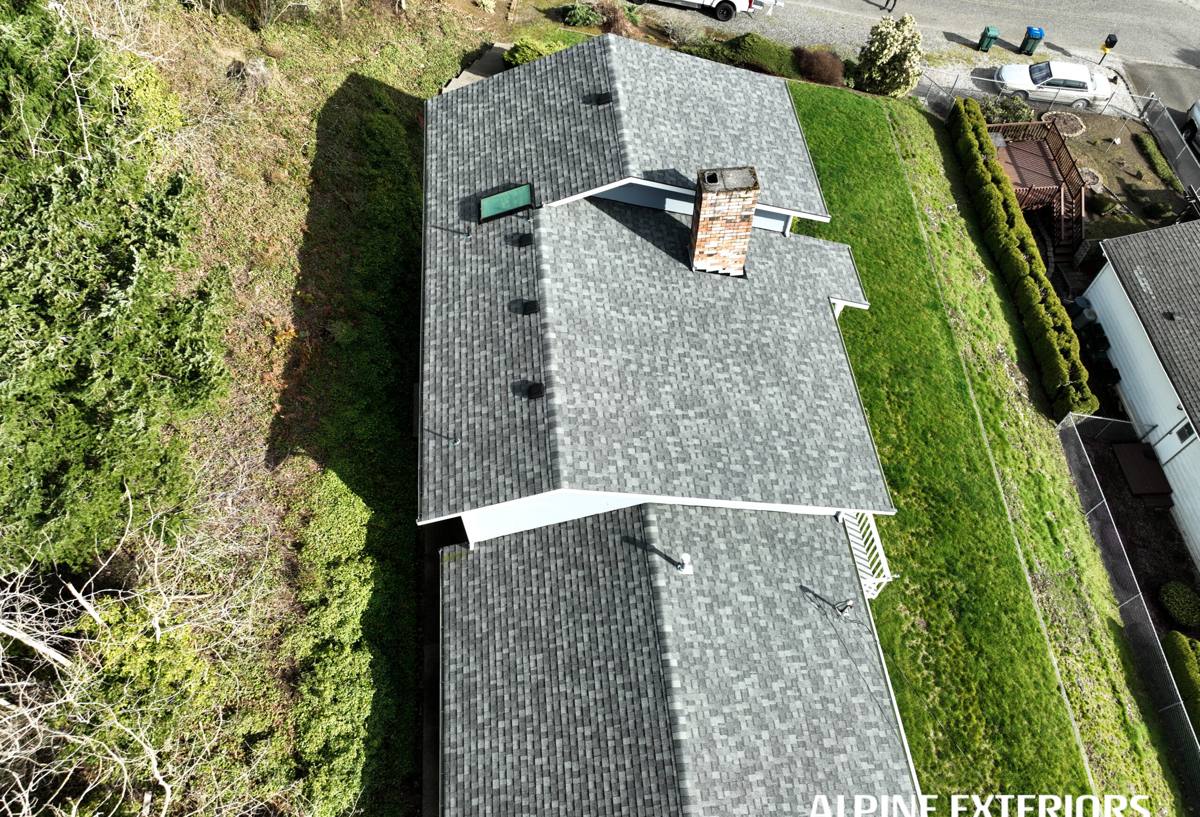
What Storm Damage Actually Looks Like on a Skagit County Roof
Homeowners often picture storm damage as a dramatic hole or a pile of shingles in the yard. Most real storm damage is quieter than that, and it's the quiet kind that causes the expensive problems later.
- Lifted or creased shingle tabs — wind gets under the edge and breaks the seal without tearing the shingle off, so it looks intact but no longer sheds water properly.
- Flashing pulled loose around chimneys, skylights, and roof-to-wall transitions — the most common source of an interior leak after a windstorm.
- Granule loss from wind-driven debris or hail, which shows up as bald patches and accelerates shingle aging even if no leak develops right away.
- Punctures or splits from branches or debris carried by wind — small, but they let water straight into the deck.
- Moss-weakened areas that give way under wind load where a clean roof would have held.
None of these require a "big" storm. A steady 40-mph blow off the water can do more damage to a roof with existing moss or aging flashing than a short, violent gust does to a well-maintained one.
Why Waiting Costs More Than the Repair
A lifted shingle or a pulled flashing seam doesn't leak every time it rains — only when wind direction, rain intensity, and roof pitch line up. That inconsistency is exactly why storm damage gets ignored. The homeowner doesn't see water in the house for weeks or months, so it doesn't feel urgent, right up until it does. By the time water is visibly staining a ceiling, it has usually been getting into the decking or insulation for a while, and the repair has grown from "replace a section of shingles and reseal flashing" to "replace decking, insulation, and possibly interior drywall."
In a marine climate like La Conner's, that timeline compresses. Constant humidity means wood that gets wet doesn't fully dry between rain events, so rot and mold set in faster than they would in a drier inland climate.
What a Correct Storm Repair Actually Involves
Inspection Before Assumptions
A proper storm repair starts on the roof, not on a clipboard. That means checking the deck for soft spots, pulling back shingles near suspected damage to look at the underlayment, and inspecting every flashing point — not just the area the homeowner pointed to. Storm damage rarely announces itself at just one spot; wind that lifted shingles on one slope usually stressed flashing elsewhere on the same roof.
Matching Materials, Not Just Patching Them
Shingle color runs change over time, and a mismatched patch is both a cosmetic problem and a resale issue. Where an exact match isn't available, the right call is to blend the repair into a less visible slope or be upfront with the homeowner about the mismatch rather than hide it.
Flashing Gets Rebuilt, Not Recaulked
Caulk is a maintenance item, not a repair. If flashing was pulled loose by wind, it needs to be reset or replaced with proper laps and fasteners so it sheds water the way it was designed to — not sealed over with a bead of sealant that will fail again in a year or two.
Ventilation Gets Checked, Not Ignored
A storm repair is a good moment to confirm the attic is venting properly. Poor ventilation traps moisture that has already gotten past the roofline, and it's a major contributor to the moss and mildew growth that's already an uphill fight in this climate.
Our Process for La Conner Storm Repairs
- Free on-site inspection. We walk the roof (not just the ground), document what we find with photos, and identify every affected area, not just the obvious one.
- Clear, written scope. You get a plain-English explanation of what's damaged, what's simply worn, and what actually needs repair versus what can wait.
- Insurance documentation, if needed. If the damage is claim-worthy, we provide the photo and material documentation your adjuster will ask for. We don't handle the claim for you, but we make sure you're not walking into that conversation empty-handed.
- The repair itself. Deck, underlayment, shingles, and flashing addressed as a system — not just the visible symptom.
- Cleanup and a final walk-through. Debris and old material hauled off, and we show you what was done before we call it finished.
Repair or Replace? What Actually Drives That Decision
Not every storm-damaged roof needs a full replacement, and not every roof that looks fine after a storm is actually fine. The honest answer depends on a few concrete factors, not on how the roof looks from the driveway.
| Factor | Favors Repair | Favors Replacement |
|---|---|---|
| Age of roof | Under 12–15 years, otherwise healthy | Nearing or past expected shingle lifespan |
| Extent of damage | Isolated to one or two areas | Spread across multiple slopes |
| Deck condition | Solid, dry decking under damaged area | Soft, delaminated, or rotted decking found |
| Moss history | Light, surface-level growth | Established moss with visible tab lifting roof-wide |
| Material availability | Close color/style match still available | Discontinued shingle line, poor match |
We'll tell you honestly which column your roof falls into. A roof that only needs repair doesn't need to be sold a replacement, and a roof that's genuinely failing shouldn't be patched just to delay the real conversation.
Working With Insurance on a Storm Claim
Wind and storm damage is one of the more straightforward categories for homeowners insurance, but claims still get denied or reduced when documentation is thin. The two things that matter most are timing and specificity: photos taken close to the storm event, and a scope of damage tied to that specific storm rather than general wear. We provide the second part. If moss damage or age-related wear gets mixed into a wind claim, insurers will often push back on the whole claim — so part of doing this right is being clear about what's storm-caused and what isn't, even when that's not what a homeowner wants to hear.
Why a Crew That Already Works La Conner Matters
Roofing crews that mostly work drier, inland areas don't always think about salt air corrosion on fasteners, or how quickly a repair needs to dry out before the next weather system rolls in off the water. Working La Conner and the surrounding Skagit County waterfront regularly means we already know which roof types and ages in this area are prone to which failures, we're not learning the local weather pattern on your job, and we can usually get a crew out faster after a storm because we're not driving in from across the county for the first time. That familiarity shows up in small decisions — fastener choice, flashing detail, timing the work around the next rain — that add up to a repair that actually holds.
A Simple Post-Storm Checklist
- Walk the yard and gutters for granules, shingle pieces, or flashing metal after any significant wind event.
- Check the attic (if accessible) for new damp spots, staining, or daylight after a storm, not just after a leak appears indoors.
- Photograph anything unusual before cleanup, in case a claim becomes relevant later.
- Note the date and general conditions of the storm — insurers ask for this, and it's easy to forget details a few weeks out.
- Get damage looked at before the next rain event where possible, especially during moss season when a roof stays wet longer.
If a recent storm has you wondering what's really going on up there, we're glad to take a look. We offer free, no-pressure estimates for La Conner homeowners — you'll get a straight answer about what needs attention now, what can wait, and what it will cost either way. The form below is the fastest way to get on our schedule.