 Anacortes Exterior
 Siding That Has to Work Against Salt Air, Not Just Weather
Oak Harbor sits on Whidbey Island, just across the water from Anacortes, and that location comes with a specific set of siding problems most inland contractors rarely deal with. Salt-laden air off the Sound, wind-driven rain that hits walls sideways instead of straight down, and a wet season that stretches long enough to grow moss on anything that stays damp are the three things we design every Oak Harbor siding job around. A product that performs fine in a dry climate can still fail here if it wasn't chosen and installed with this specific exposure in mind.
We install James Hardie fiber cement siding exclusively, and on homes in this part of Island and Skagit County that's not a marketing preference — it's the product line that actually holds up to salt exposure, standing moisture, and repeated wet-dry cycling without the maintenance headaches that come with other sidings in a marine environment.
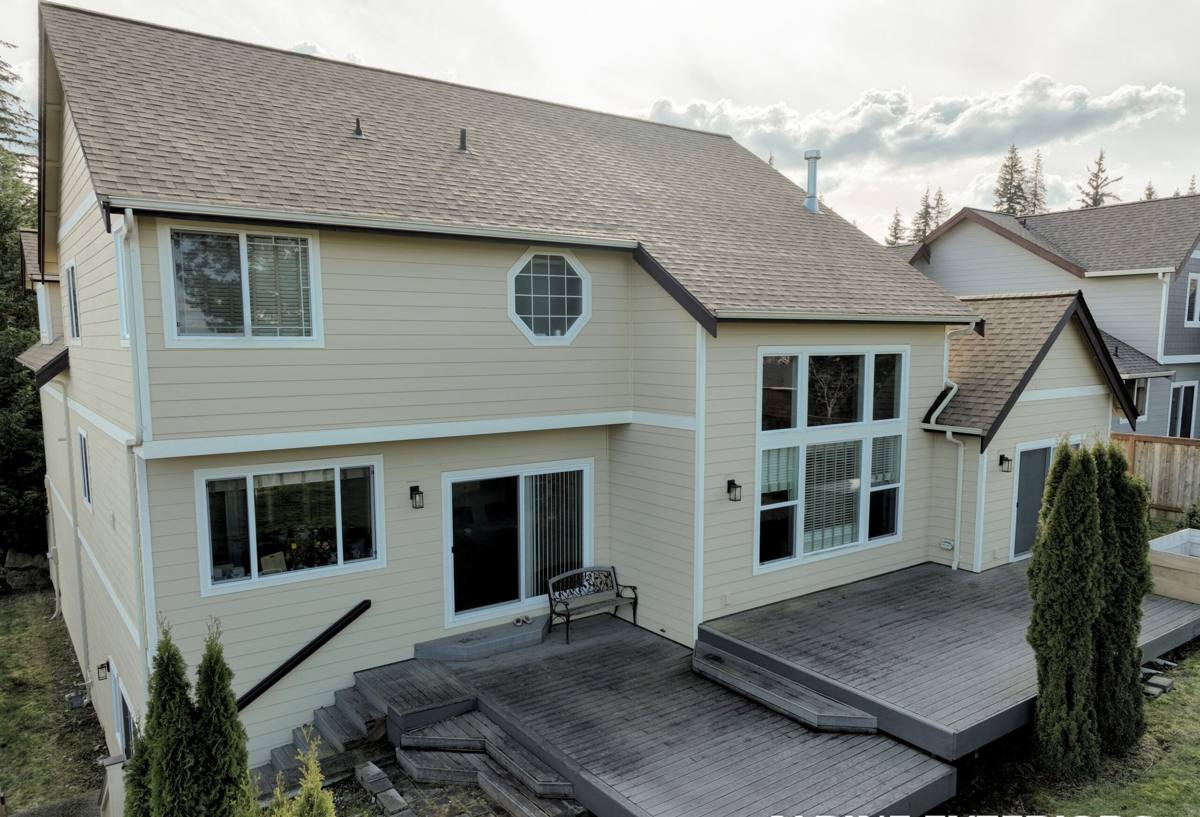
What Salt Air Actually Does to a House
Airborne salt is corrosive and hygroscopic — it pulls moisture out of the air and holds it against whatever surface it lands on. On a home a mile or two from the water, that means fasteners, flashing, and trim are under near-constant low-level moisture exposure even on days that look dry. Over years, that accelerates corrosion on anything not rated for it and keeps painted or coated surfaces damp longer than they'd stay in a drier inland location.
This is why fastener selection and flashing details matter more here than they would forty miles inland. It's also why we don't treat "coastal-adjacent" as an excuse to cut corners on corrosion-resistant hardware — a siding job that looks right for five years and then starts showing rust streaks and fastener failure isn't a job we consider finished correctly.
Wind-Driven Rain Changes Where Water Gets In
Straight-down rain is easy for any siding to shed. Wind-driven rain coming off the water at an angle pushes water sideways and upward into laps, seams, and penetrations that were never designed to see water from that direction. Around Oak Harbor and the broader Anacortes area, that's a regular weather pattern, not an occasional storm event.
The practical result is that lap spacing, caulking at penetrations, and the water-resistive barrier behind the siding all have to be treated as load-bearing parts of the weatherproofing system — not afterthoughts. A siding job that only accounts for gravity-fed drainage is a siding job that's going to leak eventually in this location.
Moss Season Is Longer Here Than Homeowners Expect
Anacortes and the surrounding islands get a long stretch of overcast, damp weather where surfaces simply don't dry out between rain events. That's exactly the condition moss and algae need to establish, and north-facing walls, areas under tree cover, and anywhere siding stays shaded most of the day are the first places it shows up.
Wood-based sidings absorb moisture into the substrate itself, which gives moss and mildew something to root into over time and can lead to soft spots, swelling, or rot underneath the surface growth. James Hardie fiber cement doesn't give organic growth the same foothold — it's non-combustible, moisture-resistant by composition, and doesn't swell or deteriorate the way wood-based products can when they stay damp for weeks at a stretch. Moss can still grow on the surface of any siding given enough shade and dampness, but with Hardie it stays a cosmetic, cleanable issue instead of a structural one.
Why We Standardized on James Hardie for This Climate
We get asked fairly often why we don't offer vinyl, LP SmartSide, or one of the other fiber cement brands. The honest answer is that after years of doing exterior work in this exact climate — salt air, sideways rain, long wet winters — Hardie is the product we've found holds up to spec without turning into a recurring maintenance call.
- It's non-combustible, which matters given the wildfire smoke and ember exposure the whole region has seen in recent summers.
- The ColorPlus factory finish is baked on under controlled conditions, which holds color and resists the fading and chalking that field-applied paint struggles with under UV and salt exposure.
- James Hardie's HZ5 product line is engineered specifically for regions with more moisture cycling, which fits this climate better than a one-size-fits-all national product.
- The transferable limited warranty is meaningful because it's backed by a large, established manufacturer — not a small regional brand that may not be around in twenty years.
We're not going to tell a homeowner that vinyl or engineered wood siding is garbage — both have legitimate uses. But for a marine-climate home that needs to go decades without repeat maintenance, we've made Hardie our standard because it's what we're willing to put our name behind.
What a Correct James Hardie Installation Involves
Hardie siding is only as good as the installation behind it. The board itself is engineered to handle this climate, but a rushed or generic install can undercut all of that. On every Oak Harbor-area project, our process includes the same core steps regardless of house size or style:
Before the Siding Goes Up
- Inspect and repair any sheathing damage found once old siding comes off
- Install a continuous water-resistive barrier, lapped correctly shingle-style so water sheds outward at every seam
- Flash all windows, doors, and penetrations before any siding contacts them
- Confirm proper clearance between the bottom of the siding and grade, decks, or roof lines so water can't wick up into the board
During Installation
- Follow James Hardie's fastener spacing and placement specs exactly — this is one of the most common places corner-cutting crews go wrong
- Use corrosion-resistant fasteners rated for the exposure, not standard interior-grade hardware
- Maintain correct lap and gap dimensions so the siding can handle wind-driven rain from any direction
- Caulk and seal penetrations with products rated for the temperature and moisture swings this climate sees
Skipping or shortcutting any one of these steps doesn't usually show up as a problem in year one. It shows up in year five or eight, as moisture intrusion, fastener staining, or premature caulk failure — right around the point a homeowner assumes the siding itself is to blame when the real issue was the install.
Cost Factors for a Hardie Siding Job in This Area
Every home is different, but the factors that move a Hardie siding estimate up or down in this region are fairly consistent. We walk through these with every homeowner before quoting anything.
| Factor | Why It Matters Locally |
|---|---|
| Existing wall condition | Salt air and long-term moisture exposure can mean hidden sheathing repair once old siding is removed |
| Exposure direction | Walls facing the water or prevailing wind need more attention to flashing and lap detailing |
| Product line (HZ5 vs. standard) | HZ5 is built for moisture-prone climates and is what we recommend for most homes here |
| Trim and color selection | ColorPlus finishes and trim profiles vary in material cost and installation time |
| Access and site conditions | Tree cover, shaded north walls, and tight lot lines affect labor time and staging |
| Scope of tear-off | Full removal versus siding over existing material changes both cost and long-term performance |
Why It Matters That We Already Work in This Area
A crew that mostly works inland, drier neighborhoods can install Hardie siding perfectly correctly by the book and still miss climate-specific details that only show up in a place like Oak Harbor — how far salt spray travels inland on a windy day, which wall orientations actually take the worst of the wind-driven rain, or how long a shaded wall stays damp in January. None of that is exotic knowledge, but it only comes from doing the work here repeatedly.
We also know the practical side: local permitting expectations, typical house ages and construction types in the area, and the kind of prep work older homes near the water tend to need once the old siding comes off. That familiarity is part of what keeps a job on schedule and on budget instead of turning into a string of surprises.
Signs Your Current Siding Isn't Keeping Up
Homeowners often wait longer than they should to address siding issues because the early signs look cosmetic. In this climate, a few specific signs are worth acting on sooner rather than later:
- Persistent moss or algae growth that returns quickly after cleaning
- Visible fastener staining or rust streaking below nail heads
- Soft, swollen, or delaminating areas, especially near the ground or under windows
- Paint that's chalking, peeling, or fading unevenly by wall orientation
- Gaps or separation at seams and corners after a windy winter
Any of these can mean the weatherproofing behind the siding is compromised, not just the visible surface — which is worth having looked at before it becomes a larger repair.
What to Expect From Our Process
We start with an on-site walk-through of the whole exterior, not just the areas that look obviously worn, since moisture problems in this climate often start on shaded or wind-exposed walls before they're visible elsewhere. From there we put together a written scope covering product line, color, trim details, and the specific prep and flashing work your home needs — no generic packages. Once work starts, we follow James Hardie's installation specifications as the baseline, not a suggestion, because that's what keeps the manufacturer's warranty intact and keeps the job performing the way it's supposed to in this climate.
If you're weighing a siding project on a home in Oak Harbor, Anacortes, or elsewhere in the surrounding area, we're happy to walk the exterior with you and talk through what your house actually needs — no pressure, no obligation. Reach out using the form below to set up a free estimate.