 Anacortes Exterior
 Guemes Island's Climate Is Tougher on Siding Than Most People Realize
Guemes Island sits right in the marine weather that moves through the San Juans and Skagit County, and homes out here take a different kind of beating than a house a few miles inland in Anacortes. Salt-laden air off the water works into seams and fastener heads year-round. Wind-driven rain doesn't just fall straight down — it gets pushed sideways into siding, trim, and corner joints. And because the island stays shaded, damp, and cool for long stretches of the year, moss and algae get a real foothold on anything that holds moisture, especially north- and west-facing walls and anywhere tree cover keeps a wall from drying out between storms.
None of that is unique to Guemes Island specifically, but the combination — salt exposure, sustained wind-driven rain, and a long moss season — is more concentrated here than in most parts of Anacortes proper. Siding that's marginal on a sheltered inland lot can fail years earlier out on the island. That's the lens we use when we talk about siding material, panel selection, and installation detail for a Guemes Island home: what actually holds up when the weather doesn't let up.
Why We Only Install James Hardie Fiber Cement
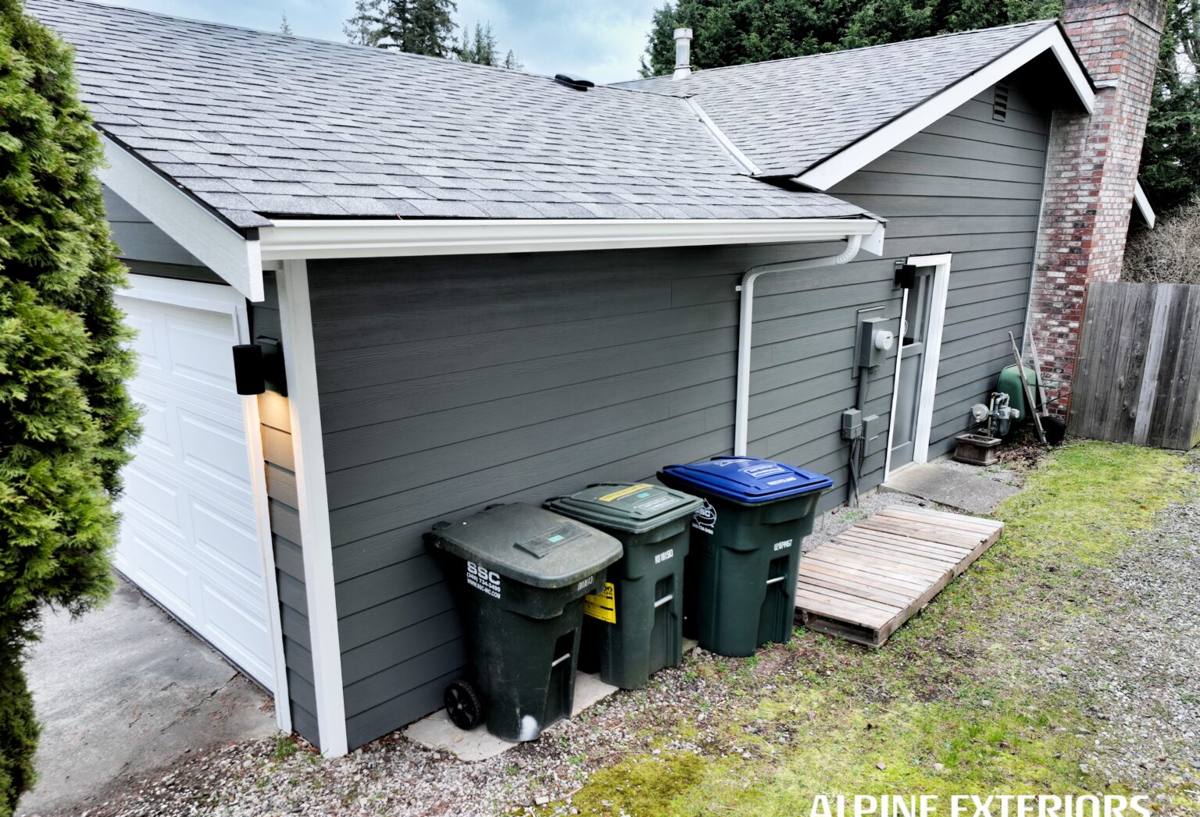
We made a deliberate decision to install James Hardie fiber cement siding exclusively — not vinyl, not LP SmartSide, not cedar, not any of the other fiber cement alternatives on the market. That's a standard we hold to on every job, including out on Guemes Island where the climate makes the difference between products matter more, not less.
Fiber cement is non-combustible, dimensionally stable, and doesn't rely on a paint film alone to keep moisture out the way engineered wood products do. James Hardie's ColorPlus finish is baked on at the factory under controlled conditions, which gives it better adhesion and UV resistance than field-applied paint — something that matters directly here, since a coastal environment is hard on any exterior coating. Hardie's HZ5 product line is engineered specifically for climates with sustained moisture exposure, which describes the Pacific Northwest coast about as well as any region in the country.
We're not going to tell you vinyl or engineered wood siding are junk products — they have real uses and plenty of installed examples that look fine for years. Our position is narrower: given what a Guemes Island wall is exposed to, we don't think those products give a homeowner the long-term value or the maintenance profile that fiber cement does, and we'd rather stand behind one product system we trust completely than offer several we have reservations about.
What Vinyl and Engineered Wood Struggle With Out Here
- Vinyl siding expands and contracts significantly with temperature swings, which opens gaps at laps and corners over time — gaps that wind-driven rain will find. It also softens and can warp when exposed to concentrated heat or reflected sunlight, and its color is baked through the material rather than a separate finish layer, so it fades unevenly and can't be refinished.
- LP SmartSide and other engineered wood products rely on an OSB or wood-strand core with a protective coating. Once that coating is breached — at a fastener, a cut edge, or a damaged corner — moisture can wick into the core and cause swelling or rot, and that failure mode is harder to catch early than it is with fiber cement.
- Cedar and primed wood siding can look excellent, but they need a real maintenance commitment: periodic refinishing, careful caulk and paint upkeep, and vigilance about moss and mildew. In a climate where moss establishes itself readily, that maintenance burden is real and ongoing, not occasional.
Panel vs. Lap Siding for an Island Home
James Hardie makes several profiles, and the right choice depends on the home's style and exposure, not just personal preference. HardiePlank lap siding is the most common choice for traditional and craftsman-style homes and gives good water shedding when installed with correct overlap and flashing. HardiePanel vertical siding works well for board-and-batten looks and modern or cabin-style homes, which show up often in this part of Skagit County. HardieShingle is an option for accent areas or a full shingle look without the maintenance a real wood shingle roof or wall would demand.
On a heavily shaded or wind-exposed elevation, we'll sometimes recommend a different profile or coursing exposure than what's used on the more sheltered sides of the same house — the goal is always to shed water fast and give the wall a chance to dry between rain events.
What a Correct Installation Actually Involves
Fiber cement siding is only as good as the installation behind it. In a marine climate, the details that get skipped on a rushed job are exactly the details that cause problems three or five years later — not immediately, which is part of why substandard work is so common in this trade.
| Detail | Why It Matters on Guemes Island |
|---|---|
| Weather-resistive barrier and proper lap | Second line of defense behind the siding when wind-driven rain pushes past the surface layer |
| Rainscreen / drainage gap | Lets the wall cavity dry out between storms instead of staying damp, which is what feeds moss and mildew |
| Correct fastener type and placement | Hardie specifies fastener penetration and spacing; wrong fasteners or blind-nailing errors cause splitting and water entry at panel faces |
| Flashing at windows, doors, and penetrations | These are the highest-risk points for water intrusion on any home exposed to sideways rain |
| Factory-cut and sealed edges | Field cuts need sealing to protect the cut edge from moisture uptake, especially at trim returns and corners |
| Proper clearance from grade, decks, and roof lines | Keeps siding from sitting in standing moisture or splash-back, a common source of premature failure |
We follow James Hardie's published installation instructions to the letter because that's what keeps the manufacturer's warranty valid — and because those instructions exist specifically to address conditions like the ones Guemes Island homes deal with.
Working Around Ferry Access and Island Logistics
Anyone who's scheduled a project on Guemes Island knows the ferry schedule becomes part of the job plan, not an afterthought. Material deliveries, crew transport, and equipment all have to move on and off the island within a limited window of sailings, and weather can affect that schedule on short notice. A crew that hasn't worked the island before often underestimates this and ends up with wasted trips, staged materials sitting exposed longer than planned, or a job that drags out because logistics weren't accounted for up front.
We plan Guemes Island projects around the ferry from the start: staging materials efficiently, batching crew trips, and building weather contingency into the schedule rather than discovering it mid-project. That planning matters more for a siding job than people expect, since materials and cut panels left exposed to the elements longer than necessary work against the very durability the product is supposed to provide.
Maintenance in a Long Moss Season
Even the most moisture-resistant siding material benefits from basic upkeep, and a moss-prone environment makes that upkeep more relevant than it would be in a drier part of the state. Fiber cement doesn't feed moss the way wood does, but moss, algae, and debris can still accumulate on any exterior surface that stays shaded and damp for long stretches.
- Rinse siding periodically with a garden hose (avoid high-pressure washing directly at seams and fastener points)
- Keep gutters clear so overflow doesn't run down the wall face
- Trim back vegetation and tree limbs that keep a wall shaded and damp longer than the rest of the house
- Check caulking at trim, window, and door joints annually and recaulk where it's cracked or pulling away
- Look at north- and west-facing walls specifically each fall, since these dry slowest and show moss first
- Touch up any chips or gouges promptly so the substrate underneath isn't exposed to moisture
Our Process for Guemes Island Siding Projects
Every project starts with an on-site look at the home's specific exposure — which walls take the brunt of the wind and rain, where existing moisture or moss patterns show up, and what the current siding or sheathing condition tells us about what's underneath. From there we put together a plan that covers product line and profile, drainage and flashing detail, and a realistic schedule that accounts for ferry logistics and weather windows. We handle removal of the old siding, correct any sheathing or moisture issues we find before covering them up, and install to James Hardie's specifications so the manufacturer's warranty stays intact. We walk the finished job with the homeowner before we consider it done.
Why a Crew That Already Works Guemes Island Matters
A siding installer who mainly works sheltered, inland lots doesn't necessarily think about rainscreen gaps, flashing sequencing, or exposure-specific coursing the same way a crew that regularly works marine-exposed sites does. On Guemes Island, those details aren't optional extras — they're what separates a house that looks good for two years from one that holds up for decades. Add in the ferry-dependent logistics, and a contractor who already has a working rhythm for island projects will run a tighter, less disrupted job than one figuring it out for the first time on your home.
If you're weighing siding options for a home on Guemes Island, we're glad to come take a look and talk through what your specific exposure calls for. Reach out for a free, no-pressure estimate — there's a form below to get started.