 Anacortes Exterior
 Cap Sante's Climate Is Rougher on Siding Than Most of Anacortes Realizes
Cap Sante sits up on the bluff above the marina, looking out over Fidalgo Bay and the boat traffic below. That view comes at a cost most homeowners don't think about until their siding starts failing early: constant exposure to salt-laden air moving off the water, wind-driven rain that hits walls at an angle instead of falling straight down, and a shoulder season that stays damp long enough for moss and algae to get a foothold on anything that holds moisture. Add in the marine haze and humidity that Skagit County sees for a good chunk of the year, and you've got conditions that will find every weakness in a siding product or an installation shortcut.
This isn't a climate where "good enough" siding survives on charm. Salt air accelerates corrosion on fasteners and trim metal. Driving rain pushes water into joints and laps that would stay dry in a more sheltered inland location. And a long, cool, wet moss season means anything organic-based on your exterior — cedar, primed wood trim, even some cementitious products installed without proper ventilation — stays wet longer than it should, which is exactly what moss, mildew, and rot need to take hold.
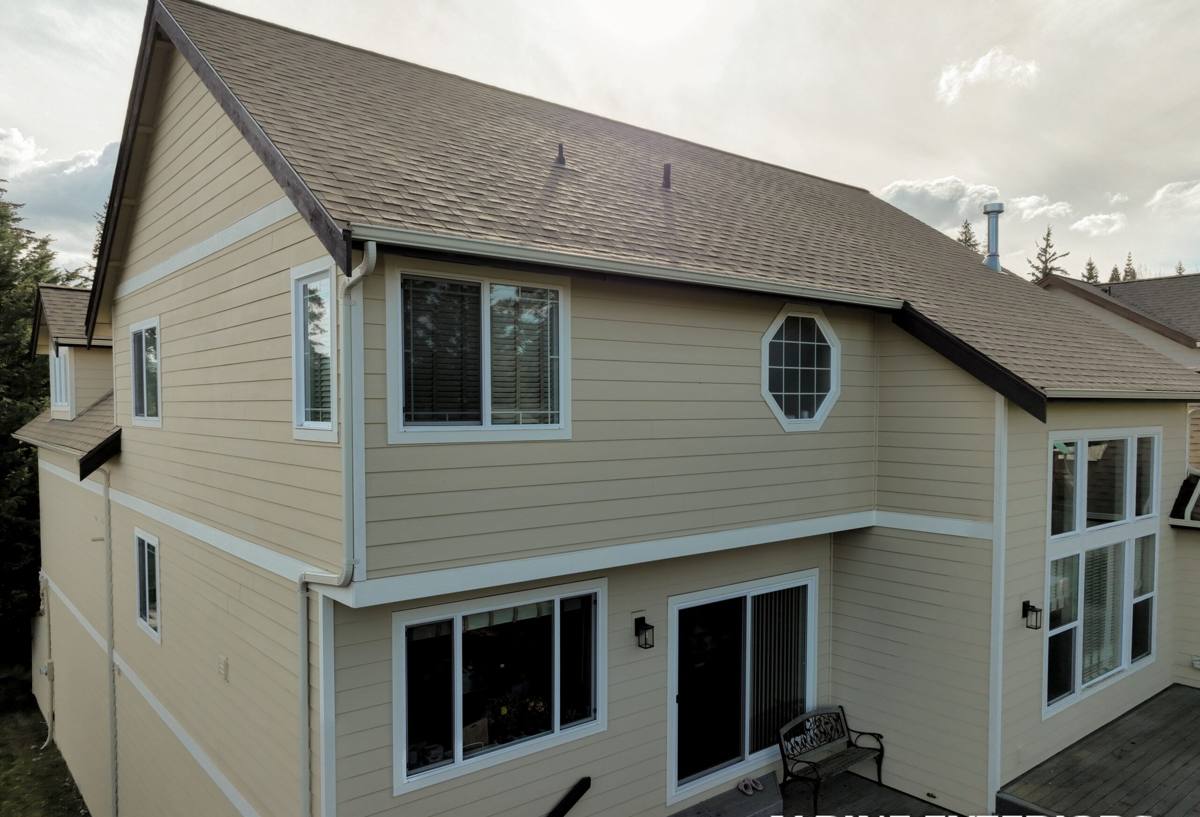
Why We Only Install James Hardie in This Kind of Exposure
We don't install LP SmartSide, vinyl, Cemplank, Allura, primed spruce, or cedar. That's not a marketing line — it's a standard we hold to because we've seen what a bluff-side, waterfront-adjacent climate like Cap Sante's does to siding over a 10-, 15-, 20-year horizon. James Hardie fiber cement is non-combustible, doesn't swell or rot the way wood-based products can, and holds its factory finish far longer than field-painted alternatives. For a home catching salt spray and wind off Fidalgo Bay, that combination matters more than it does on a sheltered inland lot.
That doesn't mean other products are junk — vinyl is inexpensive and low-maintenance in mild conditions, and cedar has real aesthetic appeal for the right buyer. But vinyl can warp and fade faster under UV and salt exposure, and it doesn't hold paint if you ever want to change your home's color. Cedar and primed wood need consistent refinishing to keep moisture out, and in a climate that stays damp as long as Cap Sante's does, that maintenance window shrinks. We'd rather put one product on every home we touch and stand behind it fully than juggle recommendations based on what's cheapest that week.
ColorPlus Finish and Salt Air
James Hardie's ColorPlus technology bakes the finish onto the board in a factory-controlled process before it ever reaches your home, rather than relying on field-applied paint that has to cure in whatever weather shows up on install day. In a salt-air environment, that matters twice: the finish resists the fading and chalking that UV and airborne salt cause over time, and because it's factory-cured, you're not depending on a coat of paint applied outdoors in Anacortes' damp shoulder season to bond correctly.
The HZ5 Product Line: Built for This Region
James Hardie engineers its siding in different formulations for different climate zones, and the Pacific Northwest falls under the HZ5 line — engineered specifically for regions with sustained moisture exposure, freeze-thaw cycling, and the kind of driving rain Cap Sante gets off the bay. It's not the same product sold in dry inland climates with a different label slapped on it; the formulation itself accounts for the moisture load this area sees.
For a Cap Sante home, that means the siding is manufactured to hold up under repeated wetting and drying cycles without the swelling, cracking, or moisture absorption issues you'd risk with a product engineered for a drier region. Combined with correct installation — proper clearances, flashing, and ventilation — HZ5 siding is built to handle exactly the conditions this neighborhood throws at it.
What a Correct Installation Actually Involves
Fiber cement siding is only as good as the installation behind it. Hardie's own warranty language is explicit about this — improper installation can void coverage, and in a high-moisture environment like Cap Sante, installation mistakes show up faster than they would somewhere drier. A correct job includes:
| Install Element | Why It Matters in Cap Sante's Climate |
|---|---|
| Proper clearance from grade, decks, and roofing | Prevents wicking moisture from wind-driven rain pooling at the base of walls |
| Correct fastener type and placement | Salt air accelerates corrosion on the wrong fastener grade; placement affects panel performance in wind |
| Rain screen / drainage plane behind the siding | Lets any moisture that gets behind the cladding drain and dry instead of sitting against the wall |
| Flashing at windows, doors, and penetrations | The most common point where wind-driven rain finds its way in |
| Caulking and joint treatment per Hardie spec | Improper sealing traps moisture instead of shedding it |
| ColorPlus touch-up and cut-edge sealing | Field-cut edges need sealing to protect the factory finish from moisture intrusion |
Skip any one of these and you've got a product with a strong track record installed in a way that undermines it. This is where a lot of siding problems on the bluff actually originate — not from the material, but from a rushed or unfamiliar install crew missing a step that doesn't show up as a problem until a few winters later.
How We Approach a Cap Sante Project
Every home on the bluff is a little different depending on how directly it faces the water and how exposed it is to prevailing wind, so our process starts with a real assessment rather than a one-size-fits-all quote.
1. On-Site Evaluation
We look at your current siding's condition, check for moisture damage or rot at trim and penetrations, and assess how exposed the home is to wind and salt spray given its position and orientation.
2. Product and Detail Planning
We confirm the right Hardie panel or lap profile and HZ5 specification for your home, and plan out flashing, drainage, and fastening details specific to your exposure — a home catching direct wind off the bay gets more attention at joints and penetrations than one tucked behind a windbreak of trees or neighboring structures.
3. Installation to Spec
We follow Hardie's published installation requirements exactly — clearances, fastener schedules, flashing sequence, and rain screen detailing — because that's what keeps the manufacturer's warranty intact and keeps water out of your walls.
4. Finish and Walkthrough
We seal cut edges, complete any ColorPlus touch-up, and walk the exterior with you before calling the job done.
James Hardie vs. the Alternatives, in This Climate Specifically
| Factor | James Hardie Fiber Cement | Vinyl | Cedar / Primed Wood |
|---|---|---|---|
| Salt air resistance | Strong — non-combustible, factory finish holds up well | Moderate — can fade and grow brittle over time | Weak without diligent maintenance |
| Moisture / rot risk | Low when installed to spec | Low, but can trap moisture at poor seams | High — organic material, needs consistent sealing |
| Moss and algae resistance | Good — dense material, factory finish sheds growth better | Fair | Poor — porous surface holds moisture |
| Finish longevity | Long — factory-baked ColorPlus finish | Moderate — color molded in, fades with UV/salt | Short — needs repainting/restaining on a cycle |
| Fire resistance | Non-combustible | Can melt/deform under heat | Combustible |
What Drives Cost on a Cap Sante Home
Every project is different, but a few factors consistently move the price on a job in this neighborhood more than they might elsewhere:
- Wall height and exposure: Bluff and hillside homes often have more elevated wall area exposed to wind, which affects scaffolding and access.
- Amount of existing damage: Moisture or rot found once old siding comes off adds sheathing or framing repair before new siding can go on.
- Trim and detail complexity: Homes with more windows, corners, and roofline intersections need more flashing and cut work.
- Panel or lap profile chosen: Different Hardie profiles and ColorPlus color options carry different material costs.
- Access constraints: Tight lots or steep grades near the marina bluff can affect staging and labor time.
We won't quote a number without seeing the home in person, but we'll walk you through exactly what's driving your estimate before any work starts.
Maintaining Hardie Siding Through Cap Sante's Moss Season
James Hardie siding is low-maintenance compared to wood, but "low-maintenance" doesn't mean "no maintenance" in a climate this damp. A simple annual routine keeps it performing the way it's designed to:
- Rinse the exterior once or twice a year to clear salt residue and organic buildup before it sets into the surface.
- Check caulking at trim, windows, and joints annually — caulk is the first thing to wear out, not the siding itself.
- Trim back vegetation and branches that keep siding shaded and damp, which is what invites moss growth.
- Inspect gutters and downspouts before the wet season so runoff isn't sheeting down the wall face.
- Address any touch-up needs at cut edges or fastener heads promptly rather than letting exposed spots sit through a wet winter.
Why Local Installation Experience Matters Here
A crew that mostly works drier, inland jobs can install Hardie siding correctly on paper and still miss the details that matter specifically on a marine bluff — drainage planning for wind-driven rain, fastener selection that accounts for salt exposure, and flashing sequences that anticipate moisture coming from an angle rather than straight down. A crew that regularly works properties around Anacortes and the Cap Sante area has already seen how this specific exposure behaves on a home over multiple seasons, and builds that into the install rather than treating your project as a generic siding job.
That local familiarity is also what lets us give you a straight answer about your specific lot — how exposed it really is, what detailing it needs, and what maintenance schedule makes sense — instead of a generic answer that doesn't account for Skagit County's marine climate.
If you're planning a siding project on the bluff or anywhere in Cap Sante, we're happy to take a look and put together a free, no-pressure estimate. Fill out the form below and we'll get in touch to schedule a time to come out.