 Anacortes Exterior
 Why Fidalgo Island Wears Out Siding Faster Than Most Places
Fidalgo Island sits almost entirely surrounded by saltwater — Rosario Strait to the west, Guemes Channel to the north, and Padilla Bay to the east — so most homes on the island pick up some degree of salt-laden air coming off the water year-round. Add in Anacortes' share of Skagit County's driving winter rain, often pushed sideways during a southwest blow, and you've got two of the toughest conditions siding can face at once: chloride-heavy moisture that corrodes fasteners and dulls finishes, and wind-driven rain that hunts out every gap in a wall assembly. Then there's shade. Plenty of Fidalgo Island lots hold onto dampness through fall and winter longer than more open, inland sites, which gives moss and algae a long season to work into seams, laps, and butt joints.
None of this is dramatic on its own. It's slow, cumulative wear — which is exactly why siding that looks fine from the curb can already be failing at the seams, and why a repair that doesn't account for salt exposure and standing moisture rarely holds for long.
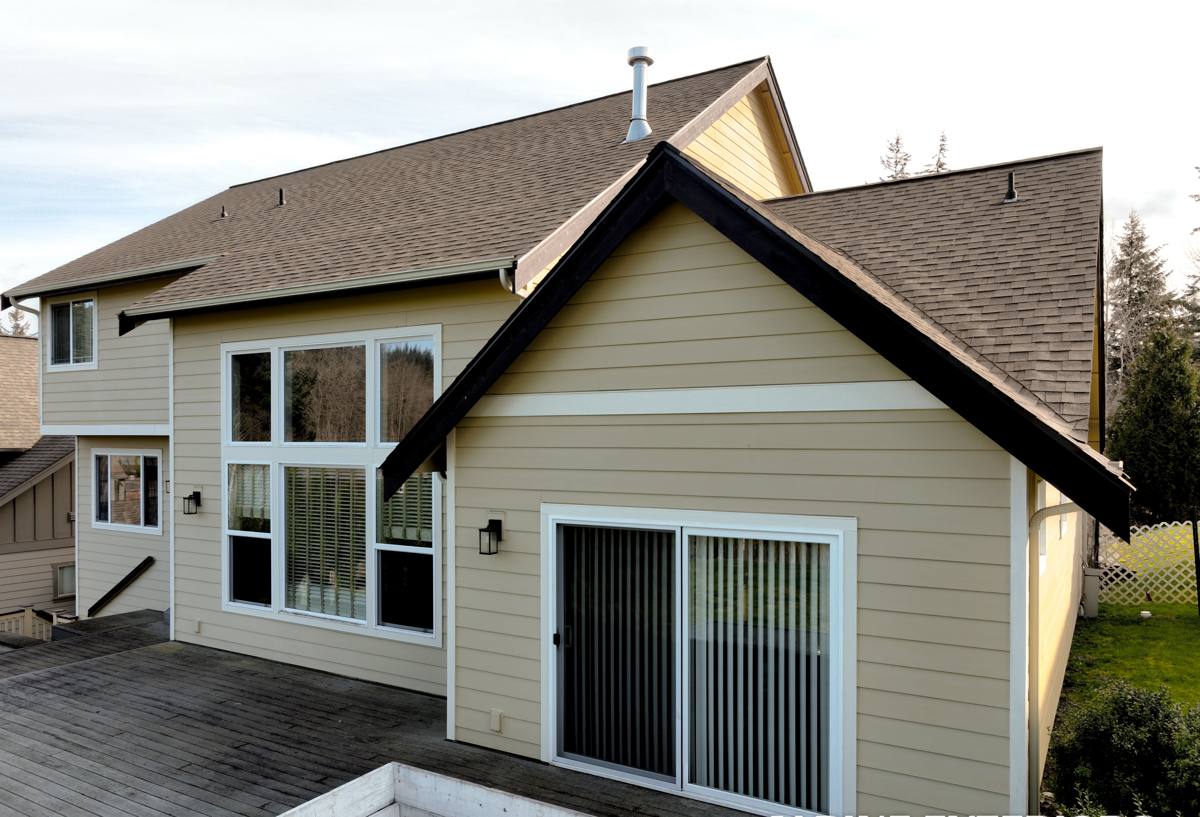
How That Exposure Actually Shows Up as Damage
We get called out to a lot of siding that "just needs a little paint," and a fair number of those jobs turn out to need real repair once we get up close. The damage on Fidalgo Island tends to follow a pattern tied directly to salt air, rain direction, and shade.
Common Failure Points We See on Fidalgo Island Homes
- Soft or swollen siding at the lowest courses, where splash-back and moss-trapped moisture sit the longest
- Cracked or separated caulking at butt joints and trim, letting wind-driven rain get behind the cladding
- Rust streaking or popped fasteners on older nailed siding — salt air speeds up fastener corrosion noticeably
- Moss and algae buildup concentrated on north- and west-facing walls that stay shaded and damp longest
- Warping, cupping, or delamination on wood or engineered-wood siding that has cycled wet and dry too many times
- Chalky, faded paint film that's lost its ability to shed water
- Soft or spongy trim and corner boards, where two materials meet and water tends to collect
Any one of these on its own might be a minor fix. Several together, especially on a west- or south-facing wall, usually means moisture has been getting behind the siding for a while — and that changes what the repair needs to include.
What a Correct Siding Repair Actually Involves
Diagnosis Before Demolition
The single biggest difference between a repair that lasts and one that doesn't is what happens before anything gets removed. We look at the whole wall, not just the damaged board — checking whether the problem is isolated (a cracked panel, a failed caulk joint) or a symptom of something behind the siding, like a flashing detail that's been feeding water into the wall for years. Repairing over an unresolved moisture source just buys a homeowner a few more years before the same spot fails again.
Checking What's Behind the Siding
Once damaged material is pulled, we're looking at the water-resistive barrier, the flashing around windows, doors, and penetrations, and the sheathing underneath. On Fidalgo Island specifically, we pay close attention to walls that face the water and take the brunt of driving rain — those are the spots where a small gap in the barrier or flashing has usually done the most damage over time. If the sheathing is soft or the barrier has failed, that gets addressed as part of the repair, not left for "next time."
Matching Material and Finish
A repair should blend in, not stand out as a patch. That means matching profile, exposure, and color as closely as the existing siding allows, and making sure new material is properly primed, caulked, and finished before it's exposed to the next wet season. On any wall being repaired with new siding, we install James Hardie fiber cement — for the reasons below.
Repair or Replace? How We Actually Decide
Homeowners often assume repair is automatically the cheaper, faster answer, but that's only true when the damage is genuinely isolated. Here's the general framework we use when we're standing in front of a wall on Fidalgo Island:
| Situation | Repair Usually Makes Sense | Replacement Usually Makes Sense |
|---|---|---|
| Extent of damage | Isolated to one or two wall sections | Spread across multiple elevations, especially water-facing walls |
| Underlying moisture barrier | Intact, no signs of water tracking behind adjacent siding | Compromised or original barrier/flashing is due for an update anyway |
| Age and material of existing siding | Newer material still under warranty, good condition elsewhere | Original material is old, discontinued, or failing at a system level (not just one spot) |
| Color and profile match | Close match available or damage is in a low-visibility area | Discontinued profile or color, or patch would be visually obvious |
| Cost over time | Lower upfront cost, appropriate for the scope | Repeated repairs to the same wall have already added up |
We'll tell a homeowner honestly when repair is the right call — plenty of jobs genuinely are a repair, not an upsell to full replacement. But we'll also tell you plainly when patching a failing wall is just delaying the same job at a higher eventual cost.
Why We Only Repair and Rebuild with James Hardie Fiber Cement
When a repair calls for new siding material — whether it's a few boards or a full wall section — we install James Hardie fiber cement, not vinyl, not LP SmartSide, not cedar or primed spruce. That's a standard we hold across every job, and it matters even more on repair work.
Patching damaged wood or engineered-wood siding with the same material usually means patching over the same vulnerability: those products absorb and hold moisture at cut edges and butt joints, which is exactly where Fidalgo Island's combination of driving rain and shaded dampness does the most damage. Vinyl can be repaired cheaply, but it expands and contracts significantly with temperature swings and offers little protection where wind-driven rain gets behind a wall. Hardie fiber cement is dimensionally stable, doesn't support moss growth the way wood fiber products can, and its factory-applied ColorPlus finish is baked on to resist the fading and chalking that salt air and UV accelerate on field-applied paint.
We're not saying every other product is unusable — plenty of homes around Anacortes have vinyl or wood siding that's held up fine for years. But when we're the ones doing the repair or replacement, we stand behind one material system, engineered for exactly this kind of marine, wet-winter climate, backed by a strong transferable warranty. That consistency is also why our repairs match cleanly into future work on the same home — we're not guessing at compatibility between products.
Our Siding Repair Process
- On-site inspection. We walk the exterior, note every problem area (not just the one you called about), and check for moisture behind the siding at suspicious spots.
- Honest scope and estimate. You get a clear explanation of what's damaged, what's causing it, and whether repair or partial replacement is the right fix — with a written estimate before any work starts.
- Remove and assess. Damaged siding comes off carefully so we can check the water-resistive barrier, flashing, and sheathing underneath.
- Correct what's behind the wall. Any compromised flashing, barrier, or sheathing gets repaired as part of the job — not patched over.
- Install and finish. New James Hardie material goes in matched to the existing siding as closely as possible, properly fastened, caulked, and finished.
- Final walkthrough. We review the completed work with you before calling the job done.
Why Hiring a Crew That Already Works Fidalgo Island Matters
Siding repair isn't identical everywhere in Skagit County. A crew that mostly works drier, more sheltered inland sites can miss things that are routine for us on Fidalgo Island — how much farther salt air travels on a windy day, which elevations take the worst of a southwesterly storm, or how long moss holds moisture against a north wall through a Pacific Northwest winter. That experience shapes real decisions: where we're more conservative about pulling siding to check for hidden damage, and which details we don't cut corners on because we've seen what happens when they're missed.
It also means faster, more accurate estimates. We're not learning the local exposure patterns on your dime — we've already seen how homes on the island age compared to homes ten miles inland, and we scope repairs accordingly.
A few things worth asking any contractor before hiring them for siding repair work here:
- Do they inspect behind the damaged siding, or just replace what's visible?
- Can they explain what's actually causing the damage, not just what it looks like?
- Do they have recent experience with homes in this specific area, not just the broader county?
- What's covered under warranty — labor, material, or both?
- Will they give you a written scope before starting demolition?
Keeping Repaired Siding Ahead of the Next Wet Season
A good repair buys you a lot of time, but Fidalgo Island's climate doesn't take a break, so a little upkeep goes a long way:
- Rinse salt residue and moss buildup off siding once or twice a year, especially on shaded or water-facing walls
- Keep gutters clear so overflow isn't running down the siding face
- Trim back vegetation that's shading a wall and keeping it damp longer than it needs to be
- Check caulking at trim and butt joints annually — it's cheap to redo and expensive to ignore
- Have any new soft spots or discoloration looked at early, before they turn into a bigger repair
If you're noticing soft spots, moss buildup, cracked caulking, or fading on your siding, we're happy to take a look and give you a straight answer on what it needs. Reach out for a free, no-pressure estimate using the form below.