 Anacortes Exterior
 Why Fidalgo Island Siding Wears Differently
Fidalgo Island sits right where the marine air off the Salish Sea meets the wetter, wind-exposed weather that moves through Skagit County. That combination is harder on exterior siding than most homeowners realize until they're dealing with it. Salt-laden air corrodes fasteners and finishes over time, wind-driven rain finds its way behind poorly detailed siding, and the long stretches of gray, damp weather each year create ideal conditions for moss and algae to take hold on north-facing and shaded walls. None of this is dramatic on its own, but stacked together year after year, it's what separates a siding job that looks good for five years from one that still looks right after twenty.
We install James Hardie fiber cement siding exclusively, and we bring up the local climate on purpose — the product choice and the installation details both need to answer to what Fidalgo Island actually throws at a house, not what works fine somewhere drier or more inland.
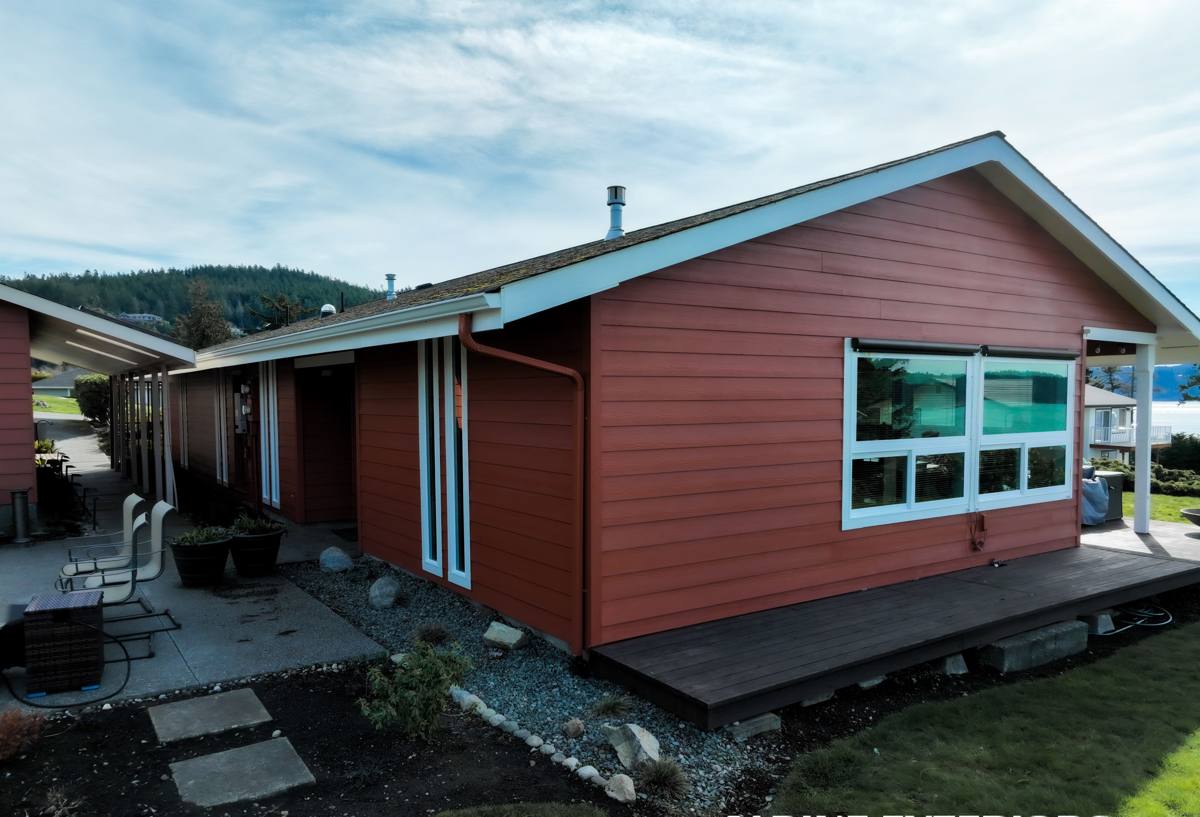
What This Climate Actually Does to a House
Salt Air and Corrosion
Homes closer to the water take the brunt of this, but salt-influenced air travels further than people expect on an island. Over time it accelerates corrosion on exposed metal — fasteners, flashing, trim edges — and it can dull or chalk lower-quality paint finishes faster than the same product would fade further inland. Siding materials and finishes that aren't built for a marine-adjacent environment tend to show their age early here.
Driving Rain
Storms coming off the water often arrive with real horizontal force behind the rain, not just volume. That matters more than people think, because most siding failures aren't about water landing on the wall — they're about water being pushed sideways and upward, finding gaps at seams, trim, and penetrations, and getting behind the cladding where it doesn't dry out quickly.
Moss and Algae Season
Anacortes doesn't have a short damp season — it has a long one. Shaded, north- and west-facing walls under tree cover stay wet for extended stretches, and that's exactly the environment moss, mildew, and algae need to establish. Porous or absorbent siding materials give these organisms something to root into; dense, properly finished fiber cement gives them far less to work with.
Why We Install Only James Hardie
James Hardie fiber cement is engineered specifically for the failure points listed above. It's non-combustible, dimensionally stable, and resistant to moisture absorption in a way that matters directly for a marine climate:
- It doesn't rot, delaminate, or swell from repeated wet-dry cycling the way wood-based or wood-adjacent products can
- Its factory-applied ColorPlus finish is baked on and warranted against fading and chipping — no field-painted surface holds up the same way to years of salt air and UV
- Hardie's HZ5 product line is engineered for climates with cold, wet weather and freeze-thaw cycling, which fits western Washington's winters
- It's dense enough that moss and algae have a much harder time gaining a foothold compared to more porous claddings
- It carries a strong, transferable manufacturer warranty when installed to Hardie's published specifications
We don't install vinyl, LP SmartSide, Cemplank, Allura, primed spruce, or cedar. That's not a knock on every homeowner who has one of those products on their house — it's that after years of doing this work in this specific climate, we standardized on the one material system that consistently holds up to salt air, driving rain, and a long moss season without the maintenance headaches or moisture risk that come with the alternatives.
What a Correct Installation Actually Involves
Fiber cement siding is only as good as its installation. Most of the siding failures we get called out to inspect aren't material failures — they're installation shortcuts that let water in behind a product that was never designed to handle standing moisture. On Fidalgo Island, where wind-driven rain is a real factor, these details matter more than they would in a milder climate:
| Detail | Why It Matters Here |
|---|---|
| Weather-resistive barrier and proper lapping | Creates the drainage plane that carries wind-driven water back out before it reaches the sheathing |
| Correct fastener type and spacing | Salt-influenced air accelerates corrosion on the wrong fastener material; Hardie specifies corrosion-resistant fasteners for a reason |
| Proper clearance at grade, roofline, and decks | Keeps siding from sitting in standing moisture or splash-back during heavy rain events |
| Flashing at windows, doors, and penetrations | The single most common point where driving rain gets behind siding when it's rushed |
| Correct joint gaps and caulking per Hardie spec | Fiber cement expands and contracts with moisture and temperature; gaps that are too tight trap water, too loose let it through |
None of this is exotic — it's the manufacturer's published installation guidance. But it takes discipline to follow it on every wall, every time, especially on the shaded or wind-exposed sides of a house where the consequences of a shortcut show up years later as trapped moisture, not immediately as a visible problem.
Our Process on Fidalgo Island Projects
Assessment
We start by walking the exterior and identifying the conditions specific to that property — how exposed it is to prevailing wind and rain, how much shade and moisture certain walls hold onto, and the condition of the sheathing and framing underneath the existing siding before we commit to a scope.
Prep and Moisture Barrier
Any water-damaged sheathing gets addressed before new siding goes on — covering over a moisture problem is how small issues turn into expensive ones. We install the weather-resistive barrier and flashing package correctly the first time, since this is the layer doing the real work of keeping water out.
Installation to Hardie Spec
Siding, trim, and fastening go in following James Hardie's published installation requirements — the same requirements that back the manufacturer's warranty. We don't deviate from those specs to save time.
Finish and Walkthrough
We finish out trim, caulking, and touch-up, then walk the job with the homeowner so they know what was done and what basic upkeep looks like going forward.
James Hardie Compared to the Alternatives in This Climate
| Factor | James Hardie Fiber Cement | Vinyl | Wood / LP-Type Products |
|---|---|---|---|
| Moisture resistance | Engineered for wet climates, dimensionally stable | Doesn't absorb water but can warp and gap with temperature swings | More vulnerable to swelling, rot, and moisture intrusion over time |
| Salt air / corrosion behavior | Finish and material hold up well; fastener corrosion managed by spec | Can become brittle and discolored over time | Wood-based substrates are more vulnerable to breakdown near salt-influenced moisture |
| Moss and algae resistance | Dense surface resists organic growth better | Smooth but can still host growth in shaded, damp areas | More porous surfaces give moss and algae more to grab onto |
| Finish longevity | Factory-baked ColorPlus finish, warranted | Color is through-body but can fade; no repaint option | Typically field-painted or primed, needs more frequent repainting |
| Fire resistance | Non-combustible | Combustible | Combustible |
What Drives Cost on a Fidalgo Island Home
Every property is different, and we'll always give you specifics after walking your home rather than a number pulled out of the air. But a few factors consistently move the price on siding projects in this area:
- How much of the existing sheathing needs repair before new siding can go on
- How exposed the home is to wind and driving rain, which affects flashing and detail work
- The Hardie product line and profile selected — lap, shingle-style panels, and trim boards all price differently
- Number and complexity of windows, doors, and other penetrations that need flashing
- Site access — some Fidalgo Island lots are tighter or more sloped, which affects staging and labor time
- Whether ColorPlus factory finish or field painting is used for color
Maintaining Hardie Siding in a Salt Air, High-Moss Climate
Fiber cement is low-maintenance compared to most alternatives, but "low-maintenance" isn't "no-maintenance," especially in this climate. A simple annual routine goes a long way:
- Rinse the exterior periodically to clear salt residue and organic buildup, especially on shaded walls
- Keep gutters clear so overflow isn't running down the siding face during heavy rain
- Trim back vegetation and tree cover that keeps walls shaded and damp longer than they need to be
- Inspect caulking at trim, windows, and joints annually and touch up before gaps widen
- Address any moss or algae growth early rather than letting it establish
Why Local Experience on Fidalgo Island Matters
A correct James Hardie installation looks similar on paper anywhere in the country — but the judgment calls that separate a durable job from a problem job are local. Knowing which walls on an island property take the worst of the wind-driven rain, how much clearance to build in near grade given our rainfall patterns, and how aggressively to detail flashing on a shaded, moss-prone elevation all come from having done this work, on this island, repeatedly. A crew that only occasionally works in a marine climate is more likely to apply a generic approach that doesn't account for what Skagit County weather actually does to a house over time.
Ready to Talk About Your Fidalgo Island Home?
If your siding is showing moss, staining, gaps, or general wear, or if you're planning ahead for a replacement, we're happy to take a look and walk you through what we'd recommend and why. Reach out for a free, no-pressure estimate — there's no obligation, just a straight assessment of what your home needs.