 Anacortes Exterior
 Ship Harbor Sits Right Where Weather and Salt Meet Wood
Ship Harbor sits close enough to the water that siding here does double duty: it has to shed near-constant moisture off Rosario Strait while also standing up to salt-laden air that never really stops working on a building's exterior. Add in Anacortes' long, gray stretch of fall-through-spring drizzle and the shaded, north-facing walls that never fully dry out, and you get a siding environment that's noticeably harder on a house than what you'd find twenty miles inland in Skagit County. Homes here don't fail because owners neglect them. They fail because the siding material wasn't built for this specific combination of salt, rain, and shade in the first place.
This page is about one job in one place: installing fiber cement siding correctly on a Ship Harbor home. Not a general overview of siding options, not a citywide pitch — the specific climate problems this neighborhood presents and what it actually takes to solve them.
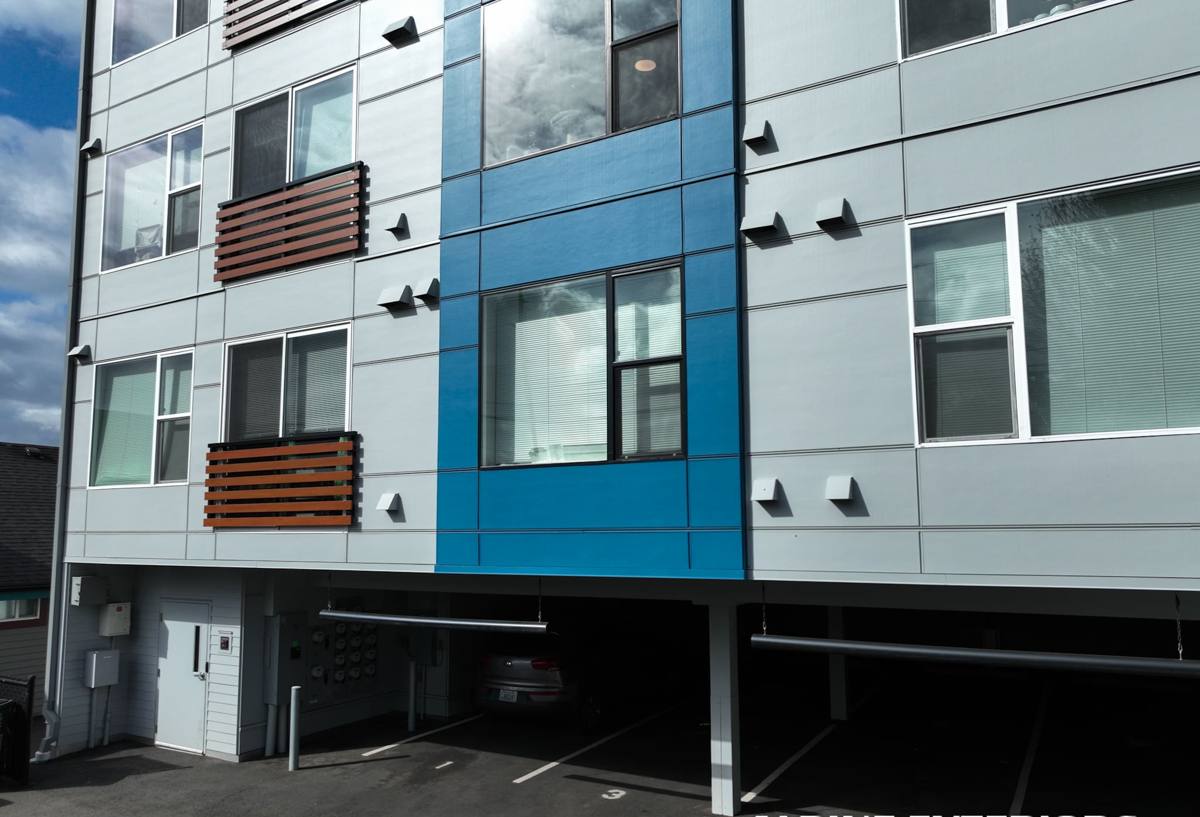
What Salt Air, Driving Rain, and Moss Season Actually Do to a Wall
Salt Air
Airborne salt from the strait settles on exterior surfaces and accelerates the breakdown of anything that relies on paint film alone for protection. It's not dramatic — there's no single storm that ruins a wall — it's a slow chemical erosion of finishes, fasteners, and caulk joints that adds up over years. Materials with weak factory finishes show chalking, fading, and edge deterioration faster in a salt-air zone like Ship Harbor than they would a short drive inland.
Driving Rain
Wind off the water doesn't just drop rain straight down — it drives it sideways into wall assemblies, forcing water into laps, seams, and butt joints that would stay dry in a calmer climate. Any siding product that depends on perfect, unbroken caulk lines to stay watertight is fighting a losing battle here, because caulk is exactly the kind of maintenance item that gets missed.
Moss and Sustained Moisture
Skagit County's moss season isn't a two-week nuisance — it's a good chunk of the year where shaded siding, especially on north- and west-facing walls near tree cover, stays damp long enough for moss and algae to take hold. Moss holds moisture against the surface far longer than open air would, which is a serious problem for any siding material that isn't dimensionally stable when wet.
Why We Only Install James Hardie Here
We've made a deliberate call as a company: we install James Hardie fiber cement siding and nothing else — not vinyl, not LP SmartSide, not Cemplank, not Allura, not primed spruce or cedar. That's not a marketing position, it's a standard we hold ourselves to because of jobs exactly like the ones we do in Ship Harbor.
Fiber cement as a category resists the two things that do the most damage in this microclimate: it doesn't rot or swell the way wood-based products can when moisture gets past the surface, and it's dimensionally stable enough that it doesn't cup, warp, or telegraph seams the way engineered wood siding can after repeated wet-dry cycles. Within fiber cement, we standardized on James Hardie specifically because of two things: the ColorPlus factory finish, which is baked on and backed by its own finish warranty rather than relying on a job-site paint crew to get full coverage in salt air, and Hardie's HZ5 product engineering, built for the Pacific Northwest's wet, marine-influenced conditions rather than a national average climate.
Choosing the Right Hardie Line and Finish for a Ship Harbor Home
| Consideration | Why It Matters in Ship Harbor |
|---|---|
| HardiePlank lap siding | The standard choice for most walls; handles driving rain well when lapped and fastened to spec |
| HardiePanel vertical siding | Useful for accent walls or gable ends where a different texture helps shed water off steep rooflines |
| ColorPlus factory finish | Reduces reliance on job-site painting in a climate where paint crews lose working days to rain |
| HZ5 engineered formulation | Formulated for wetter, higher-moisture regions rather than a one-size-fits-all national spec |
| Fastener and flashing package | Stainless or coated fasteners and correct head/sill flashing matter more here than in a dry climate |
Color selection matters too, though less for performance than for how the house reads against a wet, gray-sky backdrop most of the year. We talk through ColorPlus options with an eye toward what actually holds its look under Anacortes' cloud cover and salt air, not just what looks good on a sample chip.
What a Correct Installation Actually Involves
The siding material is only part of the equation. Most siding failures we get called out to inspect trace back to installation shortcuts, not the product itself. A correct install in a salt-air, high-rain area like Ship Harbor includes:
- A drainable weather-resistive barrier installed and lapped correctly, not just stapled up as an afterthought
- Rainscreen or furring strategy where wall orientation and shade demand it, so siding can dry on both faces instead of trapping moisture against the sheathing
- Correct fastener type, spacing, and penetration depth per Hardie's published specs — not "close enough"
- Properly flashed and caulked window and door penetrations, since these are the first place driving rain finds a way in
- Minimum clearance from grade, decks, and roof lines so splash-back and runoff don't sit against the bottom course
- Factory-cut or field-cut edges sealed per manufacturer spec to protect the cut face from moisture intrusion
Skip any one of these and you can end up with a wall that looks fine for a few years and then starts failing from the inside out — which is a much more expensive repair than doing it right the first time.
Our Process on a Ship Harbor Job
- Walk and assess: We look at wall orientation, shade patterns, existing moisture or moss staining, and how the current siding has held up — that tells us a lot about what the house actually needs.
- Scope and product selection: We recommend the Hardie line, texture, and ColorPlus finish suited to each wall, not a single blanket spec for the whole house.
- Tear-off and sheathing check: Once old siding comes off, we inspect sheathing for hidden rot or moisture damage before anything new goes up — this is often where problems from a prior install surface.
- Weather barrier and drainage plane: Installed to manufacturer spec, with extra attention to laps and penetrations given how much driving rain this area sees.
- Siding install: Fastened, spaced, and flashed to Hardie's published requirements — the details that determine whether the warranty actually holds up if something goes wrong.
- Final detailing: Trim, caulking, and touch-up work done with an eye toward the specific joints that take the most weather exposure on this site.
Living With Fiber Cement Siding in a Moss-Prone Climate
Even the right material benefits from basic upkeep in a place like Ship Harbor. Fiber cement doesn't rot from surface moss and algae the way some materials do, but leaving growth unchecked still holds moisture against the surface longer than it needs to and looks worse year over year. A simple annual rinse — not pressure-washing directly into seams — keeps shaded, north-facing walls from building up the kind of moss mat that Skagit County's damp season encourages. Gutters and downspouts that actually route water away from the wall, rather than letting it sheet down the siding face, do more for long-term appearance than any coating ever will.
What to Check Once a Year
- Caulk lines around windows, doors, and trim for cracking or separation
- Moss or algae buildup on shaded walls, especially near tree lines
- Gutter function during heavy rain — overflow and splash-back are common culprits behind localized siding staining
- Grade and mulch buildup that's crept up too close to the bottom course
Cost Factors Specific to a Ship Harbor Project
| Factor | Why It Shifts the Estimate |
|---|---|
| Tear-off condition | Hidden sheathing damage from a prior leaky install adds repair scope before new siding goes up |
| Wall exposure | Walls facing prevailing wind and rain often get a heavier flashing and drainage detail |
| Access and site layout | Waterfront-adjacent lots can have tighter access or landscaping that affects staging |
| Trim and detail complexity | Gables, dormers, and multiple roof planes add cut, flashing, and labor time |
| Color and finish choice | Standard ColorPlus colors versus premium or custom options affect material cost |
We give a real, walked-the-property estimate rather than a phone quote, because the factors above vary enough house to house in this neighborhood that a generic number isn't useful to anyone.
Why It Matters That We Already Work This Neighborhood
A crew that's done siding work around Ship Harbor and the rest of Anacortes knows which walls take the worst of the wind off the strait, how long moss season really runs in a given year, and what a bad flashing detail from a prior install tends to look like when it starts failing. That's not something you can fully substitute with a generic install checklist — it comes from doing the work in this specific climate, repeatedly, and paying attention to what holds up and what doesn't. We stand behind our installation work in addition to the manufacturer's product warranty, which matters more in a marine climate than almost anywhere else in the county.
If you're weighing a siding project on a Ship Harbor home, we're happy to walk the property, talk through what your walls are actually dealing with, and put together a free, no-pressure estimate — no obligation, just an honest look at what the job needs.