 Anacortes Exterior
 Why Mount Vernon Homes Need Siding Built for This Climate
Homes in and around Mount Vernon deal with a specific combination of weather stress that most siding products were never designed to handle for the long haul. Salt-laden air moving in off the Sound corrodes fasteners and finishes over time. Driving rain, pushed sideways by wind rather than falling straight down, finds every gap in flashing and trim. And a long, damp moss season keeps north- and shade-facing walls wet for weeks at a stretch, which is exactly the condition that lets rot, mildew, and moss colonies take hold on siding that can't shed moisture properly.
None of this is unusual for Skagit County — it's just the reality of building this close to water in the Pacific Northwest. The problem is that a lot of siding installed decades ago, and a fair amount installed more recently, wasn't specified or installed with this exact climate in mind. That's the gap we focus on closing for Mount Vernon homeowners: siding that's engineered for wet, salt-exposed, moss-prone conditions, installed in a way that actually keeps water moving out and away from the wall assembly.
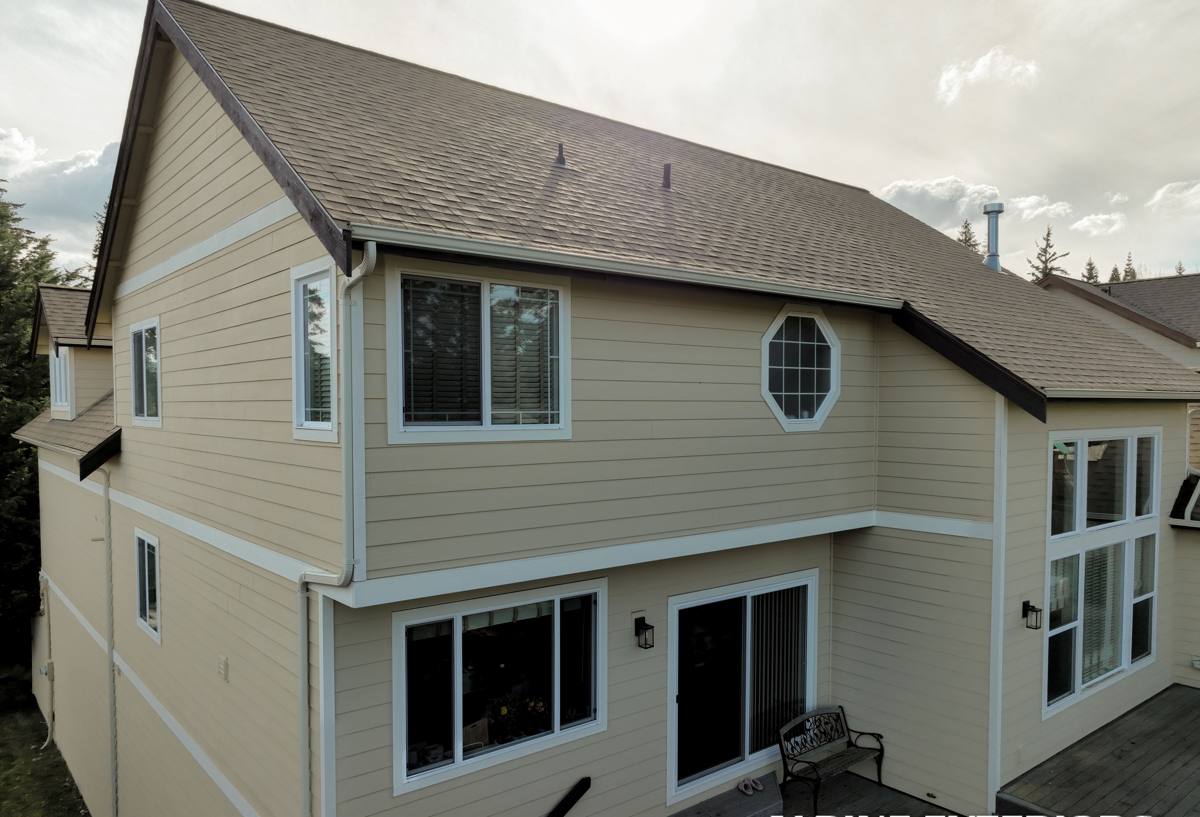
What Fiber Cement Siding Solves for Local Homes
Fiber cement is a mix of cement, sand, and cellulose fibers, cured into a rigid board that doesn't behave like wood or vinyl. That composition matters directly for a climate like this one:
- It doesn't rot. There's no wood fiber for moisture to break down, so the constant dampness of a Skagit County winter doesn't create the soft, crumbling boards you see on old wood or engineered wood siding.
- It resists moss and mildew growth better than porous wood surfaces when it's finished and maintained correctly, because the factory finish seals the surface rather than leaving raw material exposed to the elements.
- It holds paint and color far longer than wood in a wet climate, because it doesn't expand and contract with moisture the way wood does — which is a major reason wood siding finishes fail early here.
- It's non-combustible, which matters less for coastal moisture but is a real, permanent advantage over vinyl and other combustible claddings.
- It stands up to wind-driven rain without warping, cupping, or delaminating the way some engineered wood and OSB-based products can when they take on repeated moisture exposure.
Fiber cement isn't magic, though — it's only as good as the installation behind it. A poorly installed fiber cement job can still trap moisture, fail at the joints, or let water behind the cladding. The material gives you a strong foundation; the workmanship is what determines whether that foundation holds up for 30-plus years or 10.
Why We Only Install James Hardie
We install James Hardie fiber cement exclusively — not other fiber cement brands, and not vinyl, LP SmartSide, primed spruce, or cedar. Hardie's HZ5 product line is specifically engineered for climates with heavy moisture exposure, its ColorPlus finish is factory-baked rather than field-applied, and the company backs it with a strong transferable warranty. We'd rather stand behind one product system we know inside and out than offer a menu of options with different failure points and different maintenance burdens. For a longer breakdown of why we made that call, ask us — we're happy to walk through the trade-offs of the alternatives honestly.
What a Correct Installation Actually Involves
The siding itself is only part of the job. In a climate that drives rain sideways and keeps walls damp for weeks, the assembly behind the boards matters just as much as the boards themselves.
Moisture Management First
Before a single board goes up, the wall needs a properly lapped weather-resistive barrier, correctly integrated flashing at every window, door, and penetration, and a drainage plane that lets any water that does get behind the siding find its way back out instead of sitting against the sheathing. This is the step that gets rushed on cheap jobs and is the single biggest predictor of whether siding lasts.
Fastening and Clearances
Fiber cement needs to be fastened per manufacturer spec — correct nail or screw type, correct spacing, correct penetration depth. It also needs proper clearance from grade, roof lines, decks, and patios so water doesn't wick up into the bottom of the boards. In a wet climate, skipping these clearances is one of the fastest ways to create a rot and moss problem at the base of a wall.
Joints, Caulking, and Trim
Butt joints, corners, and trim intersections are where most siding failures start. Correctly sized gaps, the right sealant used the right way, and factory-mitered or properly flashed corners keep water from working its way in at the seams — which is exactly where wind-driven rain wants to go.
Finish Work
Because we use ColorPlus prefinished panels, field touch-up is minimal, and what does need finishing is done with matched, compatible product. That consistency is part of what keeps color and coverage even across a wall that's going to see years of salt air and UV exposure.
Our Process, Start to Finish
| Stage | What Happens |
|---|---|
| Assessment | We look at the existing siding, sheathing, and trim condition, check for hidden moisture or rot, and identify problem areas like grade clearance or old flashing. |
| Estimate & Plan | You get a clear, written scope — what's being removed, what's being repaired or replaced underneath, and what the finished assembly looks like. |
| Prep & Tear-Off | Old siding comes off, damaged sheathing is identified and addressed, and the wall is prepped for a correct weather barrier and flashing system. |
| Installation | Hardie siding is installed to manufacturer spec — proper fastening, clearances, joint treatment, and trim detailing throughout. |
| Final Walkthrough | We inspect the finished work with you, check caulking and trim lines, and make sure everything meets the standard we'd want on our own home. |
Cost Factors for Fiber Cement Siding Projects
Every home is different, and we don't publish blanket pricing because the real cost drivers vary house to house. Broadly, here's what moves the number:
| Factor | Why It Matters |
|---|---|
| Existing siding & sheathing condition | Hidden rot or moisture damage found during tear-off adds repair scope before new siding can go on. |
| Home size & wall complexity | More corners, gables, and trim details mean more labor and material for correct flashing and joint work. |
| Siding profile & accessories | Lap width, trim style, and accent details affect material cost and install time. |
| Access & site conditions | Multi-story sections, tight lot lines, or landscaping obstacles change scaffolding and staging needs. |
| Color & finish selection | Standard ColorPlus colors versus custom or premium finishes carry different material costs. |
The only way to get a number that means anything is a walk-through of your specific home — which is exactly what a free estimate is for.
Signs Your Current Siding Is Struggling With This Climate
If you're not sure whether it's time to look at replacement, these are the signs we see most often on homes in wetter, salt-exposed parts of Skagit County:
- Persistent moss or dark streaking on north- or shade-facing walls that comes back soon after cleaning
- Paint that's peeling, bubbling, or chalking faster than it should for its age
- Soft or spongy spots on wood or engineered wood siding, especially near the bottom courses
- Visible gaps opening up at joints, corners, or trim where caulking has failed
- Warped, cupped, or separating boards, particularly on walls that face prevailing wind and rain
- Rust streaking from corroding fasteners
- Rising energy bills that may point to a wall assembly that's no longer sealing properly
Any one of these on its own isn't necessarily an emergency, but a few together usually mean the siding and the moisture barrier behind it are past the point where patching makes sense.
Why Hiring a Crew That Already Works in Mount Vernon Matters
Siding that's correct on paper can still fail if it's installed without accounting for how this specific area's weather behaves. A crew that regularly works Skagit County homes already knows to prioritize drainage and clearance details, expects moss and moisture issues in certain wall orientations, and doesn't treat flashing and sealant work as an afterthought. That's not a marketing point — it's the difference between siding that looks right for a season and siding that actually performs for decades in salt air and driving rain. We'd rather take the time to get the assembly right the first time than come back to fix a callback born from cut corners.
Maintenance That Keeps It Performing
Fiber cement is low-maintenance compared to wood, but "low-maintenance" doesn't mean "no maintenance" in a climate like this one. A periodic gentle wash to keep salt residue and moss spores from building up, prompt attention to any caulking that starts to crack or separate, and keeping gutters and downspouts clear so water isn't dumping directly onto walls all go a long way toward getting the full lifespan out of the material and finish.
If your Mount Vernon home's siding is showing its age, or you're planning ahead for a replacement, we're glad to take a look and give you an honest read on what your home actually needs. Fill out the form below for a free, no-pressure estimate.