 Anacortes Exterior
 Why Siding Repair Looks Different in Edison
Edison sits low against Samish Bay in Skagit County, in a stretch of farmland and tidal flats that gets more sustained exposure to salt-laden air, wind-driven rain, and organic growth than a lot of inland Skagit County properties do. That combination doesn't just make siding look worn faster — it changes what actually needs to happen when something goes wrong. A repair that would hold up fine on a sheltered inland lot can fail again within a season or two out here if it doesn't account for what this particular stretch of coastline and farmland does to a wall over time.
Siding repair, done correctly, starts with understanding why a board failed in the first place, not just replacing what's visibly damaged. On a lot of Edison homes — a mix of older farmhouses and newer construction, many with limited tree cover and full exposure to open fields and water — that means paying close attention to fastener corrosion, moisture behind the cladding, and the organic growth that a long moss season leaves behind. This page walks through what actually damages siding here, how a proper repair is scoped, and why hiring a crew that already works this part of Skagit County makes a real difference in whether that repair lasts.
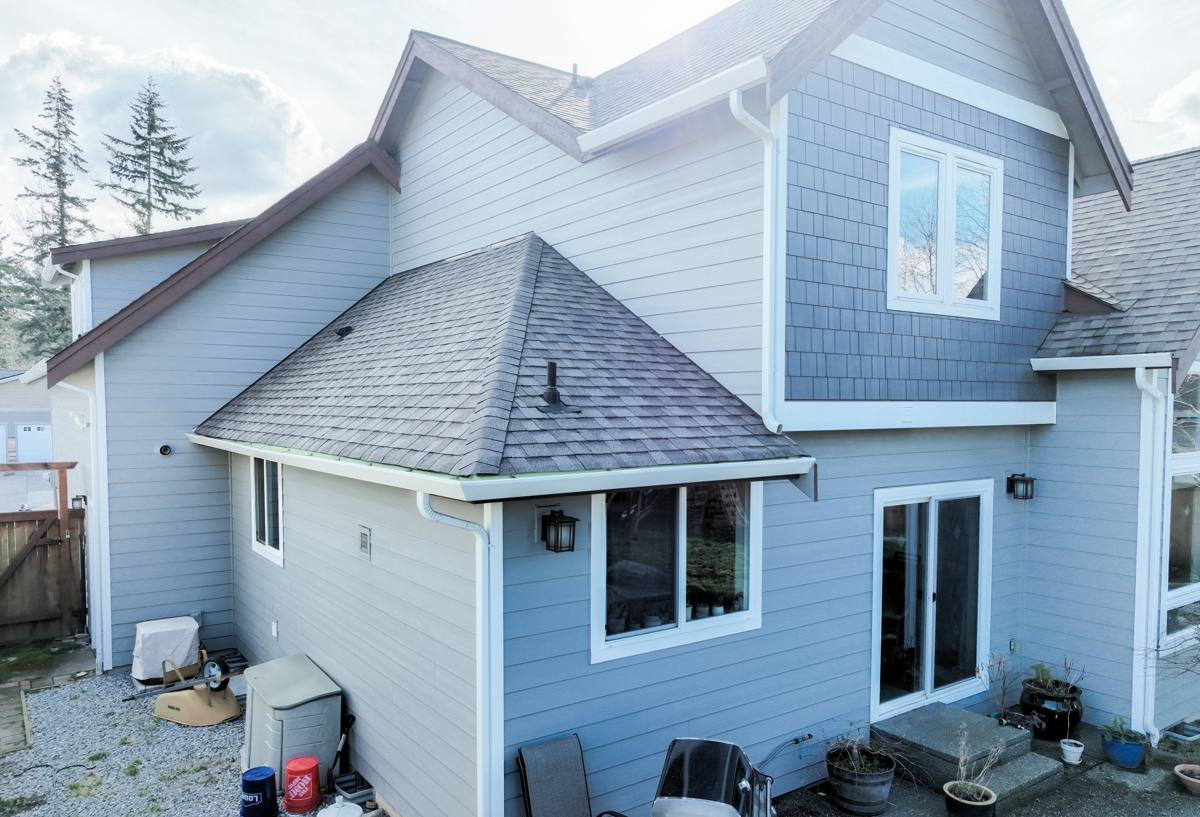
What Actually Damages Siding in Edison
Salt Air Off Samish Bay
Air moving off the bay carries salt that settles on siding, trim, and fasteners continuously, not just during storms. That steady exposure accelerates corrosion in nails, screws, and any exposed metal flashing well before the corrosion is visible from the ground. A fastener that's lost its holding strength doesn't announce itself — it shows up later as a board that's started to lift at one edge or a section of trim that's pulling slightly away from the wall.
Wind-Driven Rain
Rain here rarely falls straight down for long. Storm systems moving through push rain sideways into walls, which tests laps, seams, and trim lines that were only ever designed to shed water moving downward. Open, low-lying land around Edison offers little wind break, so walls facing the prevailing weather tend to take a disproportionate share of this exposure and show problems first.
A Long Moss Season
Mild, damp conditions keep moss and mildew active across most of the year on shaded and north-facing walls, and on siding that sits close to trees, hedges, or outbuildings. Organic growth isn't just cosmetic — it holds moisture against the siding surface long after the rest of the wall has dried, extending every wet cycle the material goes through and giving water more time to find a way in at joints and fastener holes.
Low-Lying Farmland and Persistent Moisture
The flat, open farmland surrounding Edison holds humidity and morning moisture longer than higher, better-drained ground does. Combined with limited direct sun on some elevations, siding here can stay damp for stretches that a drier or more elevated Skagit County property wouldn't experience, which is part of why timelines for organic growth and wood decay tend to run faster on these lots.
Cosmetic Wear vs. Structural Damage
Not every issue on aging siding needs the same response, and telling the difference correctly is the first real job of a repair estimate.
| Symptom | Usually Cosmetic | Often Structural |
|---|---|---|
| Faded or chalky paint finish | Yes — sun and weathering | Rarely on its own |
| Moss or dark staining on shaded walls | Yes, if surface only | If it's held moisture there for a long time |
| Small cracks at board ends or corners | Sometimes — caulk failure | Often — a moisture path into the wall |
| Soft or spongy spot when pressed | No | Yes — rot or moisture damage underneath |
| Rust streaking below fasteners | Cosmetic if isolated | Can indicate fastener failure underneath |
| Bulging, warping, or separated boards | No | Yes — usually trapped moisture behind the siding |
Cosmetic issues can typically wait for routine maintenance. Structural issues — soft spots, warping, separated boards — mean water has already reached the sheathing or framing behind the siding and shouldn't be deferred, because the damage is almost always further along than it looks from the outside.
How We Diagnose Siding Before Recommending Repair
A repair estimate that's actually worth something starts with a real inspection, not a guess based on what's visible from the driveway. That typically includes:
- Probing suspect boards and trim for soft spots that indicate moisture damage, not just a visual look from a distance
- Checking fasteners, flashing, and any exposed metal for corrosion, especially on walls facing open water or fields
- Inspecting caulk joints and butt seams for cracking or separation, since these are the most common entry points for water
- Looking at grading and drainage around the foundation, since standing water at the base of a wall accelerates every other problem on this list
- Checking for organic growth patterns that indicate a wall staying wet longer than it should
- Identifying the existing siding material correctly, since repair options differ significantly between fiber cement, wood, engineered wood, and vinyl
We walk through what we find honestly — what needs attention now, what can be monitored, and what's purely cosmetic — before recommending a scope of work.
Repair Options Depend on What's Already on the Wall
Edison has a mix of siding materials on it, and what a correct repair looks like depends heavily on which one you have. We only install James Hardie fiber cement on new work and full re-sides, but repair calls come in on homes with whatever siding was put on years or decades ago, and we're upfront about what each material allows.
| Existing Material | Repairability | Our Approach |
|---|---|---|
| James Hardie fiber cement | Good — boards replace cleanly, ColorPlus finish can often be matched | Replace damaged boards, re-detail flashing and caulk, match finish where possible |
| Cedar or primed wood | Fair — depends heavily on how far rot has spread | Replace affected boards and address the moisture source; recommend re-siding if damage is widespread |
| LP SmartSide / engineered wood | Fair — sound sections repair well, edge-swollen boards usually don't | Replace swollen or delaminated sections; flag when patching won't hold long-term |
| Vinyl siding | Limited — exact color and profile matches get harder as panels age and fade | Patch where a reasonable match exists; explain honestly when a visible mismatch is likely |
When a homeowner's existing siding is beyond a reasonable repair — widespread rot, chronic moisture problems, or a material that's simply reached the end of what patching can fix — our recommendation is a full re-side in James Hardie. That's not an upsell reflex; it's what we've standardized on because it holds up to this exact climate better than the alternatives, and it's the only material we stand behind for new installation.
What a Correct Fiber Cement Repair Involves
Matching the ColorPlus Finish
James Hardie's factory-applied ColorPlus finish is baked on under controlled conditions, which is part of why it holds color so much longer than field-applied paint. Matching it exactly on a repair depends on how long the original siding has been up and whether that color is still in current production. We'll tell you plainly if an exact match isn't realistic and what the visible options are — a close match, a full wall repaint, or, on older installations, replacing a full elevation rather than patching a visible seam.
Replacing Full Boards, Not Patching
Fiber cement doesn't patch well the way some materials do. A correct repair replaces the full damaged board or course, cut and fastened to the same spec as new installation, rather than filling or overlaying a damaged section. This keeps the repair structurally sound and avoids creating a new weak point where a patch meets the original material.
Flashing and Caulk Joints Get Redone, Not Just the Board
Most fiber cement damage traces back to a flashing or caulk failure that let water behind the board in the first place. Replacing the board without correcting that underlying detail means the same failure shows up again in the same spot. Every repair includes checking and, where needed, redoing the flashing and joint sealing around the affected area — not just swapping the damaged piece.
Repair vs. Full Re-Side: How That Decision Gets Made
Homeowners often assume any siding problem means a full re-side, or the opposite — that a patch will always be the cheaper, equally good option. Neither assumption holds up consistently. The honest factors that actually drive this decision:
- How much of the wall is affected. Isolated damage to a few boards is usually a straightforward repair. Damage spread across multiple elevations often means the underlying moisture problem is systemic, not local.
- What's happening behind the siding. If sheathing or framing has been compromised, a board-level repair doesn't address the real problem — the wall assembly needs to be opened up and corrected properly.
- Age and material of the existing siding. Siding nearing the end of its practical life may only have a repair cycle or two left before replacement becomes the more sensible investment.
- Whether a color or profile match is realistic. On aged vinyl or discontinued finishes, a technically sound patch can still leave a visible mismatch that bothers homeowners more than the original damage did.
We'll give a straight answer on which category a given repair falls into, including when replacement is genuinely the better path, rather than defaulting to whichever job is bigger.
Maintenance That Extends a Repair's Lifespan
- Rinse siding periodically to clear salt residue and organic buildup before it works into joints and fastener holes
- Trim back vegetation and clear debris from shaded walls to slow moss and mildew regrowth
- Check caulk joints once or twice a year, especially after fall and winter storms, for early cracking or separation
- Keep gutters and downspouts clear so roof water isn't dumping onto siding or pooling at the base of a wall
- Watch for soft spots, bulging, or staining and address them right away rather than waiting for the next inspection
- Maintain grading and drainage around the foundation so water moves away from the wall instead of sitting against it
Why It Matters That We Already Work in Edison
A crew that mainly works drier, more sheltered parts of Skagit County can still do competent siding work, but Edison's exposure to open water, wind, and low-lying farmland brings up variables more often than they'd see elsewhere. We know which walls in this area tend to take the worst of the wind-driven rain, how fast moss regrows on shaded farmhouse siding here compared to more elevated lots, and what fastener and flashing detailing actually holds up against sustained salt air rather than just passing inspection on day one. That familiarity means a more accurate first estimate and fewer surprises once a repair is underway, because the diagnosis accounted for how this specific stretch of Skagit County behaves rather than applying a generic checklist built for somewhere else.
Whether you're dealing with a specific problem — a soft spot, a failing caulk joint, storm damage — or just want a straight assessment of where your siding stands, we're glad to take a look and explain what we find plainly, including when the honest answer is that it doesn't need much yet. Reach out below for a free, no-pressure estimate.