 Anacortes Exterior
 Edison sits out in the farmland and tideflats west of Burlington, close enough to the water that the same salt air and marine weather patterns that shape Anacortes and the rest of Skagit County reach right into town. It's a small community, mostly older homes and a few newer builds mixed in among working farms, and the exterior materials that hold up here are not always the same ones that hold up in a drier, more sheltered part of the state. We do James Hardie siding installations in Edison as part of our regular Skagit County service area, and the climate here is exactly why we only install one type of siding.
What Edison's Climate Does to a House
Edison is low-lying, close to tidal water and open farmland, which means wind has very little to slow it down before it hits a house. That translates into more driving rain contact on exterior walls than a home would see if it were tucked into trees or shielded by other buildings. Add in the long stretch of gray, damp months that define a Pacific Northwest winter, and siding here spends a lot of the year staying wet rather than drying out between storms.
Moss and algae are a direct result of that moisture pattern. Anywhere shaded or slow to dry — north-facing walls, areas under eaves, spots near mature trees or outbuildings — tends to grow a green film over a season or two if the surface holds moisture. On some materials that's cosmetic. On others, particularly wood-based products, sustained moisture contact is how rot gets started, usually from the inside of the material out, which means it's often further along than it looks by the time it's visible.
Conditions We Watch For on Edison Homes
- Wind-driven rain intrusion at wall penetrations, corners, and window and door trim
- Moss and algae buildup on shaded or north-facing siding and roof slopes
- Corrosion on fasteners, flashing, and hardware that isn't rated for coastal-adjacent exposure
- Caulk and trim joints that have opened up from repeated wet-dry cycling over the years
- Soft or discolored siding near grade level or downspouts, where splashback keeps a wall wet longer
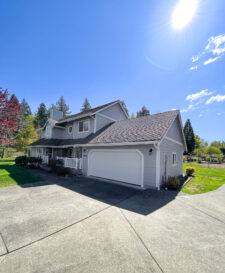
Why We Only Install James Hardie Here
We install James Hardie fiber cement siding exclusively — no vinyl, no LP SmartSide, no Cemplank, no Allura, no primed spruce, no cedar. That's a standard we hold across every job we do in Skagit County, and a farmland-and-tidewater town like Edison is a fair test of why. Vinyl siding isn't a water barrier by itself; it depends entirely on the weather-resistant barrier and flashing behind it, and it can go brittle with age and UV exposure. On a wall that's taking direct wind-driven rain regularly, that's not a small weak point. Wood-based products — cedar, primed spruce, engineered wood like LP SmartSide — need consistent repainting or recoating to stay ahead of moisture, and if that maintenance slips even for a season or two in a climate this wet, rot can start before anyone notices.
James Hardie's fiber cement is non-combustible, dimensionally stable in temperature and moisture swings, and finished at the factory with ColorPlus coating rather than field-painted. That factory finish is baked on under controlled conditions and holds color and resists cracking far better than a coat of paint applied on-site, which matters in a climate that doesn't give paint many good drying days. It's also engineered specifically for wetter climate zones, which is the category Skagit County falls into.
Hardie Product Lines We Work With
| Product Line | Best For | Notes |
|---|---|---|
| HardiePlank Lap Siding | Most Edison homes, farmhouse and traditional styles | Smooth or cedar-textured finish, wide color range |
| HardiePanel Vertical Siding | Gable ends, accent walls, outbuildings, modern additions | Clean vertical lines, often paired with lap siding |
| HardieTrim Boards | Window and door surrounds, corners, fascia | Resists the swelling and rot that plague wood trim in wet climates |
| HardieShingle Siding | Accent gables, homes wanting a shingle look without wood upkeep | Staggered or straight-edge panel options |
What a Correct Hardie Installation Actually Involves
The siding itself is only part of what makes an installation last. A lot of the failures we see on older homes in this area trace back to installation shortcuts, not the material that was originally used. Getting a Hardie job right in a climate like Edison's comes down to a handful of details that are easy to skip and expensive to fix later.
Water Management Comes First
Before any siding goes up, the wall needs a properly lapped weather-resistant barrier, correctly integrated flashing at every window, door, and penetration, and rainscreen or drainage detailing where it's called for. Hardie siding is durable, but it's still a cladding system — it works with the water management behind it, not instead of it. On a house taking regular wind-driven rain, a flashing detail that's slightly off is where water eventually finds its way in.
Fastening and Clearances
James Hardie publishes specific fastening patterns, nail types, and minimum clearances from grade, roof lines, and other surfaces, and those specs exist for a reason — get them wrong and you invite moisture intrusion or cracking at stress points. We follow manufacturer installation guidelines to the letter, not because it's required for the warranty to apply (though it is), but because it's the difference between siding that lasts decades and siding that starts showing problems in five years.
Caulking and Joint Treatment
Every seam, joint, and trim intersection is a potential entry point for water if it's not sealed correctly with the right product. In a climate that cycles wet and dry as often as this one does, cheap or improperly applied caulk fails faster than it would somewhere drier, and a failed joint on a wind-exposed wall lets water in every time it rains.
Our Process for an Edison Siding Job
- Free on-site inspection and consultation — we walk the exterior, check existing siding and trim condition, and look at what's driving any current problems
- Written estimate covering material, labor, disposal of old siding, and any repair work needed to sheathing or framing found during removal
- Scheduling that accounts for weather windows — we don't install siding during active rain, and we sequence work to keep the wall protected between removal and new siding going up
- Removal of old siding and inspection of the wall assembly underneath, including sheathing, framing, and any existing water damage
- Weather-resistant barrier and flashing installation or repair before any new siding goes on
- Hardie siding, trim, and accessory installation to manufacturer specification
- Final walkthrough with the homeowner to review the completed work
Cost Factors for a Hardie Siding Job in Edison
Every home is different, and we don't quote a price without seeing the property, but there are common factors that move the number up or down. Knowing them ahead of time makes the estimate conversation more useful.
| Factor | Why It Matters |
|---|---|
| Home size and wall complexity | More square footage and more corners, gables, and trim details mean more labor and material |
| Condition of existing sheathing | Rot or water damage found during removal adds repair scope before new siding can go on |
| Product line and finish selection | Lap, panel, and shingle profiles and ColorPlus color options carry different material costs |
| Access and site conditions | Outbuildings, tree cover, or tight farm-lot access can affect staging and scaffolding needs |
| Trim and detail work | Window and door surrounds, corner boards, and fascia add labor beyond the flat wall area |
Why a Crew That Already Works This Area Matters
Edison isn't a big town, and it doesn't get the volume of contractor attention that Anacortes or Bellingham do. That can mean longer waits for a crew that's willing to make the drive, or homeowners settling for whoever's available rather than whoever does the best work. We work throughout Skagit County, including Edison, on a regular basis, so we're not treating it as an out-of-the-way stop — it's part of our normal service area.
Working this area repeatedly also means we've seen how the local conditions — the open exposure, the farmland setting, the mix of older and newer construction — actually play out on a wall over time, not just in theory. That shapes decisions we make on-site: where we pay extra attention to flashing, which walls are most exposed and deserve the most careful detailing, and what maintenance realities we flag for the homeowner before we ever start.
Maintaining Hardie Siding Once It's Installed
Part of why we recommend Hardie is that it asks very little of a homeowner after installation, but "very little" isn't "nothing." A short annual routine keeps it performing the way it's supposed to.
- Rinse siding with a garden hose once or twice a year to clear off salt residue, pollen, and general grime — a pressure washer isn't necessary and can damage caulk joints if used carelessly
- Check caulking at trim joints and penetrations annually, especially after the wettest months, and have any cracked or missing caulk redone before it becomes a leak point
- Keep gutters clear and downspouts directed away from the foundation to reduce splashback onto lower siding courses
- Trim back vegetation that's shading siding and keeping it from drying out between rains
- Watch for chalking, fading, or any spot where the ColorPlus finish looks different from the rest of the wall, and have it looked at — it's usually minor if caught early
What James Hardie's Warranty Covers
James Hardie backs its siding with a non-prorated limited warranty that's transferable to a subsequent homeowner, which matters both for your own peace of mind and for resale value down the line. ColorPlus finished products carry their own finish warranty covering fading and cracking of the factory coating separately from the substrate warranty. The specific terms depend on the product line and finish selected, and we walk through the exact coverage during the estimate so there are no surprises about what is and isn't included.
If you're weighing a siding replacement or new construction siding for a home in Edison, we're happy to come take a look and give you a straight, no-pressure read on what your house needs and why we'd recommend James Hardie for it. Reach out for a free estimate — there's no obligation, and we'll explain our reasoning in plain terms, not sales language.