 Anacortes Exterior
 Building Decks for Ship Harbor's Marine Climate
Ship Harbor sits close enough to the water that every deck built here deals with three things a deck in a drier inland town never has to: salt-laden air, driving wind-blown rain, and a long stretch of the year where surfaces barely get a chance to dry out before the next system rolls through. Anacortes and the rest of Skagit County get a marine push straight off Rosario Strait and the San Juans, and that air carries fine salt that settles on everything — railings, fasteners, framing connectors, even the underside of decking boards. Add in shade from evergreens and the damp fall-through-spring stretch, and you get moss and algae growth that most homeowners inland never have to think about.
None of that means a deck can't last for decades out here. It means the design, material choices, and hardware have to account for corrosion and moisture from day one, not as an afterthought. A deck built the same way you'd build one in a dry eastern Washington town will show rust streaks, soft spots, and slick moss patches years before it should.
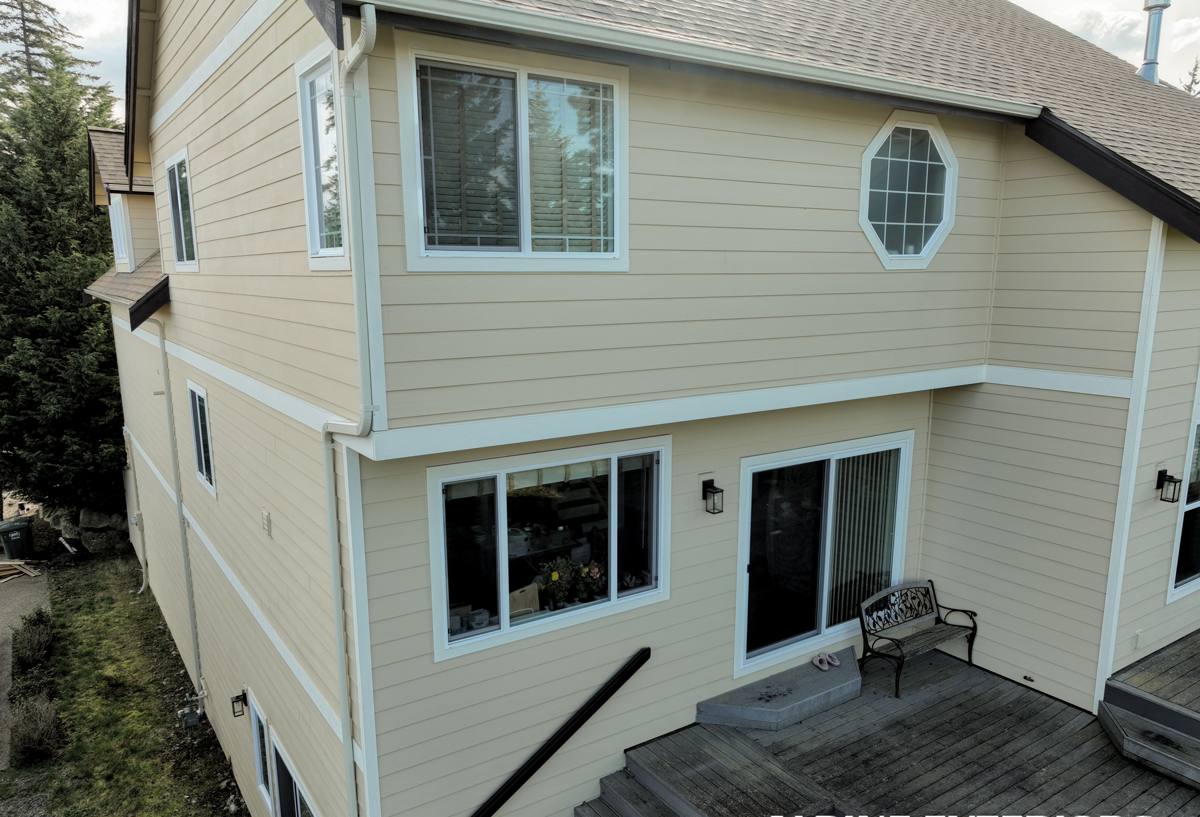
What Ship Harbor Homes Actually Need From a Deck
Wind and Salt Exposure
Homes closer to the water catch more direct salt spray and steadier wind, which accelerates corrosion on anything metal — nails, screws, joist hangers, railing brackets. Homes set back or shielded by trees deal less with salt and more with shade, moisture retention, and moss. Either way, the deck's hardware and fastener spec matters more here than it would in most parts of the state.
Drainage and Slope
A deck that doesn't shed water fast enough will hold moisture in the wood fibers or composite core longer than it should, especially under our fall and winter rain totals. Proper slope away from the house, gapped decking for airflow, and clear drainage paths underneath the structure all matter more here than they would in a dry climate.
Sun, Shade, and Moss
Decks tucked under tree cover or on the north side of a house stay damp longer and grow moss faster. That's not a defect in the deck — it's just what happens in this climate — but it does mean material choice and surface texture should account for it, since moss on a deck surface is also a slip hazard.
Choosing Decking Material for This Climate
There's no single "best" decking material — there's a best fit for your budget, your sun exposure, and how much upkeep you actually want to do. Here's how the common options hold up specifically against salt air, rain, and moss:
| Material | Moisture & Moss Behavior | Maintenance | Typical Lifespan Here |
|---|---|---|---|
| Pressure-treated fir/pine | Absorbs moisture readily; needs sealing to resist moss and swelling | Re-stain/seal every 1-2 years | 10-15 years with upkeep |
| Cedar | Naturally moisture- and rot-resistant, still grows moss in deep shade | Periodic cleaning and oil/sealer | 15-20 years with upkeep |
| Composite (capped) | Doesn't absorb water or rot; moss can still grow on the surface film | Occasional washing, no sealing/staining | 25-30+ years, manufacturer-warrantied |
| PVC decking | Fully moisture-proof core; surface moss is a cleaning issue, not a structural one | Wash as needed | 25-30+ years, manufacturer-warrantied |
We'll walk through these trade-offs against your actual site — how much sun the deck gets, whether it's close to the water, and what you want to spend on upkeep — rather than push one product as a default. Composite and PVC cost more upfront but remove most of the moisture-related maintenance that real wood demands in this climate. Wood costs less initially but only performs well here if you're committed to sealing it on schedule.
Framing and Fasteners: Where Corrosion Actually Starts
Most deck failures we see in coastal Skagit County neighborhoods don't start with the decking boards — they start underneath, where cheap fasteners and connectors corrode out of sight for years before anyone notices.
Ledger Board Attachment
The ledger board — where the deck attaches to the house — is the single most important structural connection on the whole project. It needs proper flashing to keep water from getting behind the siding, and it needs to be through-bolted or lag-screwed with hardware rated for the exposure, not just whatever's on the shelf.
Fasteners and Hardware
In a salt-air environment, mild steel or basic galvanized screws corrode faster than they would inland. Our standard is stainless steel or heavy hot-dip galvanized fasteners and connectors rated for exterior/coastal use, matched to whatever decking material is going down (some coated composites require specific fastener types to avoid a reaction with the board's coating). This costs a bit more than a generic hardware run, but it's the difference between hardware that's still tight in fifteen years and hardware that's rust-streaked and loosening in five.
Framing Material
Joists and beams get treated lumber rated for ground contact where moisture exposure calls for it, with cut ends re-treated on site. We also pay attention to airflow under the deck — a structure with no ventilation underneath holds moisture against the framing far longer than one that can breathe and dry between storms.
Our Custom Deck Process
- On-site assessment — we look at sun exposure, drainage, proximity to the water, existing structure (if replacing a deck), and how you actually want to use the space.
- Design and material selection — we go over decking, railing, and fastener options against your budget and maintenance preference, with the climate trade-offs explained plainly.
- Permitting — we handle the permit application and inspection scheduling through the appropriate local jurisdiction.
- Demo (if applicable) — removal of the old deck, with an honest look at what condition the ledger, posts, and footings are actually in before we build on or around them.
- Framing — footings, posts, beams, and joists built to span and load requirements, with corrosion-rated hardware throughout.
- Decking, railing, and finish work — installed per manufacturer spec (critical for composite/PVC warranties), with attention to drainage gaps and slope.
- Final walkthrough — we go over care and maintenance specific to the material you chose before we call the job done.
Railings, Fascia, and Finish Details
Railings take as much weather abuse as the deck surface, sometimes more, since they're fully exposed with nothing shading them. Metal cable and aluminum railing systems need marine-grade or coated hardware to avoid streaking and pitting. Wood railings need the same sealing discipline as wood decking. Composite and PVC railing systems generally hold up the best against salt air with the least upkeep, which is why we see them requested often for decks with direct water exposure.
Fascia boards and skirting deserve the same attention — they're the parts of a deck most likely to be overlooked during routine cleaning, and the first place moss and algae show up because they get less direct sun and airflow than the deck surface itself.
Maintenance Checklist for Salt-Air Decks
Whatever material you choose, a few habits go a long way toward getting the full lifespan out of it in this climate:
- Rinse salt residue and debris off the deck surface and railings a few times a year, more often if you're close to the water
- Clear leaves and needles out of gaps between boards so moisture doesn't sit trapped
- Check and clear drainage paths underneath the deck before the wet season starts
- Inspect fasteners and railing brackets annually for rust streaking or looseness
- Re-seal or re-stain wood decking on the schedule the product actually requires, not just when it looks dry
- Address moss with a gentle wash rather than pressure-washing wood aggressively, which can damage the fibers
- Keep overhanging branches trimmed back to cut down on shade and debris buildup
Permits and Code Considerations Locally
Most new decks and deck replacements in and around Anacortes require a building permit, and requirements can shift depending on deck height, size, and whether it's attached to the house. We handle the permit process as part of the job rather than leaving it for the homeowner to sort out, and we build to the load, guardrail, and attachment requirements the local building department inspects for. If your property is close enough to the shoreline, there can also be additional review depending on the specific location — something we check into before design work gets locked in rather than after.
Why Hire a Crew That Already Works Ship Harbor
A deck built without accounting for this specific stretch of coastline will look fine the first summer and start showing problems within a few years — rust bleeding from fastener heads, moss taking over shaded boards, a ledger connection that's held moisture against the house siding. We work exteriors throughout Anacortes and the rest of Skagit County regularly enough to know which fastener grades hold up, which materials are worth the extra upfront cost near the water, and where drainage tends to get overlooked on this kind of terrain. That's not something you get from a generic deck-building crew working from a one-size-fits-all spec sheet.
If you're planning a new deck or replacing one that's showing its age, we're happy to take a look and put together a straightforward estimate — no pressure, no sales pitch, just an honest read on what your specific property needs. Use the form below to get started.