 Anacortes Exterior
 Building a Deck That Actually Holds Up in Mount Vernon
Mount Vernon sits close enough to the water and low enough in the Skagit Valley that decks here take a different kind of beating than decks in drier parts of the state. It's not one dramatic storm that wrecks a deck out here — it's the slow, steady combination of salt-tinged air drifting in off the Sound, months of driving rain, and a moss season that seems to start earlier and last longer every year. A deck built without those specifics in mind will look fine for a season or two, then start showing problems: soft spots near the house, black streaking on the boards, hardware that bleeds rust, and a green film that never fully goes away no matter how often it's swept.
We build and repair decks throughout Anacortes and Mount Vernon, and the difference between a deck that lasts 20-plus years and one that needs major repair in five almost always comes down to a handful of construction details most homeowners never see until something fails. This page walks through what those details are, what a correctly built deck looks like in this climate, and how we approach the work.
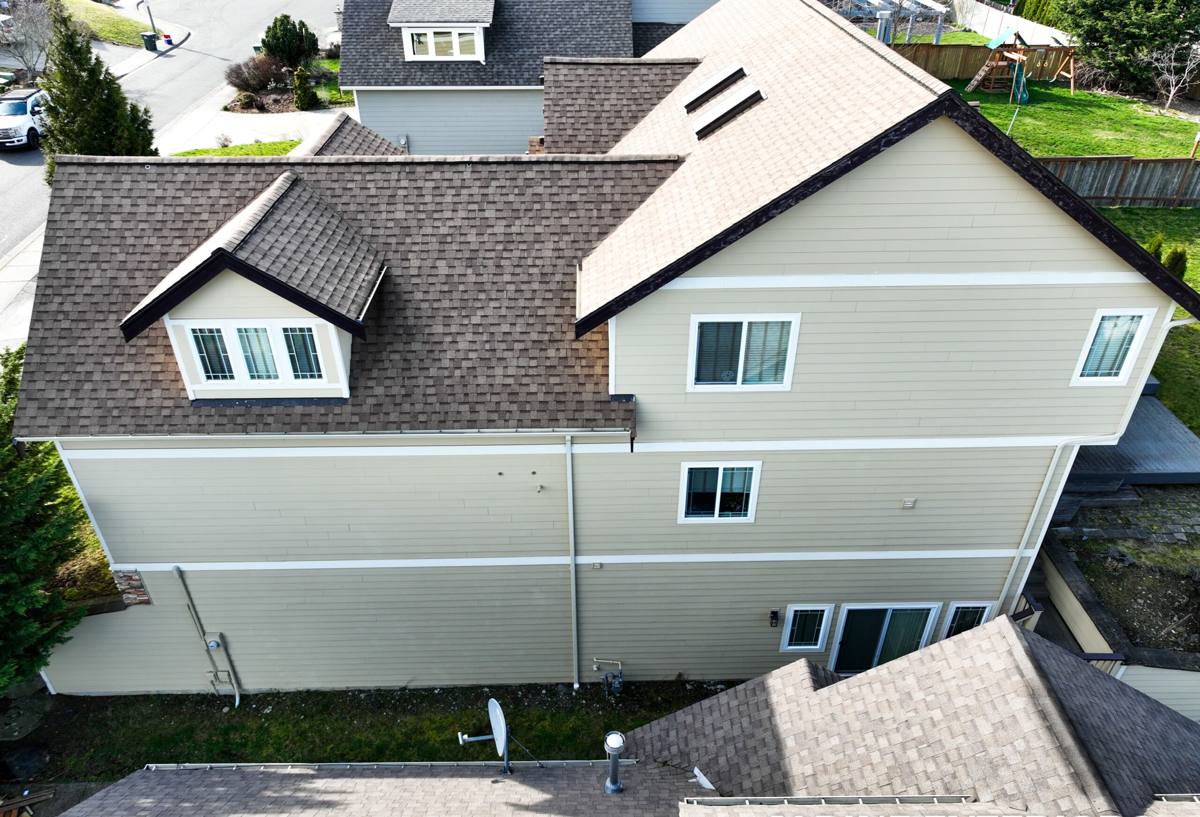
What Skagit County Weather Does to a Deck
Three regional factors matter more here than in most parts of the country, and any deck builder working in Mount Vernon needs to design around all three, not just one.
Salt Air and Corrosion
Mount Vernon isn't right on the coastline the way parts of Anacortes are, but it's close enough that airborne salt reaches inland on windier days, especially in exposed or elevated yards. Salt-laden moisture accelerates corrosion in fasteners, brackets, and any exposed metal hardware. Standard zinc-coated screws and joist hangers that would be fine in an inland climate can start rusting and staining lumber within a couple of years in this environment.
Sustained, Driving Rain
Skagit County doesn't get the heaviest rainfall in the state, but it gets a lot of days of it — steady, low-intensity rain that finds its way into every gap, seam, and fastener hole over time. The issue isn't a single downpour; it's cumulative moisture exposure across months. Any place water can collect, pool, or get trapped against wood eventually will, and that's where rot starts.
Moss and Organic Growth
Shaded yards, tree cover, and the region's damp, mild climate create ideal conditions for moss, algae, and mildew on deck surfaces — particularly on the north side of a house or under overhangs where boards don't get much sun or airflow. Moss holds moisture against the board surface, which speeds up decay in untreated or poorly ventilated decking, and it makes stairs and walking surfaces genuinely slippery.
Where Decks in This Area Actually Fail
We see the same failure points repeatedly on older or poorly built decks in Mount Vernon:
- Ledger board attachment to the house without proper flashing, letting water track behind the siding and into the rim joist
- Joist hangers and fasteners that weren't rated for exterior or coastal-adjacent exposure, corroding and weakening structural connections
- Decking boards installed tight together with no gap, trapping moisture and debris between boards
- Footings that are too shallow or undersized for the Skagit Valley's soil and frost conditions
- Poor airflow underneath the deck, especially on ground-level or low-clearance builds, which keeps framing damp long after rain stops
- Railings and stair stringers that were never designed to current code, creating a liability the homeowner doesn't find out about until a sale or inspection
Individually, any one of these might not cause a failure right away. Combined with year-round Pacific Northwest moisture, they compound quickly.
What a Correctly Built Deck Involves
Footings and Framing
Everything starts below the surface. Footings need to be sized and set to the depth required for this region's soil and frost line, not just poured to a minimum. Framing lumber should be rated for ground contact where it's close to grade, and every structural connection — ledger to house, joist to beam, post to footing — needs hardware rated for exterior and corrosive-adjacent exposure. This is the part of a deck nobody sees once it's finished, and it's the part that determines whether the deck is still solid in fifteen years.
Ledger Flashing
Where a deck attaches to the house, proper flashing is non-negotiable. Water that gets behind an improperly flashed ledger board doesn't just damage the deck — it can rot the house's rim joist and sheathing, turning a deck problem into a structural home repair. We treat ledger flashing as one of the highest-priority details on every attached deck we build.
Decking Material Choice
Material choice matters more here than in a dry climate, because every material behaves differently under sustained moisture and moss exposure. There's no universally "best" decking material — the right choice depends on budget, maintenance tolerance, and how much shade and moss pressure the site has.
| Material | Moisture & Moss Behavior | Maintenance | Typical Lifespan Here |
|---|---|---|---|
| Pressure-treated lumber | Resists rot with proper sealing; can still hold surface moss if not maintained | Needs re-sealing every 2-3 years | 15-20 years with upkeep |
| Cedar | Naturally moisture- and insect-resistant; still needs sealing to prevent graying and moss buildup | Sealing or staining every 2-3 years | 15-25 years with upkeep |
| Composite decking | Doesn't rot, but moss and algae can still grow on the surface film in shaded, damp spots | Periodic washing, no sealing needed | 25-30+ years |
| PVC decking | Fully moisture-resistant; least susceptible to organic growth with proper cleaning | Occasional washing | 30+ years |
We're honest with homeowners that composite and PVC decking cost more up front but eliminate the sealing cycle entirely, which matters in a climate where skipping a maintenance year has real consequences. Wood decks are still a good choice for homeowners who prefer the look and are willing to keep up with sealing on schedule — the trade-off is maintenance discipline, not durability alone.
Fasteners and Hardware
Every screw, bracket, and joist hanger on a deck we build in this area is rated for exterior exposure at minimum, and we upgrade to stainless or heavier corrosion-resistant hardware on decks that are more exposed to salt air or driving rain — elevated decks, waterfront-adjacent lots, or anything facing prevailing weather. Cheap or mismatched hardware is one of the most common causes of premature deck failure we see, and it's one of the cheapest things to get right the first time.
Board Spacing and Airflow
Correct gapping between deck boards lets water drain through instead of pooling on the surface, and it lets air move underneath the deck to keep framing dry. Low-clearance decks need extra attention here — sometimes that means additional venting or a slight regrade underneath so water doesn't sit against the joists.
Moss Prevention: What Actually Helps
No deck in Mount Vernon is fully moss-proof if it sits in shade, but design choices make a real difference:
- Proper board spacing so moisture drains instead of collecting on the surface
- Sealing wood decking on schedule, since a sealed surface resists moss adhesion far better than weathered, exposed wood
- Choosing composite or PVC in heavily shaded yards where wood would need constant upkeep
- Keeping nearby vegetation trimmed back to let sunlight and airflow reach the deck surface
- Periodic washing with a deck-safe cleaner rather than a high-pressure wash that can damage board surfaces or force water into seams
We factor site conditions — how much shade a yard gets, how close it is to the water, which direction it faces — into the material and maintenance recommendation for every deck we quote.
Our Process for Custom Deck Projects
1. Site Visit and Assessment
We look at sun exposure, drainage, existing grade, proximity to the house's siding and roofline, and how exposed the site is to wind and rain. This tells us what framing depth, hardware grade, and material recommendations make sense for that specific yard.
2. Design and Material Selection
We walk homeowners through the real trade-offs between wood and composite or PVC decking for their situation — not a one-size-fits-all pitch, but an honest look at budget versus long-term maintenance for their specific site.
3. Permitting
Most deck projects in Mount Vernon and the surrounding Skagit County area require a building permit, particularly for elevated decks or anything attached to the home's structure. We handle the permitting process as part of the project so homeowners aren't left navigating it alone.
4. Construction
Footings, framing, ledger flashing, and hardware come first — the parts that determine the deck's structural life. Decking, railings, and stairs go on last, built to current code for rail height and baluster spacing.
5. Final Walkthrough
We go over maintenance expectations specific to the material chosen — sealing schedule for wood, cleaning cadence for composite or PVC — so homeowners know exactly what upkeep their new deck needs to hit its full lifespan in this climate.
Why Local Experience with Mount Vernon Conditions Matters
A deck builder who mostly works in drier inland climates will often under-spec hardware, skip or shortcut ledger flashing, or recommend a material without accounting for how much moss pressure a shaded Skagit Valley yard actually gets. We work in Anacortes and Mount Vernon regularly, which means we're not guessing at how this region's rain patterns, salt exposure, and moss season affect a deck over time — we're building around conditions we deal with on every project.
That local familiarity also shows up in smaller ways: knowing which yards tend to hold more moisture after a storm, which sites get more wind-driven rain, and which material choices homeowners in this area tend to regret versus stick with. None of that comes from a materials catalog — it comes from building and maintaining decks here for years.
Repair, Replacement, or New Build
Not every deck problem means starting over. We evaluate existing decks for homeowners who are seeing early warning signs — soft boards, rust streaking, sagging near the ledger — and give a straight answer on whether targeted repair makes sense or whether the framing has deteriorated enough that a full rebuild is the more honest long-term investment. We'd rather tell a homeowner a repair will hold for years than sell an unnecessary replacement, and we'd rather recommend a rebuild than patch a deck with framing issues that will just resurface.
If you're planning a new deck or dealing with an aging one in Mount Vernon or anywhere around Anacortes, we're happy to take a look and give you a straightforward, no-pressure estimate. Fill out the form below and we'll get in touch to schedule a site visit.