 Anacortes Exterior
 Conway sits in the lower Skagit Valley, close enough to Skagit Bay and the Stillaguamish delta that homes here deal with a particular mix of weather: salt-tinged air moving up off the water, long stretches of driving rain through the fall and winter, and a moss season that runs longer than it does further inland. A roof out here isn't just shedding water — it's holding up against sustained moisture exposure for a good chunk of the year. When it's time to replace one, that context should shape the decisions, not just the price tag.
Why Conway's Setting Wears On a Roof Differently
The flat, low-lying farmland around Conway doesn't offer much in the way of windbreaks. A house here can take weather from the water and from open fields with little to slow it down, which means wind-driven rain — rain pushed sideways instead of falling straight — hits roof planes and flashing points harder and more often than it would on a more sheltered, tree-lined lot. That kind of rain finds gaps that a straight-down downpour never would, working under shingle edges and around penetrations if the underlayment and flashing aren't installed with that in mind.
Add in the salt air carried up the valley from Skagit Bay, which accelerates corrosion on exposed fasteners and metal flashing, and a moss season that can run eight months or more on shaded, north-facing slopes, and a Conway roof is working harder than a comparable roof in a drier, more sheltered part of Skagit County. None of that means a roof here can't last its full service life — it means the installation details matter more, not less.
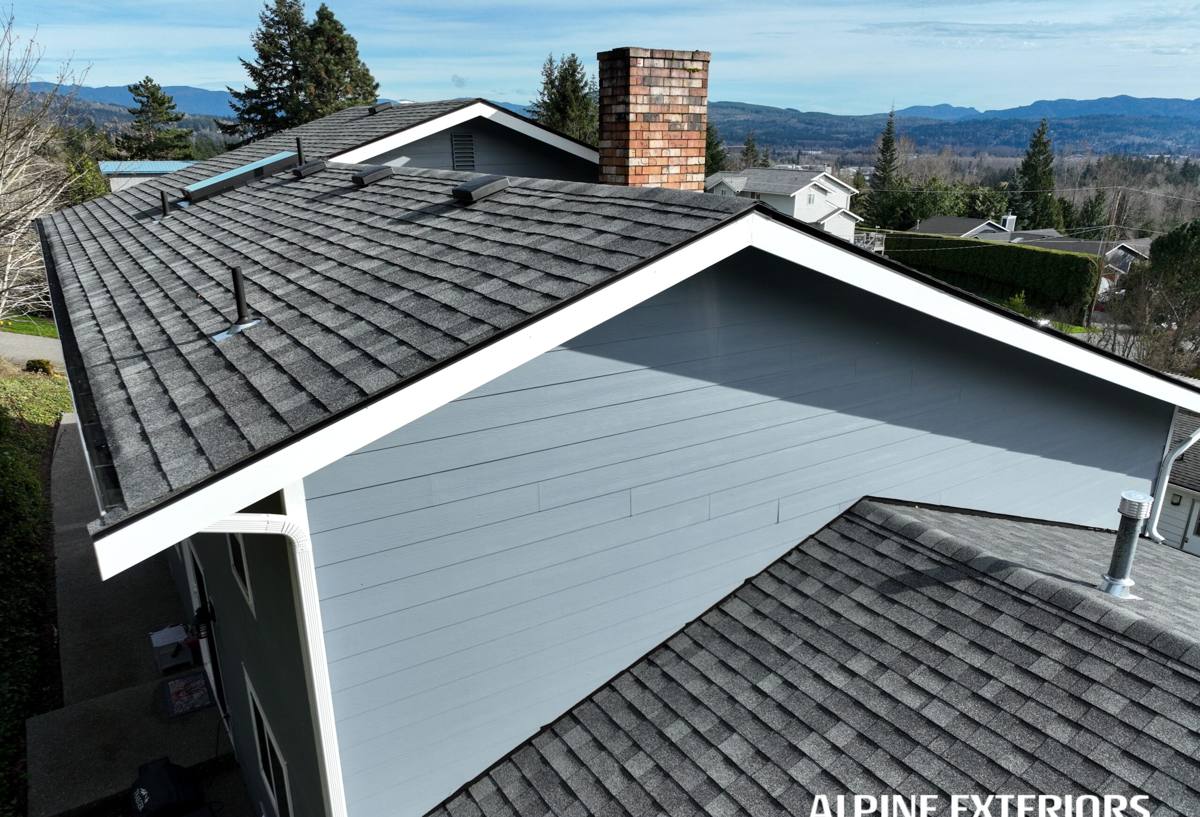
Signs a Conway Roof Has Reached Replacement Territory
Not every roofing problem means a full tear-off. But there's a point where patching individual issues stops making financial sense and a full replacement becomes the honest recommendation. We look at the whole picture — age, material condition, and how much of the roof is already compromised — before ever suggesting a full replacement.
- Shingles that are cupping, curling, or losing granules across large sections rather than just one spot
- Soft or spongy decking felt underfoot, especially near valleys or chimney flashing, which usually means water has already reached the wood
- Persistent moss growth that keeps returning within a season or two of cleaning, a sign the surface is holding moisture longer than it should
- Daylight visible through the attic or staining on interior ceilings, both signs the roof has already failed in at least one spot
- A roof approaching or past its material's expected service life, especially if the original installation quality is unknown
If a roof is showing one or two of these in isolation, a repair may still be the right call. When several show up together, or the roof is old enough that more problems are likely hiding under the surface, replacement usually ends up costing less over time than a string of repairs.
Why This Determination Isn't a Quick Glance
We don't make a replace-versus-repair call from the driveway. It takes getting on the roof, checking decking condition at a few representative spots, and looking at flashing, ventilation, and the general state of the material before giving a homeowner a straight answer either way.
What a Correct Roof Replacement Involves in This Climate
A roof replacement done for Conway's conditions isn't fundamentally different in scope from one done anywhere else — tear-off, deck inspection and repair, underlayment, flashing, new roofing material, ventilation — but the details inside each of those steps carry more weight here.
Tear-Off and Deck Inspection
Removing the old roofing down to the decking is the only way to actually see what's underneath. In a climate with this much sustained moisture exposure, hidden decking damage around old flashing points or valleys is common enough that we treat this step as non-negotiable, not optional. Any soft or rotted decking gets replaced before anything new goes down — installing new roofing over compromised decking just hides the problem instead of fixing it.
Underlayment That Matches the Exposure
A synthetic underlayment with a self-adhered, waterproof membrane at the eaves, valleys, and around penetrations gives a Conway roof a real second line of defense against wind-driven rain that gets past the primary roofing material. This detail matters more here than it would in a drier, more sheltered location, because the odds of wind-driven rain actually testing that second line are meaningfully higher.
Flashing Done Right the First Time
Flashing at valleys, chimneys, skylights, and wall intersections is where the majority of roof leaks actually originate — not through the field of the shingles themselves. Correctly lapped, properly fastened flashing, integrated with the underlayment rather than just caulked over it, is one of the details that separates a roof that lasts from one that starts leaking within a few years.
Ventilation That Prevents Moisture From the Inside
A roof deals with moisture from both directions. Balanced intake and exhaust ventilation keeps warm, moist attic air from condensing against the underside of the decking, which over time can cause rot and premature failure that has nothing to do with the weather outside. Replacement is the right time to correct ventilation that was never adequate to begin with.
Roofing Material Considerations for a Conway Property
| Factor | Asphalt Composition Shingle | Metal Roofing |
|---|---|---|
| Wind-driven rain resistance | Good, when properly installed with correct underlayment and flashing | Very good; fewer seams and laps for water to find |
| Moss resistance | Susceptible on shaded slopes without periodic cleaning | Less hospitable to moss growth on smooth panel surfaces |
| Salt air / corrosion | Fasteners and flashing need corrosion-resistant hardware | Panel and fastener coatings matter; quality varies by product |
| Typical service life | 20-30 years depending on product tier and installation | 40-plus years with proper installation and maintenance |
| Upfront cost | Generally lower | Generally higher |
Both materials can perform well on a Conway home when installed correctly. The right choice usually comes down to budget, how long the homeowner plans to stay in the house, and personal preference on appearance — we'll walk through the honest trade-offs for your specific roof rather than push one option across the board.
Our Process for a Conway Roof Replacement
- On-site inspection and honest assessment of whether replacement or repair is the right call
- Written estimate outlining scope, material options, and timeline, with no pressure to decide on the spot
- Tear-off and full decking inspection, with any compromised decking replaced before new material goes down
- Installation of underlayment, flashing, ventilation components, and final roofing material to manufacturer specifications
- Final walkthrough so you can see the completed work and ask questions before we consider the job done
Why Hiring a Crew That Already Works in Conway Matters
Conway is a small, spread-out community, and the houses here don't all face the same weather the same way — a lot depends on how close a given property sits to the water, how open the surrounding land is, and which direction the roof slopes face relative to the prevailing storms coming up the valley. A crew that regularly works roofs in this part of Skagit County develops a working sense of which slopes hold moss longest, which flashing details actually get tested by real weather here, and which corners simply can't be cut on a property like this. That's a different starting point than a crew that mostly works drier, more sheltered areas and treats every roof the same.
What to Ask Before Hiring for a Roof Replacement in This Area
- Ask whether the estimate includes full tear-off and decking inspection, not just a layover or partial replacement
- Confirm what underlayment and ice-and-water or waterproof membrane will be used at eaves, valleys, and penetrations
- Ask specifically how flashing will be integrated at valleys, chimneys, and skylights, not just what material will be used
- Get clear terms on both the manufacturer's material warranty and the contractor's separate workmanship warranty
- Verify the contractor is licensed, bonded, and insured to perform roofing work in Washington State
What This Means for Your Roof
Every roof in Conway has its own history — its own age, its own exposure, its own combination of past patches and original installation quality. That means the right recommendation for one house isn't automatically right for the one next door. We're not going to push a full replacement when a targeted repair will genuinely hold up, and we're not going to cut corners on flashing or underlayment just to shave a line off the estimate. Salt air, driving rain, and a long moss season don't leave much room for shortcuts on a roof out here, and we'd rather tell you that plainly than find out the hard way in a few years.
If your Conway home's roof is due for a look, we're happy to come out, walk the roof, and give you a straight answer on what it actually needs. Reach out for a free, no-pressure estimate.