 Anacortes Exterior
 Roofing on the Bluff: Why Cap Sante Takes a Different Kind of Beating
Homes on and around Cap Sante sit up on a bluff overlooking the marina and the water, which is part of what makes the area so desirable — and part of what makes the roofs up there work harder than roofs a few miles inland. Elevation and open exposure to the water mean more direct wind, more wind-driven rain, and more salt-laden air moving across the roof deck year-round. That combination doesn't show up as one dramatic failure. It shows up as slow, steady wear: fastener corrosion, flashing that fails a few years before it should, and moss that gets a head start because the roof rarely gets a full day of direct sun to dry out.
None of that means a Cap Sante roof is doomed to constant problems. It means repairs need to account for the exposure, not just patch the symptom. A fix that would hold up fine on a sheltered inland roof in Mount Vernon or Burlington can fail early up here if it doesn't account for wind uplift and salt exposure. That's the difference between a repair that lasts and one you're calling about again next winter.
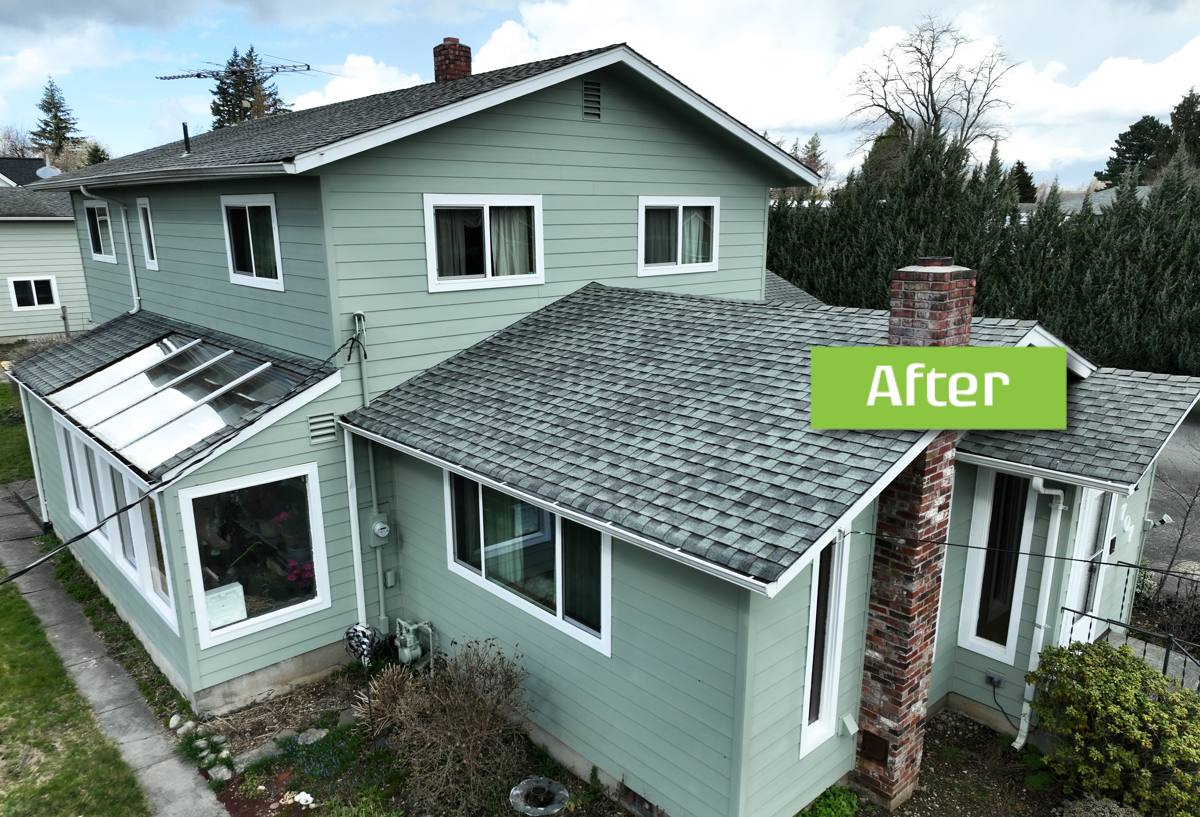
What Skagit County Weather Actually Does to a Roof
Anacortes doesn't get the extreme storms some parts of the country deal with, but it gets something arguably harder on a roof: persistent, low-grade exposure. Driving rain off the water finds every gap in flashing and every lifted shingle tab. Salt air accelerates corrosion on exposed nails, screws, and metal flashing faster than manufacturers' warranties usually assume. And our long, wet moss season means organic growth gets a foothold on north-facing slopes and shaded valleys almost every year, holding moisture against the roofing material for months at a stretch.
Individually, none of these are catastrophic. Together, over several seasons, they're exactly what turns a small, cheap repair into a bigger one if it's ignored. A lifted shingle tab that would dry out fine in a drier climate stays damp longer here, which is what lets water actually work its way under the layer below.
The Three Things We See Most Often on Cap Sante Roofs
- Flashing failure around chimneys, vent pipes, and roof-to-wall transitions, usually from corrosion or sealant that's dried out and cracked
- Moss and algae growth on shaded or north-facing slopes, lifting shingle edges and holding moisture against the roof deck
- Wind-lifted or missing shingles, often on ridges and edges where uplift pressure is highest
Signs Your Roof Needs Repair, Not Just a Look
Most roof problems don't announce themselves with a leak on day one. By the time water is visibly coming through a ceiling, it's usually been getting in for a while. Catching the early signs saves money and prevents interior damage.
- Granules collecting in gutters or at the base of downspouts
- Shingles that look curled, cupped, or lifted at the edges
- Dark streaking or thick moss growth, especially on shaded slopes
- Soft or discolored spots on interior ceilings or upper walls
- Daylight visible through the roof deck from inside the attic
- Flashing that looks rusted, cracked, or pulled away from the surface it seals
- A noticeable rise in how often you're checking the attic after storms
If you're seeing two or more of these, it's worth having someone look before the next round of heavy rain rather than after.
What a Correct Repair Actually Involves
A roof repair that's done right isn't just about replacing the shingles a homeowner can see from the ground. Most repair failures we get called to fix started because someone addressed the visible symptom and skipped the part underneath it.
- Find the actual entry point. Water travels along the roof deck and rafters before it shows up as a stain, so the wet spot on your ceiling is often several feet from where the leak actually starts.
- Check the decking underneath. If the plywood or sheathing under the damaged area has soaked up moisture, replacing shingles over it without addressing the deck just seals the problem in.
- Replace flashing, not just seal it. Caulk over failed flashing is a temporary patch, not a repair. Corroded or cracked flashing needs to come out and be replaced properly.
- Match the repair to the existing roof system. Underlayment, fastener pattern, and shingle overlap all need to tie back into what's already there so water sheds correctly across the repaired section.
- Clean up growth and debris before closing it up. Sealing moss or organic debris under new material just gives it a head start on doing the same damage again.
Roofing Materials Around Cap Sante: Repair Considerations
What a repair should look like depends heavily on what's already on your roof. Anacortes has a real mix of ages and materials, and each one behaves differently under our climate conditions.
| Material | Common Repair Needs | What to Watch For Here |
|---|---|---|
| Asphalt composition shingle | Lifted or missing tabs, granule loss, flashing replacement | Most common roof type locally; moss and wind uplift are the usual culprits |
| Wood shake or shingle | Split shakes, moss removal, spot replacement | Needs the most consistent moss management of any roof type in a wet coastal climate |
| Metal roofing | Fastener re-seating, seam and flashing sealant, corrosion spots | Salt air makes fastener and seam condition worth checking more often than inland |
| Flat or low-slope membrane | Seam separation, ponding water, flashing at penetrations | Common on additions and outbuildings; drainage matters more than material here |
Whatever material is on your roof, the repair only holds if the person doing it understands how that specific material ages in a marine climate — not just how to patch it in general.
Moss, Algae, and Salt Air: Repair vs. Ongoing Maintenance
One thing worth being honest about: a repair fixes the damage that's already happened. It doesn't stop moss from coming back next season if the conditions that grew it in the first place — shade, moisture, organic debris — are still there. For a lot of Cap Sante homes, the most cost-effective approach combines a proper repair now with a light annual maintenance routine: clearing debris, checking for early moss regrowth, and confirming flashing and fasteners are still sound after winter storms.
We'll always tell you plainly whether what you're looking at is a one-time fix or the kind of recurring issue that benefits from a yearly check. Neither answer benefits us more than the other — we'd rather you trust what we tell you than oversell a service you don't need.
How Our Repair Process Works
Inspection
We start on the roof itself, not just from the ground with binoculars. That means checking flashing points, valleys, penetrations, and the underside in the attic where accessible, since that's where the real story of a leak usually shows up.
Diagnosis and Estimate
You get a plain explanation of what's actually wrong, what caused it, and what fixing it involves — including whether it's a contained repair or a sign of broader wear that's worth planning for. The estimate reflects the real scope, not a guess.
The Repair
Work is done to match the existing roof system: proper flashing replacement, correct underlayment and fastener technique, and shingle or material matching that blends in rather than leaving an obvious patch.
Cleanup and Follow-Up
We clear debris and old material from the site and gutters before we leave, and we'll tell you honestly if there's anything worth keeping an eye on going forward — including whether the rest of the roof is holding up well or approaching the point where repair stops making sense.
Repair vs. Replace: What Actually Drives That Decision
Homeowners often assume a leak means a new roof. Usually it doesn't. The decision comes down to a handful of concrete factors, not the age of the roof alone.
| Factor | Leans Toward Repair | Leans Toward Replacement |
|---|---|---|
| Extent of damage | Localized to one section or penetration | Widespread across multiple slopes |
| Roof deck condition | Solid, dry sheathing underneath | Soft, rotted, or repeatedly wet decking |
| Remaining material life | Shingles elsewhere still have useful years left | Granule loss and brittleness are showing across the roof |
| Repair history | First real issue in a while | Same areas needing repeat repairs |
We'll give you a straight answer on which side of that line your roof falls on, along with the reasoning behind it — not just a recommendation to take on faith.
Why Hiring a Crew That Already Works in Cap Sante Matters
Roofing technique doesn't change much from one town to the next, but the priorities do. A crew that works regularly in this part of Skagit County already knows to check fastener corrosion a little closer, plan around moss on the shaded slopes, and account for wind exposure on bluff-facing homes without needing to be told. That local familiarity shows up in fewer callbacks and repairs that are built for the conditions your roof actually faces, not generic conditions from a training manual.
It also means someone who can talk through what's realistic for your specific roof and situation, rather than a one-size answer applied to every job on the schedule that day.
If you've noticed moss buildup, a stain on the ceiling, or shingles that don't look quite right after the last storm, it's worth getting a second set of eyes on it before the next round of rain. We offer free, no-pressure estimates for roof repair work in Cap Sante and throughout Anacortes — use the form below to get one scheduled.