 Anacortes Exterior
 Building Decks for Burlington's Damp, Mossy Climate
Burlington sits inland from Anacortes in the Skagit Valley, but it still gets the same marine-influenced weather that defines this whole corner of Washington: long stretches of drizzle, damp air that never fully dries out between storms, and a moss season that can run from October well into spring. Add in the salt-tinged air that moves through the county from Puget Sound and the Guemes Channel, and you've got a climate that is genuinely hard on exterior wood structures. A deck built the way it might be built in a drier part of the state won't hold up the same way here.
We build and repair custom decks throughout the Anacortes area, and Burlington is a regular part of that work. The problems we see on Burlington decks are consistent: rot starting at the ledger board where it meets the house, fasteners rusting or staining the decking within a few years, moss turning boards slick and dark, and footings that were never sized for how wet this ground gets in the winter months. None of that is inevitable — it's a result of how the deck was built in the first place.
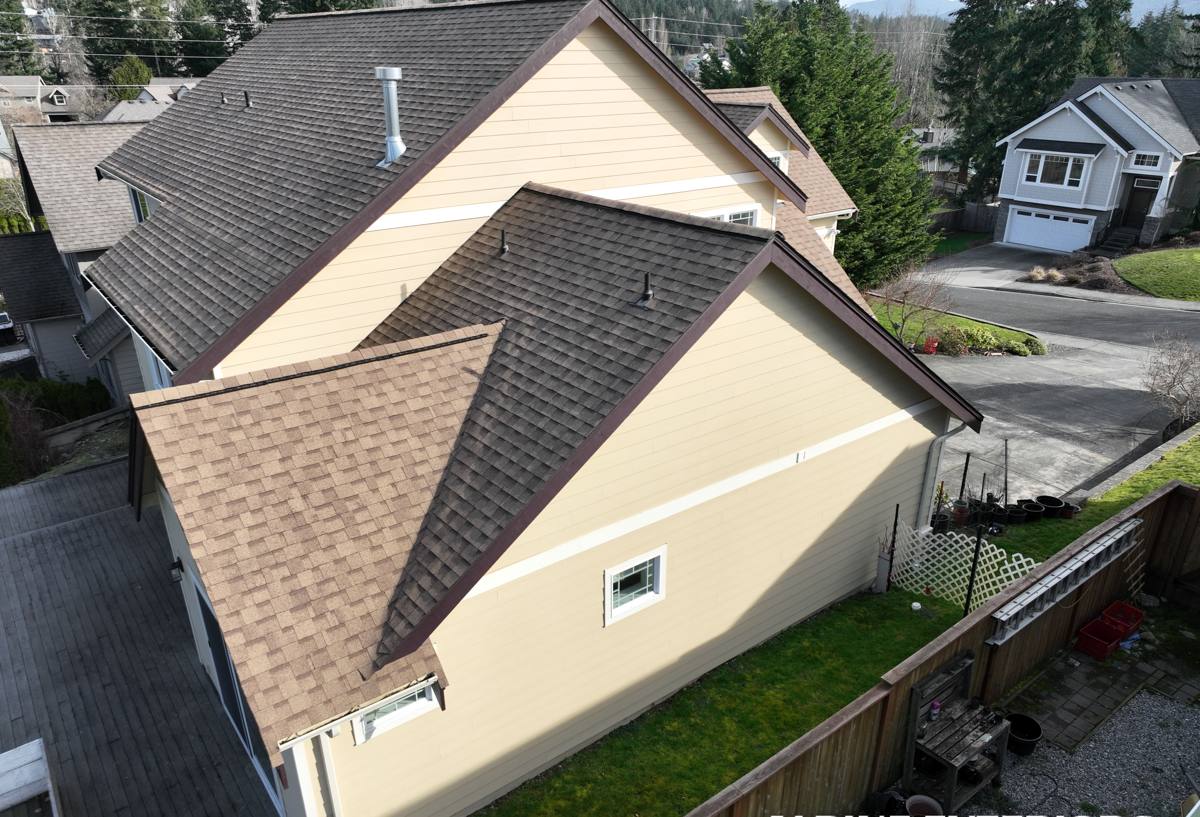
What Actually Goes Wrong on Decks in This Area
Most deck failures we're called out to look at aren't dramatic. They're slow. Water finds a way behind the ledger flashing, or standing in a joist that wasn't sloped to drain, or trapped under decking boards that were laid too tight. Given enough damp months in a row, that moisture doesn't evaporate — it just sits there and starts breaking things down.
Ledger Attachment and Flashing
The ledger board — where the deck bolts to the house — is the single most common failure point on any Pacific Northwest deck. If the flashing behind and over the ledger isn't installed correctly, water runs straight down the house sheathing and rots the band board from the inside out, often long before it's visible from the deck surface. This is not an area to cut corners on, and it's one of the first things we inspect when we're asked to look at an existing deck.
Fasteners and Hardware
Standard galvanized fasteners can corrode faster here than homeowners expect, especially on decks that get any exposure to salt-laced air moving through the valley. Corroding fasteners don't just look bad with black streaking down the boards — they lose holding strength over time. We use stainless steel or coated fasteners rated for the wood or composite product involved, matched to the connector hardware so nothing in the assembly is working against the fastener next to it.
Framing and Footings Built for Skagit County Ground
What's under the deck matters as much as what's on top of it. Skagit Valley soil holds moisture longer than sandier or better-draining ground elsewhere in the state, and that affects how footings behave over the years.
Footing Depth and Placement
Footings need to be dug to the depth required by code for this area and set on undisturbed or properly compacted soil — not just poured into a shallow hole and hoped for. Skimping here is one of the more expensive mistakes to fix later, because by the time a footing has shifted or heaved, the deck surface above it is already showing the damage.
Ventilation Under the Deck
Low decks or decks built close to grade need airflow underneath to keep joists from staying wet for weeks at a time. We look at grading, drainage, and clearance under the frame during design, not as an afterthought — a deck that can't breathe underneath will rot from below no matter how well the top surface is finished.
Choosing the Right Decking Material for This Climate
There's no single "correct" decking material for every Burlington home — it depends on budget, how much upkeep you're willing to do, and how the deck will be used. What matters is being honest about the trade-offs of each option rather than pushing whatever's easiest to sell.
| Material | Upfront Cost | Maintenance | Moisture Behavior |
|---|---|---|---|
| Pressure-treated lumber | Lowest | Needs re-sealing every 1-2 years | Prone to checking and moss growth if not maintained |
| Cedar | Moderate | Regular oiling/sealing to hold color and resist decay | Naturally rot-resistant but still absorbs water without upkeep |
| Capped composite | Higher | Occasional washing, no sealing | Resists moisture absorption well; minimal moss adhesion |
| PVC decking | Highest | Lowest of all options | Fully moisture-resistant, won't rot or splinter |
We don't push composite or PVC on every job — solid-sawn wood, especially cedar, still has a place for homeowners who want that look and are willing to keep up with sealing. What we do insist on is being upfront about what each material actually requires once it's installed, especially in a climate that gives wood so little chance to dry out between rain events.
Dealing With Moss and Slip Hazards
Moss on a deck is more than a cosmetic problem. Once it establishes on a board surface, it holds moisture against the wood or composite cap, and it turns the deck genuinely slippery — a real concern on stairs and near entry points, especially through the wetter months when moss growth is at its worst.
A few things reduce how much moss you'll deal with over the life of the deck:
- Board spacing that allows proper drainage and airflow instead of trapping water between boards
- Positioning and design choices that account for shaded, north-facing areas where moss takes hold fastest
- Decking profiles with grip-friendly surface texture, since smooth-faced boards get slicker once any film of algae forms
- Routine cleaning with a deck-safe wash rather than a pressure washer set too aggressively, which can strip wood fibers or damage composite caps
No deck in this region is going to be moss-proof forever. The goal is a design and material combination that keeps it manageable with reasonable, periodic cleaning rather than a constant fight.
Permits and Code Requirements for Burlington Decks
Most custom deck projects in Skagit County require a permit, particularly once you're above a certain height off grade or attaching structurally to the house. Guardrail height, baluster spacing, stair rise and run, and footing depth are all governed by code, and inspectors here pay close attention to ledger attachment and flashing details given how often that's where problems start.
We handle the permit process as part of the job rather than leaving it to the homeowner to sort out — pulling the right permit, building to the details that will pass inspection, and scheduling inspections at the right points in the build. Skipping this step to save time up front is one of the more common ways homeowners end up with problems at resale, when an unpermitted deck can complicate a sale or an insurance claim.
Our Process for a Custom Deck Build
Every deck we build starts with a look at the specific conditions of your property — sun exposure, drainage, how the house is framed at the attachment point, and how the deck will actually be used day to day.
- On-site assessment — we look at the ground, the house structure at the ledger location, drainage patterns, and sun/shade exposure before discussing design.
- Design and material selection — we walk through material trade-offs honestly, based on your budget and how much maintenance you want to take on.
- Permitting — we prepare and submit what's needed for Skagit County or City of Burlington approval, and build to pass inspection the first time.
- Footings and framing — footings poured to proper depth, ledger flashed correctly, joists spaced and protected against moisture intrusion.
- Decking, railing, and finishing — installed per manufacturer specifications for whatever material you've chosen, with fasteners matched to the product.
- Final walkthrough — we go over care and maintenance specific to your material choice before we consider the job finished.
Keeping a Burlington Deck in Good Shape Year-Round
A well-built deck still needs some ongoing attention in this climate. Here's what we recommend to homeowners regardless of which contractor built it:
- Clear leaves and debris from between boards and off ledger flashing before fall rains set in
- Check and re-tighten hardware annually, since seasonal moisture cycles can loosen connections over time
- Reseal wood decking on the schedule appropriate to the product — don't wait until graying and checking are already visible
- Wash composite or PVC decking periodically to prevent algae film from building up, especially in shaded sections
- Inspect under the deck once a year for standing water, soft framing, or signs of pests
- Address small rot or fastener issues immediately — in this climate, small problems left alone don't stay small for long
Why Hire a Crew That Already Works in Burlington
A deck built to a generic set of specs, without accounting for Skagit County's rainfall, moss season, and soil conditions, will show its age faster than one built by a crew that already knows what fails here and why. We're not guessing at flashing details or footing depth based on a manual written for a different climate — we've seen what a decade of Skagit Valley weather does to a deck, both the ones built right and the ones that weren't.
That local knowledge shows up in the small decisions: how tight to space boards, which fasteners actually hold up, where extra flashing is worth the labor, and which materials are worth the added cost for a given household's tolerance for upkeep. It's the difference between a deck that needs attention every year and one that mostly takes care of itself.
If you're planning a new deck or replacing one that's showing its age, we're happy to come take a look and talk through honest options for your property — no pressure, no obligation. Use the form below to request a free estimate.