 Anacortes Exterior
 Bow Sits Right Where Salt Water Meets Skagit Valley Weather
Bow is a small, spread-out community west of Anacortes, tucked between Skagit County farmland and the salt water of Samish Bay. That mix of open fields, tree-lined lots, and coastal exposure creates a specific set of problems for exterior siding — problems that are different from what you'd deal with installing siding twenty miles inland. Homes here take on salt-laden air pushing in off the bay, long stretches of driving rain, and the kind of shaded, damp conditions that keep moss and algae growing on north-facing walls for most of the year.
None of that is unusual for western Skagit County. But it does mean that a siding job done to a generic standard — the kind that would hold up fine in a dry inland climate — often starts showing problems within a few years out here. Cupping, staining, soft spots at the bottom courses, paint failure, moss creeping up from the ground line. We've replaced siding on Bow-area homes that was barely a decade old, not because the homeowners neglected it, but because the product and the installation weren't matched to the exposure.
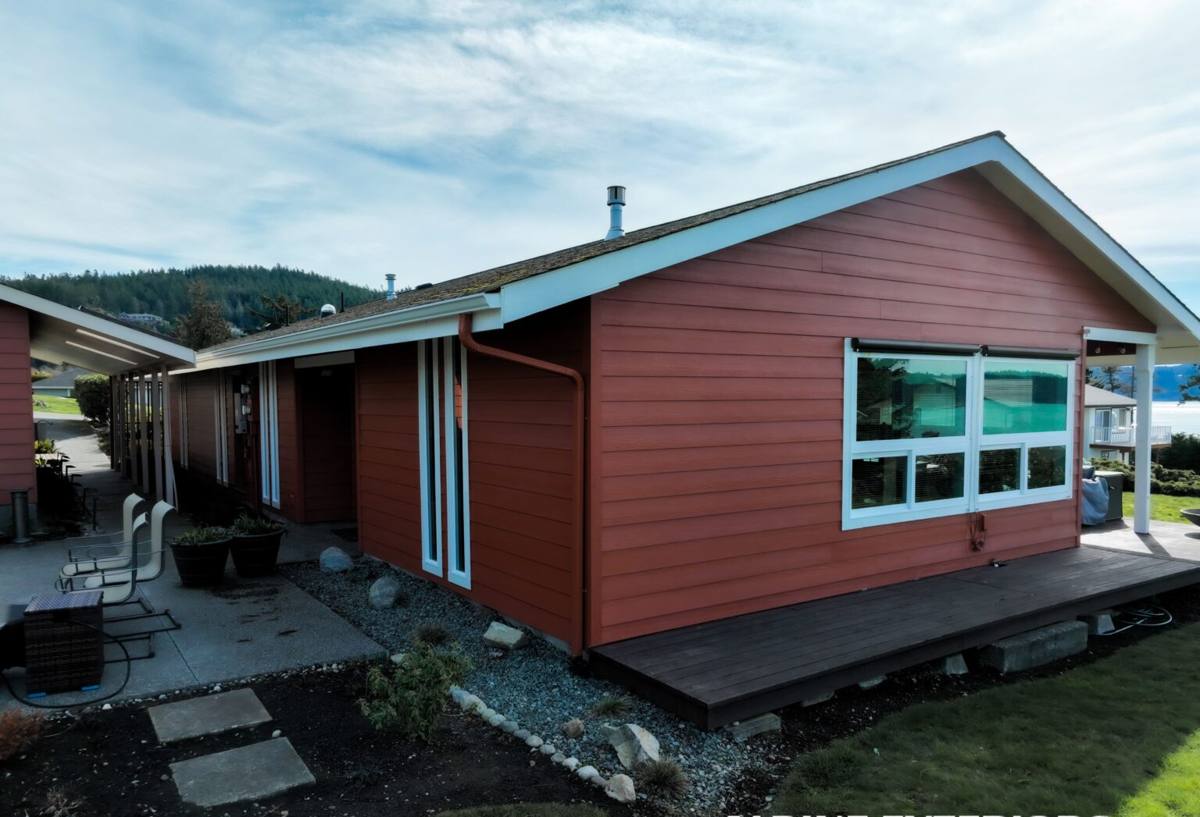
What Salt Air, Rain, and Moss Actually Do to Siding
Salt Air
Proximity to Samish Bay means airborne salt settles on exterior surfaces more than most homeowners expect. Salt is hygroscopic — it pulls moisture out of the air and holds it against whatever surface it lands on. On siding that isn't dimensionally stable or properly finished, that constant low-grade moisture exposure accelerates swelling, paint breakdown, and, on wood-based products, rot.
Driving Rain
Storms coming off the water tend to arrive with wind behind them, which means rain doesn't just fall on a house, it gets driven sideways into every seam, joint, and fastener penetration. A siding system that relies on caulk and paint film alone to keep water out — rather than proper flashing, laps, and drainage behind the cladding — will eventually let water in somewhere.
Moss and Algae
Shaded lots, high humidity, and a long wet season (roughly October through May in this part of Skagit County) give moss and algae months at a time to establish themselves on siding, especially on north and west-facing walls or anywhere tree cover limits sun and airflow. Beyond the appearance issue, moss holds moisture directly against the siding surface, which is exactly the condition that causes long-term damage on moisture-sensitive materials.
Why We Install Only James Hardie Fiber Cement
We don't install vinyl, LP SmartSide, cedar, or primed wood siding, and Bow is a good example of why. Vinyl expands and contracts with temperature swings and can crack in cold snaps; it also doesn't hold up structurally the way a rigid product does under wind-driven rain. Wood-based products — cedar, primed spruce, engineered wood panels like LP SmartSide — depend on an intact factory or field-applied coating to keep moisture out, and once that coating is compromised at a cut edge, a fastener hole, or a scratch, wood-based siding can absorb water and begin to break down from the inside, especially in a climate that rarely gives it a chance to fully dry out.
James Hardie fiber cement is non-combustible, dimensionally stable, and doesn't feed mold or rot the way wood-based products can, because there's no organic wood fiber for moisture to break down. It's not immune to moisture problems if installed poorly — no siding is — but it gives us a product that tolerates this climate's punishment far better than the alternatives, and it comes backed by a strong transferable warranty when installed to Hardie's specifications.
Matching the Right Hardie Product to a Bow Home
James Hardie makes several siding profiles and, more importantly for this area, offers HZ5 formulations engineered for climates with more moisture and temperature swing. For a Bow property close to open water, we default to HZ5 products and ColorPlus factory-finished color, which puts a baked-on finish over the fiber cement before it ever reaches the jobsite — a meaningfully more durable finish than field-applied paint, especially against salt exposure.
| Siding Material | Behavior in Salt Air / Driving Rain | Moss & Moisture Resistance | Typical Finish Durability |
|---|---|---|---|
| James Hardie Fiber Cement (HZ5, ColorPlus) | Dimensionally stable, non-combustible, engineered for wet coastal climates | Doesn't feed rot; surface can still host moss if never cleaned | Factory-baked finish, long repaint intervals |
| Vinyl | Can warp, crack, or blow off in wind-driven storms | Won't rot, but traps moisture behind panels if installed loose | Color fades; can't be repainted easily |
| Cedar / Primed Wood | Absorbs moisture at joints and cut edges; swells and checks | Prone to rot and moss growth once coating fails | Requires regular refinishing |
| LP SmartSide (engineered wood) | Coating must stay intact to prevent moisture wicking | Vulnerable at damaged edges and fastener penetrations | Field or factory finish, moderate repaint cycle |
What a Correct Installation Actually Involves
The siding itself is only part of the equation. Most of the failures we see on older homes in this area trace back to installation shortcuts, not the material. A correct job on a Bow home includes:
- A weather-resistive barrier installed with proper shingle-lap sequencing so water sheds outward at every layer
- A drainage plane or rainscreen gap behind the siding so any moisture that gets past the cladding can drain and dry instead of sitting against the wall sheathing
- Correct flashing at every window, door, deck ledger, and roof-to-wall transition — the spots where nearly all real-world leaks start
- Manufacturer-specified fastener placement and spacing, driven to the correct depth (overdriven fasteners crack fiber cement and create entry points for water)
- Proper clearance between the bottom of the siding and grade, decks, or roofing so the lowest courses aren't sitting in standing water or splash-back
- Caulking and sealant used only where Hardie's install guide calls for it — sealant is a backup, not the primary water management strategy
Skip any one of these and you can still end up with moisture problems even with the best siding material on the market. This is where installation experience matters as much as product choice.
Our Process on a Bow Project
1. On-Site Assessment
We walk the exterior, check the current siding and trim condition, look at grading and drainage around the foundation, and note any areas with existing moss, staining, or moisture damage — particularly on shaded or water-facing walls.
2. Tear-Off and Sheathing Check
Once old siding is off, we inspect the sheathing underneath. Any water-damaged sheathing gets identified and addressed before anything new goes on — covering a compromised wall with new siding just hides the problem.
3. Weather Barrier and Drainage Plane
We install the water-resistive barrier and drainage gap system before any cladding goes up, since this layer does most of the actual work keeping water out of the wall assembly.
4. Flashing at Every Penetration
Windows, doors, and any wall penetrations get properly flashed and integrated with the weather barrier — not caulked over as an afterthought.
5. Hardie Installation to Spec
Panels or lap siding go up per James Hardie's published installation guide, with correct fastener type, spacing, and clearances, keeping the manufacturer's warranty intact.
6. Final Walkthrough
We review the finished exterior with the homeowner, including basic care and what to watch for going forward.
Signs Your Current Siding Is Already Losing the Fight
If you're not sure whether your Bow home's siding needs attention now or can wait, look for:
- Soft or spongy spots when you press on the siding, especially near the bottom courses or below windows
- Persistent moss or algae growth that comes back within weeks of cleaning
- Visible cupping, buckling, or gaps opening up at seams and corners
- Paint that's peeling, bubbling, or has an uneven, chalky appearance
- Staining or discoloration streaking down from window sills, trim, or roof lines
- A musty smell near exterior walls inside the home
Any one of these on its own might be minor. Two or three together usually means moisture has been getting behind the siding for a while.
Cost Factors for a Bow Siding Project
Every home is different, but a few things consistently move the price on jobs in this area:
| Factor | Why It Matters Here |
|---|---|
| Extent of sheathing repair needed | Homes with a history of moisture intrusion often need sheathing replaced before new siding goes on |
| Home size and wall complexity | More corners, gables, and trim detail mean more labor and material waste |
| Siding profile and finish chosen | Lap siding, panel systems, and trim/color combinations price differently |
| Access and site conditions | Rural lots with tree cover, long driveways, or tight access can add setup time |
| Removal and disposal of old siding | Volume and type of existing material affects tear-off and haul-away cost |
We'll never quote a number without seeing the house — anyone who does hasn't actually looked at your walls.
Why It Matters That We Already Work This Area
A crew based out of Anacortes that already works Bow, Edison, and the surrounding Skagit County shoreline knows what this climate does to a house without having to guess. We're not learning on your project that fastener placement matters more here, or that a drainage gap isn't optional near open water — we already build that way by default. That familiarity also means we're realistic with homeowners: we'll tell you when a wall needs sheathing repair before new siding goes on, and we won't sell you a product that isn't suited to standing up to salt air and driving rain for the long haul.
If your Bow home's siding is showing its age — or you're planning ahead before the next wet season sets in — we're happy to take a look and give you a straightforward, no-pressure estimate using the form below.