 Anacortes Exterior
 Siding Repair in Sedro-Woolley: What Skagit Valley Homes Are Up Against
Sedro-Woolley sits inland from the salt water, tucked against the Skagit River and the foothills of the Cascades, and that geography shapes what happens to siding here. Homes further out toward Anacortes and the San Juan shoreline deal with more direct salt spray; Sedro-Woolley's problem is persistent dampness. The valley traps moisture, fog sits longer in low spots near the river, and the tree cover that makes this area beautiful also means shade, slow-drying wall surfaces, and a moss and mildew season that runs longer than it does in more open, wind-exposed parts of the county. Add in driving rain events that blow in off the Sound and funnel up the valley, and you've got a climate that is genuinely hard on exterior wall systems — just not in the exact way coastal homes experience it.
We repair siding throughout Skagit County, and Sedro-Woolley jobs have a recognizable pattern: moisture intrusion at penetrations and trim, moss and algae staining on north- and shade-facing walls, and — on older homes with wood or non-fiber-cement products — soft spots and delamination where water has been getting behind the material for years before anyone noticed.
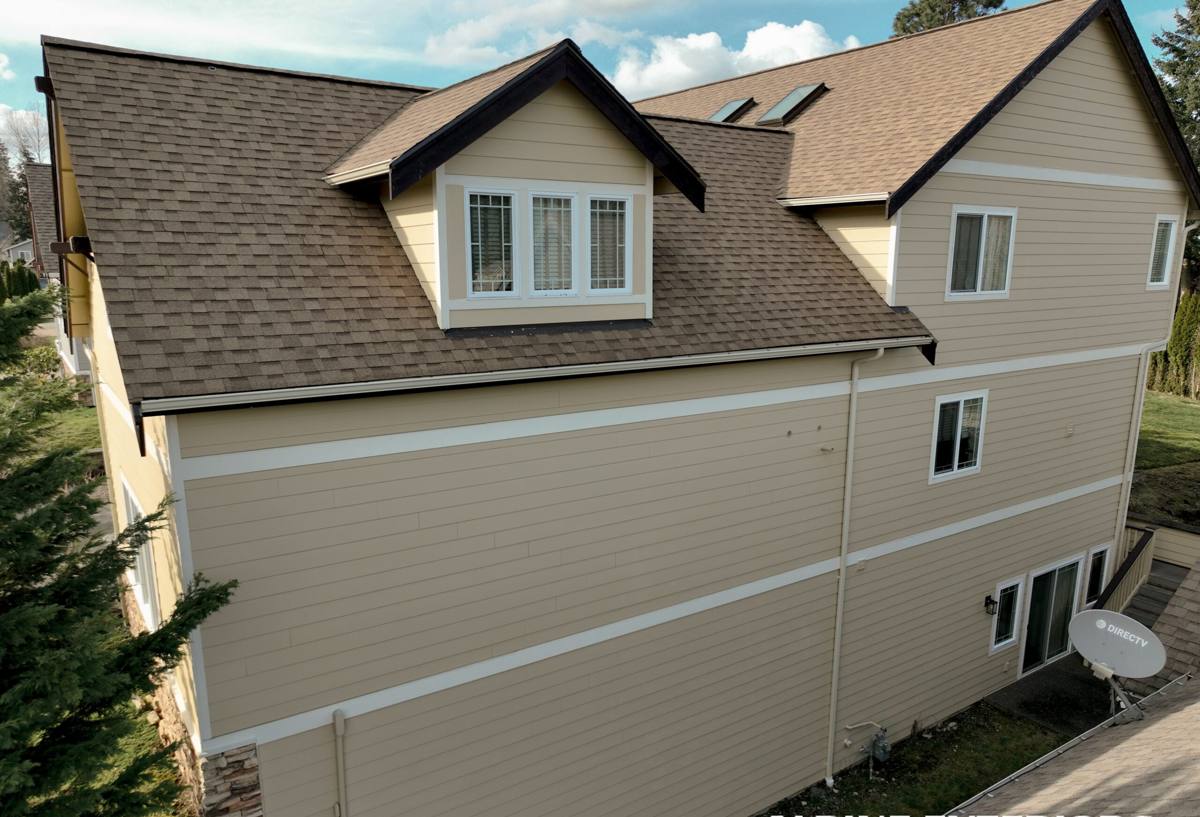
Why Siding Repair Isn't Always Simple in This Climate
A lot of siding repair calls start as "just replace this one damaged section" and turn into a bigger conversation once we're actually up on the wall. That's not us upselling — it's what damp-climate siding failure looks like. Water rarely stays where it enters. It tracks behind the cladding, follows the sheathing down, and shows up as soft trim or a stained patch several feet from the actual point of entry. A repair that only addresses the visible symptom without finding the entry point is a repair that fails again in a season or two.
What we check before we touch anything
- Where water is actually getting in — often not where the damage is most visible
- Condition of the water-resistive barrier and flashing behind the siding at that section
- Whether the sheathing or framing underneath has soaked, softened, or started to rot
- How far the damage has spread laterally and vertically from the visible problem
- Whether the existing material is even worth patching, or whether the section needs full replacement
Skipping that inspection step is how homeowners end up paying for the same repair twice.
Common Sedro-Woolley Siding Problems We See
Moss and algae growth
Shaded walls, north-facing elevations, and anything near mature trees hold moisture longer. On wood siding and some fiber cement products with a weaker factory finish, that constant dampness feeds moss and algae growth that stains the surface and, over time, holds water against the material itself. This is more of a cosmetic and maintenance issue early on, but left alone it accelerates whatever's happening underneath.
Trim and penetration failures
Every window, door, hose bib, vent, and light fixture is a place where the siding gets cut and water gets an opportunity. Caulk fails. Flashing gets installed short or skipped. These small gaps are where the majority of real moisture damage originates, even though the siding itself often looks fine from ten feet away.
Delamination and soft spots on non-Hardie products
We see this most on older wood siding, primed spruce products, and some lower-grade fiber cement or composite products that weren't engineered for sustained Pacific Northwest moisture exposure. The face layer separates from the core, edges swell, and paint stops holding. Once a panel is delaminating, it's not something you patch — it needs to come off.
Impact and settling damage
Cracked panels from storm debris, ladder contact, or general age-related brittleness. Structural settling can also open seams and joints that were tight when the house was built.
What a Correct Siding Repair Actually Involves
A repair done right isn't just cutting out the bad piece and nailing up a new one. Our process:
- Inspect — identify the true source of moisture, not just the visible symptom
- Open it up — remove enough surrounding material to see the actual extent of damage to sheathing, framing, and the weather barrier
- Repair the substrate first — replace any rotted or compromised structural material and correct the flashing detail that let water in to begin with
- Re-establish the water-resistive barrier — proper lapping and sealing so the wall assembly sheds water the way it's supposed to
- Match and install new siding — matched profile, reveal, and finish so the repair blends with the surrounding wall
- Detail the trim and penetrations — the step that's skipped most often, and the one most likely to determine whether this repair lasts
Step 3 is where a repair either solves the problem or just delays it. If we replace the visible siding but leave a compromised flashing detail underneath, the homeowner is paying for the same repair again in a few years — just with more rot to deal with next time.
Repair vs. Replace: How We Help You Decide
Not every siding problem in Sedro-Woolley needs a full re-side, and we're not going to tell you it does. But there's a point where patch repairs stop making financial sense.
| Situation | Usually a Repair | Usually Replacement |
|---|---|---|
| Damage location | Isolated to one or two sections | Spread across multiple walls or elevations |
| Underlying material | Sound, no widespread moisture intrusion | Sheathing or framing compromised in several areas |
| Siding material | Product still performs, matchable | Discontinued, deteriorating, or a product we won't warranty a patch on |
| Age of siding | Under two-thirds of expected service life | Nearing or past expected lifespan |
| Repair frequency | First real issue | Second or third repair to the same area |
If a house has needed repeated patchwork in the same spot, that's usually a sign the whole wall assembly needs to be opened up and corrected rather than patched again.
Why Material Choice Matters for the Repair Itself
This is also where the type of siding on the house matters, not just for the original installation but for every repair after it. We install James Hardie fiber cement exclusively, and one reason is how it behaves during repair work. It's non-combustible, dimensionally stable, and engineered specifically for climates like ours through Hardie's HZ5 product line — built to handle sustained moisture exposure rather than just tolerate it. When we do need to cut into a Hardie wall for a repair, we're working with a product that hasn't been silently absorbing water behind the surface, and ColorPlus factory finish means a well-matched patch doesn't stick out with an obvious color mismatch the way field-painted repairs sometimes do.
Products like vinyl, LP SmartSide, primed spruce, or cedar each have their own repair challenges — vinyl becomes brittle and hard to match after sun exposure, wood-based products are the ones most prone to the delamination and soft-spot failures described above, and color matching on field-finished materials is rarely exact. We don't install those products as a standard practice, and part of the reason is exactly this: what happens when the siding eventually needs a repair, ten or twenty years down the road.
Why Hire a Crew That Already Works in Sedro-Woolley
Siding repair is diagnostic work as much as it's installation work. A crew that's worked on homes throughout the Skagit Valley — Sedro-Woolley included — knows what a shaded, river-valley wall looks like after fifteen years versus what a wind-exposed wall looks like, and adjusts the inspection accordingly. That local pattern recognition is what keeps a repair from turning into a return visit.
It also matters for basic logistics: matching an existing product line, sourcing the right Hardie profile and color, and scheduling around our actual weather rather than a generic seasonal assumption. A crew that treats every Skagit County job the same way, regardless of microclimate, is more likely to miss the flashing detail that's specific to a shaded valley wall versus an open, salt-exposed one.
What to Expect From Us
- An honest inspection that tells you whether this is a repair or the start of a bigger conversation
- No pressure toward full replacement if a targeted repair will genuinely hold
- Straightforward explanation of what we found, in plain language, before any work starts
- Repair work that addresses the water source, not just the cosmetic damage
- Matched materials and finish, using James Hardie products with a factory finish that holds its color over time
If you've got a section of siding that's stained, soft, cracked, or just doesn't look right, we're happy to take a look and give you a straight answer about what it needs. Reach out for a free, no-pressure estimate using the form below.