 Anacortes Exterior
 What Oak Harbor's Climate Actually Does to Siding
Oak Harbor sits on the water, and that changes what a siding job needs to hold up against. This isn't a generic Pacific Northwest climate problem — it's a specific combination of three things working on your walls at the same time, year-round.
Salt Air
Homes closer to the shoreline take on a steady drift of salt-laden air. Salt is corrosive to exposed metal — fasteners, flashing edges, hose bibs, light fixtures — and it accelerates the breakdown of paint films that aren't engineered to resist it. Over years, a siding product with a weak factory finish will chalk, fade, and lose its seal faster here than the same product would forty miles inland.
Driving Rain
Storms coming off the Salish Sea don't just fall straight down — wind pushes rain sideways into lap joints, trim edges, and anywhere a wall penetration wasn't flashed correctly. A siding system that looks fine on a calm day can still be letting water behind it during a January blow if the laps, caulking, and flashing details weren't done to spec.
A Long Moss Season
Mild, wet winters that stretch across much of the year give moss and algae a long runway to establish themselves, especially on north-facing walls, shaded elevations, and anywhere tree cover keeps a wall damp longer than it should be. Moss holding moisture against a wall surface is a slow, ongoing stress test on whatever material is underneath it.
None of these three things is unusual on its own. What makes Oak Harbor and the surrounding Whidbey Island shoreline demanding on siding is that a home can be dealing with all three at once, every year, for the life of the siding.
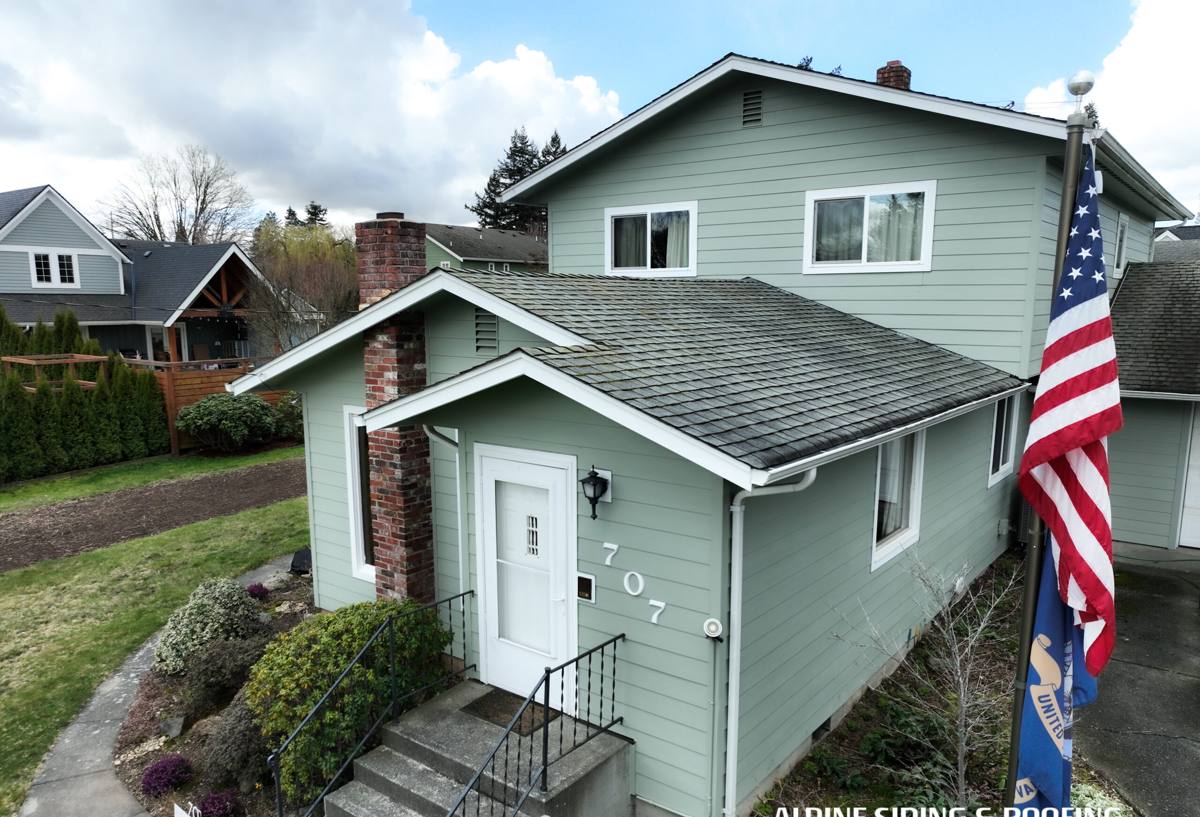
Why We Only Install James Hardie Fiber Cement
We don't install vinyl siding, LP SmartSide, Cemplank, Allura, primed spruce, or cedar. That's a deliberate standard, not a lack of options. In a climate that combines salt exposure, wind-driven rain, and sustained moisture, the material matters more than it does in a drier region, and James Hardie fiber cement is the product we're willing to warranty our work behind.
Fiber cement is cement, sand, and cellulose fiber — it doesn't swell, rot, or delaminate the way wood-based and engineered-wood siding products can when they take on repeated moisture exposure. It's non-combustible, which matters anywhere wildfire smoke and ember exposure has become a regional concern in dry summer months. And James Hardie's ColorPlus finish is a factory-baked, multi-coat finish engineered to resist UV and weather fade far longer than field-applied paint — which matters directly in a salt-air environment where paint films take extra abuse.
James Hardie also builds its siding in climate-specific lines. The HZ5 product line is engineered for the wetter, harsher-weather regions of the country, which includes Western Washington's marine climate. That's the line we spec for most Oak Harbor homes, particularly anything with direct water exposure or heavy wind.
Why Not the Alternatives
| Material | Salt Air Behavior | Moisture Behavior | Maintenance Here |
|---|---|---|---|
| James Hardie Fiber Cement (HZ5) | Factory finish resists fading and chalking | Cement-based, does not swell or rot | Occasional rinse, caulk checks |
| Vinyl Siding | Can warp or discolor with sun and heat cycling | Sheds water but traps moisture behind panels if installed loose | Low, but panels crack and fade over time |
| LP SmartSide (engineered wood) | Finish holds up reasonably well | Wood-based substrate is vulnerable to edge swelling if seals fail | Requires diligent caulk and paint upkeep |
| Cedar / Primed Spruce | Natural material, finish breaks down faster in salt exposure | Absorbs and releases moisture, prone to rot without upkeep | Highest — regular refinishing needed |
Every one of these products has a legitimate use case somewhere. Our position is narrower than "this product is bad" — it's that in this specific climate, with the maintenance realities of coastal Washington, fiber cement installed to spec is what we're comfortable standing behind long-term.
What a Correct Fiber Cement Installation Actually Involves
Fiber cement siding is only as good as the installation underneath it. A rushed or generic install can undercut even the best material, especially in a wind-driven-rain climate.
Weather-Resistive Barrier and Flashing
Every wall gets a continuous weather-resistive barrier before siding goes on, with proper flashing at windows, doors, decks, and any other wall penetration. This is the layer doing the real work of keeping wind-driven rain out of the wall assembly — the siding itself is the second line of defense, not the only one.
Fastening and Clearances
James Hardie publishes specific fastening patterns, clearances from grade, roof lines, and decks, and minimum gaps at butt joints and trim. These aren't suggestions — they're what keeps water from wicking into cut edges and what keeps the warranty valid. On a coastal property, we pay particular attention to clearance at grade and any spot where sprinklers or landscaping keep the base of a wall consistently damp.
Sealing and Finish Work
Cut edges get sealed. Joints get properly caulked or backed, not just caulked over a gap. Where ColorPlus factory finish is used, we keep field-touch-up to the minimum the system allows, since factory-cured finish outperforms field-applied paint in salt air over the long run.
Our Process, Start to Finish
- Inspection. We check the current siding, sheathing, and any signs of existing moisture intrusion before quoting anything — this tells us whether it's a straightforward re-side or whether sheathing repair is part of the job.
- Tear-off and prep. Old siding comes off, damaged sheathing gets addressed, and the wall is prepped for a clean weather barrier.
- Weather-resistive barrier and flashing. Installed continuously, with flashing detailed at every penetration before any siding goes up.
- Siding installation. Installed to James Hardie's published fastening and clearance specs for the HZ5 line.
- Trim, caulking, and touch-up. Joints sealed, cut edges finished, and any factory-finish touch-up handled per the manufacturer's process.
- Final walk-through. We go over the finished work with the homeowner before calling the job done.
What Drives Cost on a Job Like This
Every home is different, so we don't post fixed prices — but these are the factors that typically move a quote up or down.
| Factor | Why It Matters |
|---|---|
| Tear-off vs. re-siding over existing material | Removing old siding and repairing sheathing takes more labor but avoids covering up hidden damage |
| Home size and number of stories | More square footage and taller walls mean more material, more staging, more time |
| Trim and architectural detail | Homes with lots of corners, gables, and trim lines take longer to flash and finish correctly |
| Wind and water exposure | Waterfront or high-wind-exposure walls may warrant extra attention to flashing and clearances |
| Site accessibility | Steep lots, limited staging area, or tight neighborhood access affect labor time |
| Color and finish selection | ColorPlus factory-finish options versus field-painted siding affect material cost |
Signs Your Oak Harbor Home May Need New Siding
- Soft or spongy spots when you press on the siding, especially near the bottom of walls
- Persistent moss or algae buildup that keeps coming back after cleaning
- Peeling or bubbling paint, particularly on north-facing or shaded walls
- Rust streaking around fasteners or trim edges
- Visible gaps, warping, or separation at seams and trim joints
- Cracking or crumbling on old fiber cement or wood-based siding
- Rising heating bills that suggest air and moisture are getting through the wall
Why a Crew That Already Works Oak Harbor Matters
We're based in Anacortes, and Oak Harbor is a regular part of our service area — a short drive across Deception Pass from Fidalgo Island onto Whidbey Island. That regularity matters more than it sounds like it should. A crew that works this shoreline routinely understands the difference in wind exposure between a bluff-facing wall and a wall tucked behind a stand of trees, and that difference changes how carefully flashing and clearances need to be handled.
It also means straightforward logistics — material deliveries, scheduling, and site visits don't require special planning, because this is territory we already cover alongside our home base in Skagit County. A contractor unfamiliar with the area is learning these things on your project. A crew that already works Oak Harbor isn't.
Living With Fiber Cement Siding After Installation
One advantage of fiber cement in this climate is how little ongoing maintenance it actually needs compared to wood-based alternatives. It won't rot, and it resists moss and algae better than wood or wood-composite siding because the material itself doesn't hold moisture the same way. That said, a coastal environment still calls for some basic upkeep:
- An occasional rinse to clear salt residue and organic buildup, especially on shaded walls
- A yearly look at caulking around windows, doors, and trim to catch any separation early
- Keeping gutters clear so water isn't dumping down a wall face repeatedly
- Trimming back vegetation that keeps a wall section shaded and damp longer than the rest of the house
None of this is heavy maintenance — it's the kind of basic homeowner upkeep that keeps a correctly installed system performing the way it's designed to for decades.
If you're dealing with aging siding, visible moisture damage, or you're just planning ahead for a home on Oak Harbor's shoreline, we're happy to take a look and give you a straightforward assessment. Reach out for a free, no-pressure estimate using the form below.