 Anacortes Exterior
 Anacortes sits on Fidalgo Island, and every roof out here answers to the same island conditions: salt-laden air off the water, rain that comes in sideways more often than it falls straight down, and a moss season that runs longer than most homeowners expect. Roof repair on Fidalgo Island isn't a smaller version of a mainland repair job — it's a different set of failure points, because the things that wear out a roof here aren't always the things a general contractor is used to looking for. This page covers what actually goes wrong with roofs on Fidalgo Island, what a correct repair looks like, and how our process works for homeowners in and around Anacortes.
Why Fidalgo Island Roofs Fail Differently
Three conditions do most of the damage out here, and they rarely act alone — they compound each other over the life of a roof.
Salt Air
Airborne salt off the Salish Sea speeds up corrosion on anything metal: fasteners, flashing, vent stacks, gutter hardware. A fastener that would last decades forty miles inland can start rusting within a few years on Fidalgo Island if it wasn't rated for a marine environment. Corroded fasteners and flashing are one of the most common causes of a "mystery leak" — the roofing material looks fine, but the hardware holding it together has quietly failed underneath.
Driving Rain
Wind off the water pushes rain sideways more than a typical inland storm does, which means water reaches laps, seams, and flashing details that would stay dry in a calmer weather pattern. A roof that was only ever built or repaired to a minimum standard is far more likely to leak at valleys, chimney flashing, and roof-to-wall transitions than one repaired with wind-driven exposure in mind.
Moss Season
Shaded, moisture-holding conditions support a long moss and algae season on north-facing slopes and anywhere tree cover keeps a roof from drying out between rains. Moss holds water against the roofing material, lifts shingle edges, and works its way under laps that were never sealed with that kind of pressure in mind. A repair that just clears moss off the surface without addressing what's underneath tends to need repeating within a season or two.
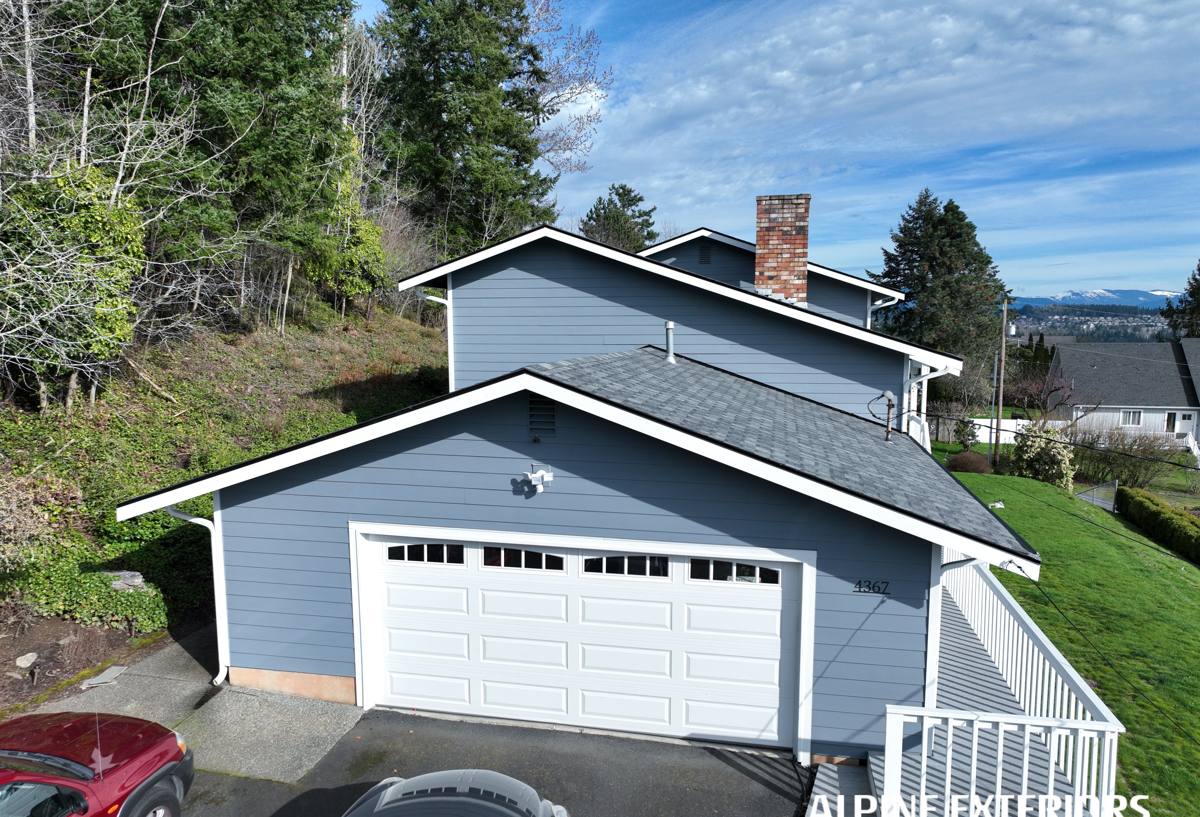
Signs a Fidalgo Island Roof Needs Repair
Not every issue means a new roof. These are the signals that usually mean a repair will genuinely fix the problem, not just mask it:
- A leak that shows up in one specific spot during heavy wind-driven rain but not in light, straight-down rain
- Rust staining at nail heads, flashing edges, or metal vent stacks
- A handful of shingles that are cracked, lifted, or missing after a windstorm, with the rest of the roof still sound
- Moss buildup concentrated on one slope or section rather than spread evenly across the whole roof
- Soft or discolored ceiling spots inside that trace back to a specific roof penetration — a chimney, skylight, or vent
- Flashing that's visibly separated, corroded, or missing sealant at a chimney, wall transition, or valley
- Granule loss or wear that's localized rather than affecting the entire roof surface uniformly
If instead you're seeing widespread curling and granule loss across every slope, daylight through the deck, or a roof at or past its rated service life, that points toward replacement rather than repair — we'll always tell you honestly which side of that line your roof is on.
Repair vs. Replacement: Making the Right Call
The hardest part of a roof repair call is often deciding whether a repair is the right move at all, or whether it's a stopgap that delays a replacement you'll need anyway. Here's how we think through it.
| Situation | Repair Usually Makes Sense | Replacement Usually Makes Sense |
|---|---|---|
| Age of roof | Roof is well within its rated service life | Roof is at or past the manufacturer's expected lifespan |
| Extent of damage | Isolated to one section, penetration, or storm event | Spread across most or all slopes |
| Deck condition | Deck is sound where accessed | Soft, rotted, or water-damaged sheathing found in multiple areas |
| Leak history | First occurrence or isolated to one recurring spot that hasn't been properly flashed | Recurring leaks in multiple, unrelated locations over time |
| Moss/algae pattern | Localized to a shaded section, manageable with cleaning and targeted repair | Roof-wide, tied to underlying material breakdown rather than just shade |
We'll give you a straight answer during the inspection rather than defaulting to whichever job pays more. A well-timed repair on a sound roof is money well spent; a repair on a roof that's already failing broadly just delays the inevitable and adds cost on top of an eventual replacement.
Common Repairs We Handle on Fidalgo Island
Flashing Repair and Replacement
Flashing at chimneys, skylights, vent penetrations, and roof-to-wall transitions is where most leaks actually originate, not the field of shingles itself. Salt air corrodes flashing faster here, and once it separates from the roofing surface or from the wall it's sealing against, water finds its way in during any wind-driven rain event. We remove failed flashing, check the underlayment beneath it for damage, and install corrosion-resistant flashing properly integrated with the roofing system rather than just re-caulking the old piece.
Storm and Wind Damage Repair
Wind off the water can lift, crack, or strip shingles even on a roof that's otherwise in good shape. We match repair materials as closely as possible to the existing roof, replace damaged sections down to the underlayment where needed, and check surrounding shingles for wind uplift that isn't visibly damaged yet but has had its seal broken.
Moss and Algae Damage Repair
Removing moss is only half the job. Once moss has been sitting on a section of roof for a season or more, we check for lifted shingle edges, soft spots in the underlayment, and granule loss underneath the growth before simply cleaning the surface and calling it done. Where moss has caused actual material damage, that section gets repaired, not just cleared.
Fastener and Hardware Corrosion Repair
When a leak traces back to corroded fasteners rather than the roofing material itself, we replace the affected hardware with fasteners rated for marine exposure. Reusing standard fasteners in the same repair just guarantees the same failure a few years down the road.
Gutter, Edge, and Ventilation Fixes
A repair job is also the right time to check that gutters and roof edges are actually shedding water instead of backing it up under the roofline, and that intake and exhaust ventilation are working. Poor ventilation keeps a roof deck damper than it should be, which feeds the same moss cycle a repair is trying to solve.
What a Correct Repair Actually Involves
A repair that holds up on Fidalgo Island takes more diagnosis than a quick patch. Our approach:
- Find the actual source, not just the symptom. Water can travel along the underlayment or decking before showing up as a ceiling stain far from where it actually entered. We trace the path rather than patching where the stain appears.
- Check what's underneath. Any repair that involves removing shingles or flashing is a chance to inspect the underlayment and deck for hidden moisture damage before closing it back up.
- Match materials appropriately. Where an exact match to existing shingles isn't available, we choose a compatible replacement that won't create a mismatched seam prone to its own leak point.
- Use marine-rated hardware. Standard fasteners and flashing get replaced with corrosion-resistant versions suited to salt air exposure, even if that's not what failed originally.
- Confirm the fix under real conditions. Where possible, we check the repair against actual wind-driven rain exposure, not just a visual inspection on a dry day.
Our Repair Process
- Initial inspection. We look at the reported problem area and the roof as a whole, since an isolated-looking leak can have a cause elsewhere on the roof.
- Honest assessment. We tell you whether a repair will actually solve the problem, and flag it clearly if we think you're better served by planning for replacement instead.
- Written estimate. You get a clear scope of what we'll repair and why, before any work starts.
- Repair work. Damaged material comes out, the deck and underlayment underneath get checked, and the repair goes in with corrosion-resistant hardware and properly integrated flashing.
- Cleanup and check. Debris is cleared, gutters are checked near the repair area, and we confirm the fix is sound before we consider the job done.
- Follow-up. If a repair is a stopgap ahead of a future replacement, we'll say so up front and let you know roughly what timeline makes sense.
What Affects Roof Repair Cost on Fidalgo Island
Repair costs vary more than people expect, mostly based on what we find once we're actually looking at the problem area rather than the size of the visible damage alone.
| Factor | Why It Matters Here |
|---|---|
| Cause of the damage | Corroded flashing or fasteners often mean more hardware replacement than a simple shingle swap |
| Extent of hidden damage | Deck or underlayment damage found once the surface is opened up adds to the scope |
| Roof pitch and access | Steep or hard-to-reach areas take longer and need more safety setup |
| Material match | Older or discontinued shingle profiles can be harder to match exactly |
| Number of penetrations involved | Chimneys, skylights, and multiple vents each add their own flashing detail |
| How long the problem sat unaddressed | A leak caught early is usually cheaper to fix than one that's had a season to spread |
We don't quote a number without inspecting the actual damage, since two roofs with the same visible symptom can need very different scopes of work once we're up there.
Why Hire a Crew That Already Works Fidalgo Island
A roofer who mostly works inland jobs isn't wrong about roofing in general — they're working from a different set of defaults. Fastener specs, flashing choices, and moss-related repair habits that are perfectly adequate on a typical inland roof are often undersized for what Fidalgo Island puts a roof through year-round. A crew that already works in Anacortes has seen which details actually fail out here — corroded fasteners hiding under an intact-looking shingle, flashing that separated at a wall transition, moss that did more damage than it looked like from the ground — not just which ones fail in general.
That local pattern recognition is what shortens the gap between "there's a leak somewhere" and "here's exactly what's wrong and what it'll take to fix it." It also means fewer repeat calls, because the repair addresses the actual island-specific cause instead of the surface symptom.
Keeping a Repaired Roof Sound Between Visits
- Keep gutters and downspouts clear so water isn't backing up under roof edges during heavy rain
- Address new moss growth while it's still light rather than letting it sit through another wet season
- Trim back tree limbs that keep a section of roof shaded and slow to dry
- Have flashing points checked after any major windstorm, even if nothing looks obviously wrong from the ground
- Report a new stain or drip right away — a small, fresh leak is almost always cheaper and easier to fix than one that's had months to spread
If you've got a leak, storm damage, or a roof that's just starting to show its age, we're happy to come take an honest look. Reach out for a free, no-pressure estimate using the form below.