 Anacortes Exterior
 Why Cap Sante's Marine Climate Is Hard on a Deck
Homes around Cap Sante sit close to the water, and that proximity comes with a specific set of conditions that inland decks in Skagit County rarely deal with. Salt-laden air off the water accelerates corrosion on anything metal — fasteners, brackets, railing hardware — long before it would fail on a deck built ten miles inland. Add Anacortes' driving, wind-pushed rain and the long stretch of gray, damp months typical of Fidalgo Island, and you get a deck surface that stays wet longer, dries slower, and grows moss and algae in any spot that doesn't get direct sun or airflow.
None of this means composite decking is a bad choice here — it's usually the right one. But it does mean the details of the build matter more in Cap Sante than they would in a drier climate. A deck that's installed the same way you'd install one in eastern Washington will show problems here within a few seasons: soft spots at the substructure, streaking under railing posts, and moss creeping in along shaded board edges.
What a Correct Composite Deck Build Requires Here
Composite decking boards themselves are engineered to resist moisture, but the board is only part of the system. Most of the failures we get called out to fix on older decks trace back to the substructure and hardware, not the decking material itself.
Framing and Fasteners
In a salt-air environment, standard galvanized fasteners corrode faster than the manufacturer's warranty assumes. We use stainless steel or high-grade coated fasteners rated for coastal exposure, and we follow the decking manufacturer's approved fastener list — using the wrong screw can void a warranty even if the installation looks fine.
Ledger and Flashing Details
Where a deck attaches to the house, proper ledger flashing keeps wind-driven rain from working its way behind the siding and into the rim joist. This is one of the most commonly skipped steps on lower-cost deck jobs, and it's the single biggest cause of hidden rot behind an otherwise good-looking composite deck.
Joist Protection and Airflow
We wrap or tape the tops of joists to keep standing water out of the wood substructure, and we space the frame to allow airflow underneath the decking. Composite boards don't rot, but the wood or steel frame under them still can if it stays wet and can't breathe.
Composite vs. Wood vs. PVC in a Marine Climate
Homeowners near the water often ask us to compare their options directly. Here's how the three main decking paths perform under Cap Sante's conditions specifically:
| Material | Moisture Behavior | Maintenance | Typical Lifespan Here |
|---|---|---|---|
| Pressure-treated wood | Absorbs and releases moisture; prone to cupping and splintering with repeated wet-dry cycles | Annual staining or sealing recommended | 10-15 years before major repairs |
| Composite (wood-plastic blend) | Minimal absorption; capped boards shed water and resist staining | Periodic cleaning to prevent moss/algae buildup | 25-30+ years, manufacturer-warrantied |
| Cellular PVC | Fully impervious to moisture | Lowest maintenance; occasional cleaning | 25-30+ years, typically higher upfront cost |
We install composite most often in this area because it strikes the balance homeowners want: it looks and feels close to real wood, handles the wet climate well when installed correctly, and doesn't carry the premium price of full PVC systems. We're happy to price PVC or discuss wood alternatives too — the right call depends on your budget and how the deck will be used.
Our Installation Process
1. Site Assessment and Substructure Check
On a replacement job, we start by pulling old decking to inspect the ledger, joists, and posts. Salt air and long-term moisture exposure can hide rot under boards that look fine from the top. We won't build a new composite deck surface over a substructure that isn't sound — that just hides a problem instead of fixing it.
2. Framing, Flashing, and Drainage
We correct or rebuild the frame as needed, install proper ledger flashing, and set joist spacing to the composite manufacturer's span requirements — which are often tighter than standard wood-decking spacing. For lower decks or covered patio decks, we can also install an under-deck drainage system to keep the space below usable and dry.
3. Board Installation and Fastening
Boards are laid with the manufacturer-specified gapping to allow for expansion and drainage, fastened with hidden clips or coated screws depending on the board profile, and run in a layout that accounts for water flow off the deck surface.
4. Railings, Fascia, and Finish Work
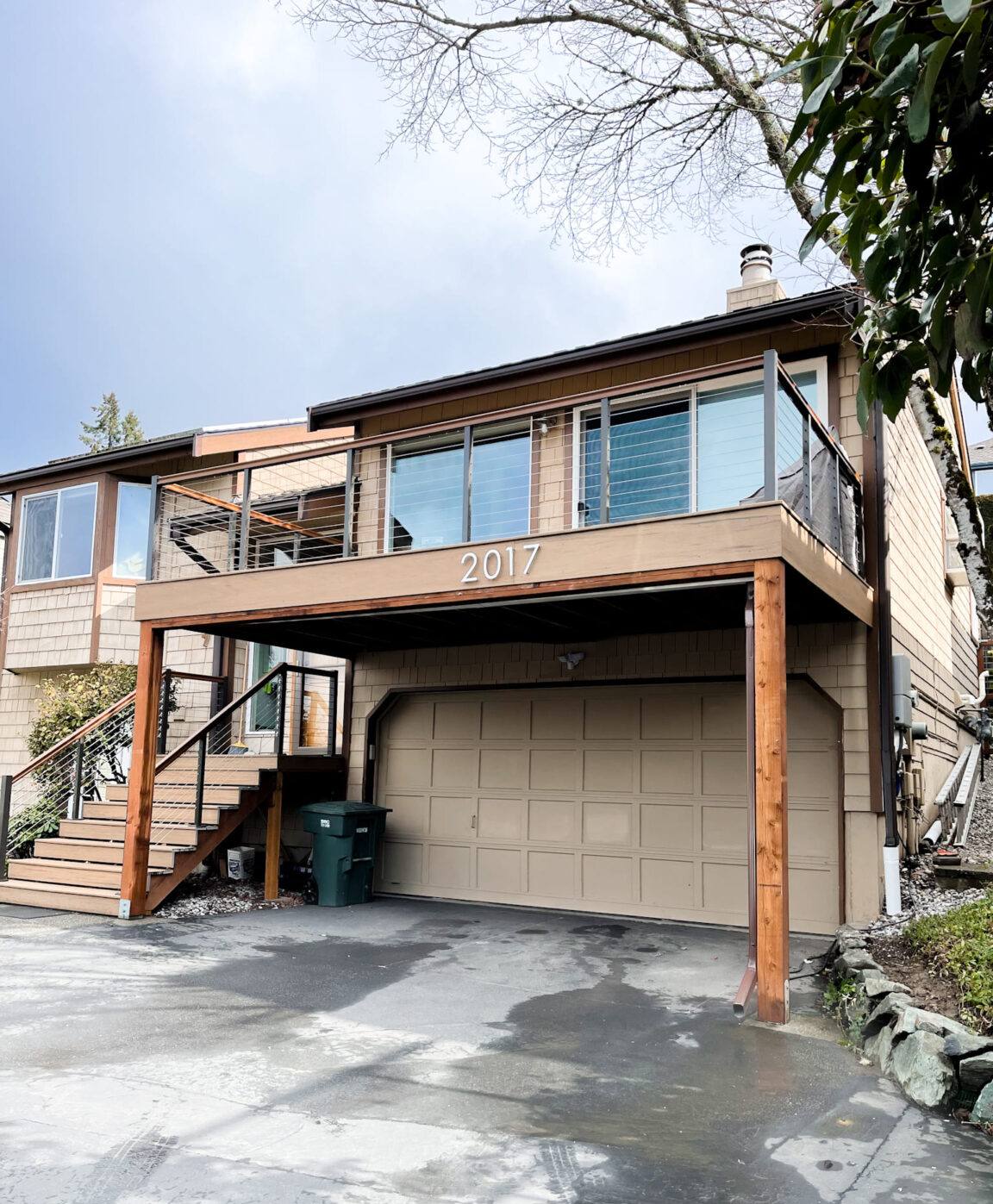
Railing posts are through-bolted and flashed at the deck surface — a common weak point where water sits against the board if it isn't detailed correctly. Fascia boards and stair details are finished to match, and we clean up the site fully before calling the job done.
Choosing the Right Composite Board for This Location
Capped vs. Uncapped Composite
Capped composite boards have a protective outer shell that resists moisture absorption, staining, and fading far better than older-style uncapped composite. In a climate with this much rain and shade-driven moss growth, we generally recommend capped boards for Cap Sante homes — the price difference is modest compared to the maintenance it saves over the life of the deck.
Grooved vs. Solid-Edge Boards
Grooved-edge boards allow for hidden fastener systems, which give a cleaner look and eliminate exposed screw heads that can corrode or streak over time in salt air. Solid-edge boards are sometimes preferred for stair treads or high-traffic areas where a fully fastened-down edge is wanted.
Color Selection
Darker composite boards absorb more heat, which matters on decks with strong afternoon sun exposure off the water. Lighter and mid-tone colors also tend to show less pollen, dust, and the fine mineral residue that can settle on decks near the marina. We'll talk through color options based on your deck's orientation and sun exposure.
Maintenance in a Moss and Algae-Prone Climate
Composite decking is low-maintenance compared to wood, but "low-maintenance" doesn't mean "no maintenance" in a climate like this one. A little seasonal attention keeps a Cap Sante composite deck looking good for its full warranty life.
- Sweep off standing debris and pooled leaves regularly, especially in shaded corners where moss takes hold first
- Rinse the deck surface every few months with plain water to prevent algae film from building up
- Use a soft-bristle brush and a cleaner labeled safe for composite decking on stubborn moss or green staining — avoid pressure washing at close range, which can damage the board's cap layer
- Check railing post bases and stair connections annually for any signs of loosening or corrosion at the fasteners
- Keep gutters and downspouts clear so runoff isn't draining directly onto or under the deck
- Trim back overhanging vegetation to let sun and air reach shaded deck sections
Cost Factors for a Cap Sante Composite Deck
Every deck is different, so we don't quote pricing off square footage alone. These are the factors that actually move the number on a Cap Sante project:
| Factor | Why It Matters |
|---|---|
| Substructure condition | Rebuilding a rotted frame costs more than decking over a sound one — this is the biggest variable on older homes |
| Deck size and shape | Multiple levels, angles, or curves take more labor and material than a simple rectangle |
| Board tier and brand | Entry-level capped composite vs. premium capped composite affects both material cost and expected lifespan |
| Railing type | Composite or aluminum railing systems cost more than basic wood or cable options but hold up better to salt air |
| Site access and elevation | Bluff-side or elevated lots near the water sometimes require extra staging or material handling |
| Drainage systems | Under-deck drainage adds cost but is often worth it for lower decks used as covered living space below |
Broadly, homeowners in this area should expect composite decking to run higher up front than pressure-treated wood, with that gap offset over time by lower maintenance costs and a longer service life. We'll always give you an itemized number, not a vague range, once we've seen your specific deck.
Permits and Site Considerations Near the Water
Anacortes and Skagit County have building requirements that apply to deck construction, including guardrail height and spacing on elevated decks and, in some cases, setback rules depending on your lot's proximity to the water or a slope. We handle the permitting process as part of the job rather than leaving it to the homeowner to sort out. On bluff or view-lot properties in particular, it's worth having a contractor who knows to flag site conditions — like slope or drainage patterns — that could affect the footing design before work starts, not after.
Why a Crew That Already Works Cap Sante Matters
Decking looks like a fairly standardized trade until you build enough of them in one specific microclimate to see the patterns. We've worked on enough homes around Cap Sante and the rest of Anacortes to know which fastener grades actually hold up here, which deck orientations get hit hardest by wind-driven rain, and where moss tends to establish first on a new build. That's the kind of thing you only learn by building decks in this exact environment repeatedly — not from a spec sheet.
It also matters for the long run. If a fastener starts to show early corrosion, or a board needs attention under warranty, you want a contractor who's still local, still reachable, and familiar with your specific deck — not someone who built it once and moved on to a different region.
If you're planning a new composite deck or need to replace one that's showing its age, we're happy to take a look and put together a straightforward, no-pressure estimate. Use the form below to get started.